
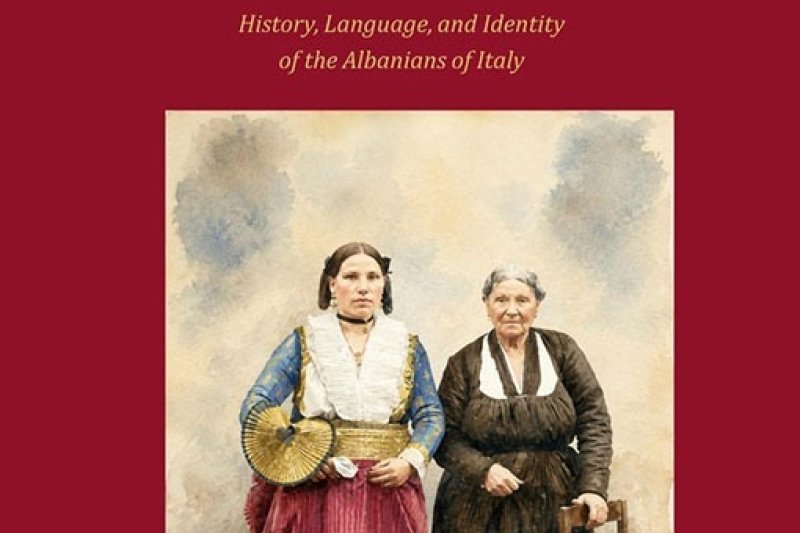
Boccia’s ‘Five Centuries of Albanian Life in Southern Italy’
For more than five hundred years, some fifty villages scattered across the mountains of southern Italy and Sicily have kept speaking a language that crossed the Adriatic in the fifteenth century. Their inhabitants call themselves Arbëreshë, and their speech arbërisht: an archaic form of Tosk Albanian that has preserved, far from Albania, words and sounds the standard language no longer uses.
A new book by Lluixhi Boccia, Arbëreshë — History, Language, and Identity of the Albanians of Italy, now available in English, tells this story for a general readership. It follows the migrations that began in the age of Skanderbeg and continued after the Ottoman conquest of the Balkans, the founding of villages in Calabria, Sicily, Apulia, Basilicata, Molise, Campania and Abruzzo, and the long effort of these communities to remain themselves while becoming Italian.
The chapters move through the language, the Byzantine rite kept alive in the parishes, the rhapsodies and the vallja danced on Easter Tuesday, the women's costumes with their gold-embroidered bodices, the calendar of feasts and the cuisine. They trace a literature that opens in 1592 with Luca Matranga's catechism and reaches, in the nineteenth century, Girolamo De Rada and the Arbëresh contribution to the Albanian national awakening. The book also follows the second emigrations to the Americas, the work of the associations, and the numbers that describe the communities today.
The final chapter asks a direct question: what is needed now. Italian Law 482 of 1999 recognises Albanian as a historic minority language, yet fewer and fewer children learn arbërisht at home. The book argues that a language survives only when it is passed on in the first years of life, and that the most effective measures are often the simplest.
It is meant for the descendants of the Arbëreshë in Italy and abroad, and for readers in Albania and Kosovo who wish to know a branch of their own history that has lived, for five centuries, on the other side of the sea. The book is available on Amazon: www.amazon.com/dp/B0HDG5WWPD