Kazakhstan’s New Historical Cycle
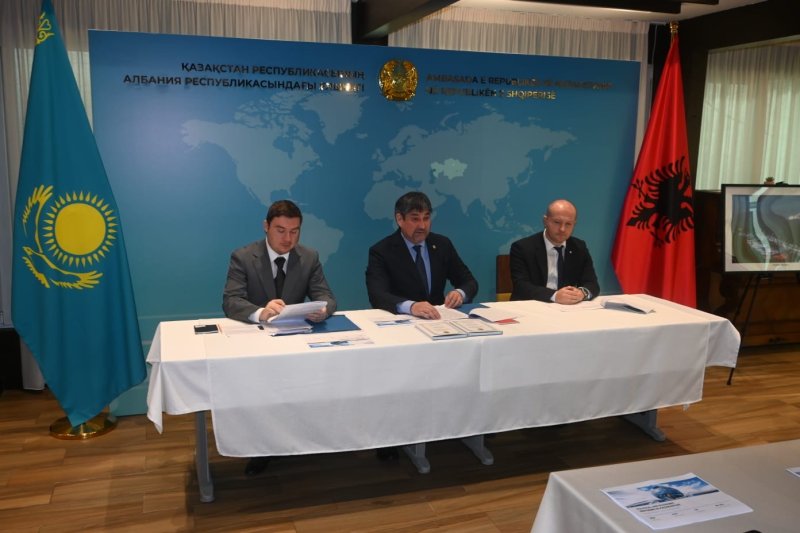
On November 25, the Ambassador of Kazakhstan to Tirana, Mr. Iskander Aisariyev, hosted a round-table discussion with media representatives and students. The primary focus was to examine the key points of the message delivered by President Kassym-Jomart Tokayev to the people of Kazakhstan, titled "Kazakhstan’s Current Priorities in a New Historical Cycle," which was presented on October 28 this year.
Ambassador Aisariyev emphasized that the document comes at a significant juncture, as Kazakhstan marks the 35th anniversary of its independence this year, alongside a transition towards a new model of state governance, in accordance with the revised Constitution that entered into force on July 1. The President described this phase as the country’s entry into a "new historical cycle," one that demands discipline, order, and social unity.
Regarding economic indicators, the Ambassador noted that by the end of this year, Kazakhstan’s Gross Domestic Product (GDP) is expected to approach USD 400 billion, while GDP per capita is projected to exceed USD 19,000, placing the economy 47th globally. The country’s gold and foreign currency reserves, combined with the assets of the National Fund, exceed USD 130 billion. One of the key sections of the address is devoted to the extensive “Construction for the People” programme. This initiative, unprecedented in scale, aims to develop infrastructure across all regions of the country, including roads, airports, railways, hospitals, schools, and municipal service facilities. To this end, approximately USD 14.5 billion will be allocated from the National Fund through 2029.
“I am confident that many Albanian and Balkan companies, with their considerable experience in construction and engineering, will be interested in participating in the implementation of this megaproject,” Aisariyev emphasized.
The section of the address devoted to logistics is of particular interest. Kazakhstan is positioning itself not merely as a transit country, but as an emerging logistics hub between Asia and Europe. Currently, about 85 percent of goods transported from China to Europe pass through Kazakh territory. Next year, the Bakhty–Ayagoz railway line is scheduled to become operational, increasing transport capacity towards China by 20 million tons. Furthermore, construction of the Aral–Caspian highway will continue. This route shortens the Trans-Caspian Route, also known as the Middle Corridor, by nearly one thousand kilometres.
“I am convinced that this area also creates concrete opportunities for Albanian logistics and transport companies,” the Ambassador stated.
Regarding the energy sector, President Tokayev has set the goal of achieving a stable energy surplus by 2029. This is to be accomplished through the modernization of production capacities, the development of coal-based energy using “clean” technologies, and the expansion of renewable energy sources, most notably solar power. Following a national referendum, a decision was made to construct several nuclear power plants. Construction of the “Balkhash” nuclear power plant is set to begin next year, while a cooperation agreement for the “Moyynkum” nuclear power plant will be signed.
As for geology and water resources, the President has also called for the modernization of the geological sector through the use of modern technologies, open data, and the attraction of private capital, alongside the establishment of a national system for managing critical metals. Special attention is being devoted to water security. Plans include reducing network losses, completing the reform of water tariffs, and establishing a national water information system. These measures are directly linked to improving irrigation efficiency.
Regarding agriculture, agricultural production in Kazakhstan grew by approximately 6 percent last year, reaching nearly USD 33.5 billion. The President called for the expanded use of artificial intelligence in agriculture, an increase in domestic production of tractors and combine harvesters, and improvements in irrigation efficiency, which could boost yields by a factor of 2 to 2.5. Also noteworthy is the development of deep processing, ranging from corn and soybeans to cotton and textile clusters, as well as the meat industry.
The Ambassador emphasized that, given Albania’s extensive experience in agriculture and the food industry, there is potential for mutually beneficial and practically relevant cooperation.
Another notable development is the creation of a special legal zone, “Alatau City,” featuring an investment court that operates according to the principles of the English common law system. For small and medium-sized enterprises, which account for approximately 40 percent of the country’s GDP, a three-year moratorium on inspections has been proposed, starting on January 1, 2027, along with further decriminalization of economic offences.
In the digital sphere, two supercomputers are already operational in Kazakhstan, and a third is expected to become operational by the end of the year. A fibre-optic line has been laid along the bed of the Caspian Sea, and the use of artificial intelligence is expanding across sectors ranging from agriculture to public administration.
The social agenda occupies a significant place in the message. It includes the construction of eight perinatal hospitals and seven multidisciplinary paediatric hospitals, salary increases for primary healthcare personnel, and an increase in the minimum wage, effective January 1, 2027.
Regarding education, the President called for reducing the administrative burden on teachers, particularly in terms of paper-based reporting and excessive digital documentation, as well as providing safeguards for their protection. Between 2020 and 2023, teachers’ salaries in Kazakhstan doubled. Further provisions include salary supplements based on qualification categories, 56 calendar days of paid annual leave, and a healthcare allowance granted when taking annual leave. These measures are intended to enhance the prestige of the profession and strengthen social protection for teachers.
“President Kassym-Jomart Tokayev’s message serves, in essence, as a roadmap for Kazakhstan’s development in the coming years. Many of the areas outlined, such as logistics, energy, and the investment climate, align directly with the interests of the Republic of Albania,” stated Ambassador Aisariyev.
Subsequently, Dr. Redion Luli offered attendees his perspective on the significance of these developments and their relevance to the broader region. In the final part of the event, during an informal discussion with participants, Ambassador Aisariyev highlighted Albania’s abundant natural resources, strategic geographical location, and the industrious spirit of its people—assets that make cooperation between the two nations a mutually beneficial opportunity.
/ADN