
APEC Between Economic Cooperation and Great-Power Rivalry
Thirty-five years after China joined APEC, the summit held in Shenzhen conveyed a vision for the future of economic cooperation in the Asia-Pacific, placing openness, innovation and cooperation at its centre. At a time when the global economy is being reshaped by technological transformations, trade tensions and strategic rivalries, China’s role and APEC’s outlook are becoming increasingly important.
At a time when the global economy is undergoing profound changes and international relations are increasingly influenced by geopolitical rivalries, the 33rd APEC Economic Leaders’ Meeting, held on November 18–19 in Shenzhen, China, brought renewed attention to a fundamental issue: the future of economic cooperation in the Asia-Pacific and the role this region will play in the development of the global economy.
APEC, as one of the world’s most important platforms for economic cooperation, represents a space where economies with considerable weight in international trade, production, investment and technological innovation come together. In this context, this year’s summit took on particular significance for China, which, 35 years after joining the forum, is hosting it for the third time, following Shanghai in 2001 and Beijing in 2014.
In his speech on November 18 at the APEC CEO Summit 2026, Chinese President Xi Jinping described the Asia-Pacific as “our common home”, as well as a “vast space for common development” and a “broad stage for working together”. Under the theme “Advancing Together and Building a Shared Future”, the summit placed three priorities at its centre: openness, innovation and cooperation.
These two definitions convey a broader understanding of the region’s potential. The vast space symbolizes the resources, market opportunities and economic development potential of the Asia-Pacific, while the shared stage underscores the importance of collective capabilities, built on common rules, mutual trust and coordinated action.
For China, APEC is not merely a mechanism for strengthening regional economic ties, but also a platform for presenting its development priorities and its vision of a more open, interconnected and innovation-driven global economy. Its position as one of the leading actors in the global economy gives this vision a dimension that extends beyond the boundaries of the Asia-Pacific.
In this context, Xi Jinping’s message can be understood on two levels: as a reflection of China’s ambition to continue its process of economic development and modernization, and as a broader proposal for the future of the international economic system, in which openness, cooperation and competition among major powers will increasingly influence the course of global developments.
35 Years in APEC: From Integration to Responsibility for the Future
When China joined APEC in 1991, it was at an important stage of its domestic economic transformation. Reforms and the policy of opening up had already begun, but integration into the international economy remained an ongoing process. Thirty-five years later, China has become one of the world’s leading centresof manufacturing, trade, investment and technology.
This transformation cannot be understood separately from the development of the Asia-Pacific. Over these decades, the region has undergone a period of extraordinary economic expansion, becoming one of the main engines of the global economy. APEC, with its 21 participating economies, has contributed to this process through dialogue, trade facilitation, investment and regional connectivity.
Today, APEC economies account for around 40 per cent of the world’s population, more than 60 per cent of global GDP and nearly half of international trade. These figures demonstrate that any change in this region has implications far beyond its borders.
Therefore, the 35th anniversary of China’s membership in APEC is not merely an institutional anniversary. It also marks a moment of reflection on the relationship between economic integration and shifting global balances. China is no longer simply an economy seeking access to international markets. It is an actor with considerable weight in shaping the dynamics of global trade, technology and investment.
Shenzhen: From the History of Reform to an Innovation-Driven Economy
“I have often said that to see China as it was thousands of years ago, you should go to Xi’an; to see China as it was 500 years ago, you should visit Beijing; and to see China as it was 100 years ago, you should go to Shanghai. Tonight, allow me to add one more thing: to see China as it has been over the past 50 years, come to Shenzhen.”
With this historical reference, Chinese President Xi Jinping summed up in a single sentence the extraordinary transformation of Shenzhen, from a small fishing village in 1978 into an international metropolis and one of China’s leading innovation hubs.
Shenzhen represents more than the success of an industrial centre. It reflects the transformation of China’s economic development model itself: from manufacturing and export processing towards scientific research, advanced technologies and innovation.
This orientation is directly linked to the 15th Five-Year Plan for the 2026–2030 period. Industrial modernization, the development of advanced technologies, the expansion of domestic consumption and the creation of new quality productive forces are all part of a strategy aimed at steering the Chinese economy towards a higher value-added model.
Shenzhen’s experience demonstrates that economic transformation requires a long-term vision, investment in knowledge and technology, as well as an environment open to ideas and cooperation. These are factors that create not only opportunities for China’s development, but also new avenues for exchange and partnership with other economies.
From the Four Proposals to the Four Characteristics of the Asia-Pacific Community: Beijing’s Diplomatic Message
In its official communications during the APEC Summit in Shenzhen, China’s Ministry of Foreign Affairs placed President Xi Jinping’s vision within a broader diplomatic context: building an Asia-Pacific community based on peace, stability, economic openness and common development. This vision was articulated through two key moments: the four proposals put forward by Xi at the APEC CEO Summit on November 18, and the four characteristics of the Asia-Pacific community, developed at the 33rd APEC Economic Leaders’ Meeting on November 19.
At the regular press conference on November 18, Chinese Foreign Ministry spokesperson Guo Jiakun summarized Xi’s four proposals as a platform for building an Asia-Pacific community and ensuring prosperity for the entire region.
The first proposal was safeguarding peace and stability. According to the position presented by Xi and conveyed by Chinese diplomacy, this requires upholding the post-war international order, promoting a multipolar world based on equality and rules, as well as inclusive economic globalization. Emphasis was placed on resolving differences through dialogue and consultation, and addressing challenges through solidarity and cooperation.
The second proposal, building bridges of openness and cooperation, was related to safeguarding the multilateral trading system, with the World Trade Organization at its centre.
The third proposal was promoting innovation as an engine of economic growth. It included strengthening partnerships in science, technology and innovation, deepening cooperation in the digital economy and artificial intelligence, as well as accelerating the green and low-carbon transition. According to this vision, technological progress should be transformed into a shared source of development for the economies of the region.
The fourth proposal, expanding mutual benefits, focused on eliminating trade and investment barriers, as well as promoting more balanced development. Xi emphasized the importance of a people-centred approach, so that the results of development would be shared among all economies, groups and communities, combining economic efficiency with social equity.
A day later, at the 33rd APEC Economic Leaders’ Meeting, this vision was expanded into a more comprehensive concept of the Asia-Pacific community. Xi Jinping identified four fundamental characteristics: solidarity and mutual assistance, openness and integration, entrepreneurship and innovation, and inclusive development.
These characteristics represent the political, economic and social dimensions of Beijing’s vision. Solidarity and mutual assistance are linked to shared responsibility in addressing challenges; openness and integration to strengthening economic and institutional ties; entrepreneurship and innovation to creating new sources of growth; while inclusive development is linked to a broader distribution of economic benefits and improvements in people’s well-being.
To give concrete form to this vision, Xi presented four pillars of cooperation: economy and trade, connectivity, innovation and development, which China’s Ministry of Foreign Affairs identified as key areas for building the Asia-Pacific community.
In the field of economy and trade, the priority is to advance the Free Trade Area of the Asia-Pacific (FTAAP), facilitate trade and investment, and promote greater integration of regional markets.
Connectivity includes infrastructure development, the harmonization of rules, and facilitating the movement of people and cross-border payments.
In the area of innovation, the emphasis is placed on digital infrastructure, artificial intelligence, data governance and technological cooperation.
Meanwhile, development includes energy and food security, clean energy, employment, vocational training, social welfare and cooperation in combating cross-border corruption.
To provide concrete support for these objectives, Xi Jinping announced that China would contribute US$20 million to practical cooperation under the APEC framework. He also announced the establishment in Shenzhen of an Asia-Pacific Community Studies Centre, which will support policy research and academic exchanges. Alongside this, China will establish cooperation institutions in the fields of digital technology, cross-border data flows, clean energy and the development of small and medium-sized enterprises.
At the press conference on November 19, China’s Ministry of Foreign Affairs also announced that the APEC Economic Leaders’ Meeting had unanimously adopted the 2026 APEC Economic Leaders’ Declaration, which sets out the Shenzhen Vision for Building an Asia-Pacific Community, together with three concrete outcomes in the fields of trade, connectivity and innovation.
Taken together, these proposals and initiatives reflect China’s efforts to place cooperation in the Asia-Pacific within a broader diplomatic and economic framework.
For Beijing, building an Asia-Pacific community is both a project of economic integration and a platform for strengthening multilateral dialogue. At a time when the global economy is facing protectionism, fragmentation and strategic rivalries, Chinese diplomacy presents this vision as an alternative oriented towards openness, consultation and mutual benefits.
APEC Beyond Economics: Shenzhen and the Responsibility of Three Powers for the World Order
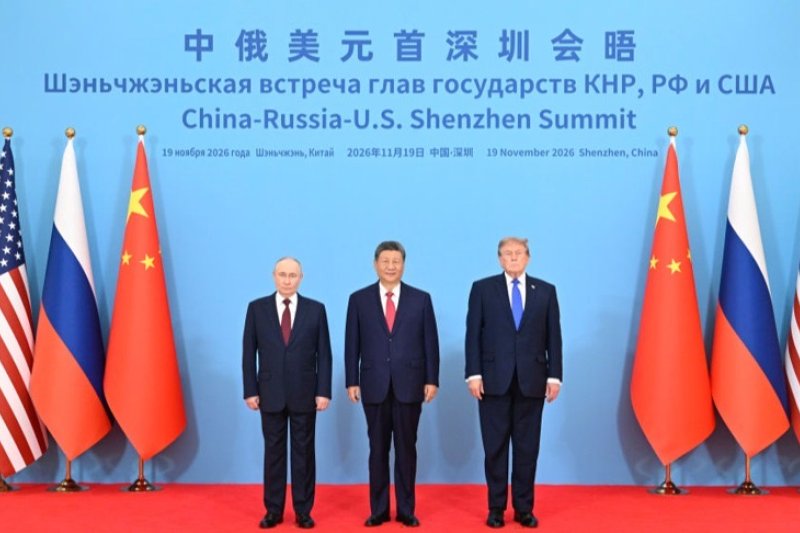
The trilateral summit between Xi Jinping, Vladimir Putin and Donald Trump, held on November 19 in Shenzhen, represented one of the most important diplomatic moments of the APEC Summit. Beyond the symbolism of a meeting in this format among the leaders of China, Russia and the United States, its significance lies in the political message it conveyed: in an international system characterized by strategic rivalry, conflicts and uncertainty, relations among major powers remain decisive for global stability.
Chinese President Xi Jinping placed this responsibility at the centre of his remarks, emphasizing that positive interaction among major powers is not a choice, but a necessity. According to him, China, Russia and the United States, as permanent members of the UN Security Council, should set an example through cooperation and contribute to maintaining international peace and stability.
Referring to the history of the Second World War, Xi recalled that more than 80 years ago, the three countries fought side by side as the main anti-fascist forces. “History is the best textbook,” he stressed, underscoring the need to draw lessons from the past and not allow current differences to undermine their responsibility for peace.
On the political front, Xi outlined four principles for relations among major powers: mutual respect, peaceful coexistence, mutually beneficial cooperation, and dialogue and consultation. He called for respect for the sovereignty, territorial integrity, political systems and development paths chosen by each country. In this context, he also warned against the risk of the so-called “Thucydides Trap”, arguing that competition among powers should be managed through dialogue rather than confrontation.
For his part, Vladimir Putin endorsed the importance of constructive cooperation among Moscow, Beijing and Washington, proposing discussions on global and regional issues, energy security and common threats, including international terrorism and cross-border crime. He also emphasized the responsibility of the three countries to strengthen the international legal order.
U.S. President Donald Trump highlighted the special responsibility of the three leaders to keep dialogue open on issues of global importance. He mentioned the peaceful resolution of the conflict in Ukraine as one of the main topics of discussion, as well as the issue of Iran’s nuclear programme, reiterating Washington’s position against Tehran acquiring nuclear weapons.
Another important dimension of the meeting was the link between security and the economy. Xi Jinping called for stronger trade and economic cooperation, opposed economic decoupling and the disruption of industrial and supply chains, and emphasized the need for coordination to ensure stability in the global energy market. This approach is directly linked to the APEC agenda, where economic openness, interdependence and regional cooperation remain central themes.
At the conclusion of the meeting, the three leaders issued a joint statement, reaffirming their commitment to strategic stability and international security. The document identified four areas of cooperation: UN reform, aimed at making the organization more effective in addressing global challenges; energy security, through a stable supply of energy and refined petroleum products; respect for state sovereignty and immunities, opposing the abuse of jurisdiction by the International Criminal Court and similar bodies; and nuclear security, through dialogue on reducing risks and preventing the proliferation of nuclear weapons.
The three leaders also reaffirmed the principle that a nuclear war cannot be won and must never be fought.
From Shenzhen to the World: APEC’s Message Beyond the Asia-Pacific
The APEC Summit in Shenzhen demonstrated that the Asia-Pacific has become one of the decisive regions for the future of the global economy. The region’s economic weight, technological development and interdependence among its economies make it an important factor in shaping new economic and international balances.
However, the significance of the summit extends beyond the economic agenda. At a time when strategic rivalries, protectionism and fragmentation are putting international relations to the test, the challenge lies in preserving dialogue and cooperation as instruments of stability and development. For China, Shenzhen was also an opportunity to present its vision of the role of the Asia-Pacific and multilateral cooperation in a changing world order.
In his speech at the summit, Xi Jinping linked this perspective to an objective that goes beyond the boundaries of the region: building “a community with a shared future for humanity.” This vision places dialogue, trust and common development as the foundations of a future in which cooperation among nations becomes a driving force for global peace, stability and prosperity. / Argumentum.al