
Folie Village, the Ambition to Create a Tourism landmark in Jalë
From the Millenium cinemas to a project conceived by Oppenheim Architecture, Albanian entrepreneur Alban Xhillari’s journey continues with an investment that brings together hospitality, architecture and the local economy.
The story of Albania’s transition is also the story of the entrepreneurs who built businesses in an economy that was learning to operate through competition and private initiative. In opening the country to the world, expanding freedom of choice and raising service standards, they gave Albania more than the communist state had in 45 years. In 2008, the Financial Times singled out four of them: Edmond Leka, Samir Mane, Alban Xhillari and the late Dritan Hoxha.
Among these figures, Xhillari has maintained a more discreet public profile, while his businesses have become part of everyday life in Albania. For many Albanians, their introduction to his work came through a film premiere at Kinema Millenium, an evening at Folie or a holiday in Jalë.
Millenium introduced the first modern cinema franchise, giving Albanian audiences the opportunity to see major international releases on the same premiere date as audiences worldwide. It was an investment that responded to a society’s desire to connect with the wider world and brought a new option to city life.
This approach continued with Folie Terrace and dining concepts such as Opium and Chakra Indian Fusion. Later, that experience in entertainment and hospitality extended to the coast through Folie Marine and Soleil Village & Villas. The names changed, but the idea remained the same: to create services that people wanted and develop them to contemporary standards.
The economic significance of this journey is also reflected in employment. According to figures confirmed for this article, Xhillari’s businesses currently employ more than 2,800 people, while the number of people employed by them over approximately 30 years of operation has exceeded 11,000. A network of suppliers and service providers also operates around them, extending their impact beyond the companies themselves.
Since 1995, through Millenium Group, Mr. Xhillari has been active in the construction sector, never compromising on architectural quality. Two of modern Tirana’s most iconic projects were developed by Millenium Group: the Millenium Building, designed by the international practice Architecture Studio in collaboration with the local firm Atelier4; and the Credins Headquarters in the Blloku district, which introduced a model of visionary, avant-garde design by AVatelier, a practice that also received a SHARE Architecture Award.
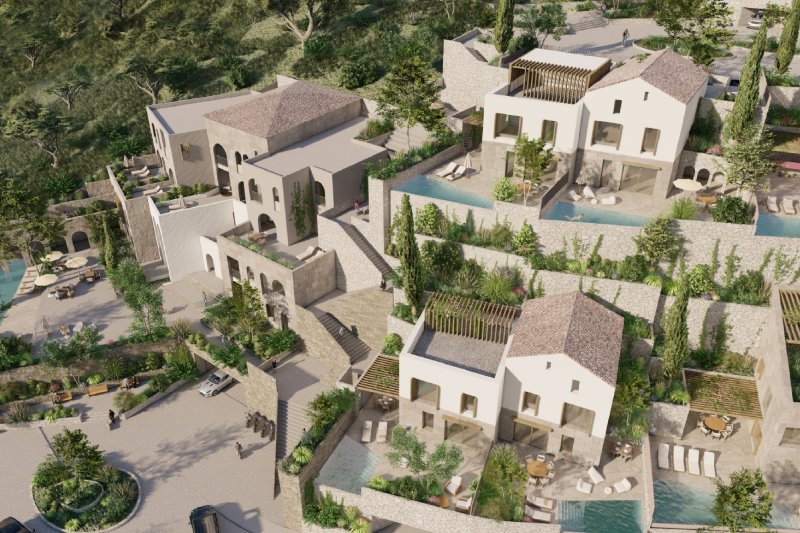
Today, this story takes a new direction with Folie Village and the ambition to create a project that becomes part of Jalë’s identity as a tourism destination.
Architecture shaped by the character of the place
Folie Village has been conceived by Oppenheim Architecture, drawing inspiration from the architectural heritage and natural setting of Jalë and nearby villages such as Vuno and Dhërmi. The development comprises private villas and apartments with sea views, integrated with service amenities and shared spaces.
This choice gives the project a clear starting point. Jalë has a character of its own, and its architecture must recognize it. Building forms, materials and the relationships between spaces acquire meaning when connected to the terrain and local traditions. In its project concept, Oppenheim Architecture documents its study of Vuno’s traditional buildings, particularly their substantial walls and approaches to shading. Arches, courtyards, verandas with greenery and buildings that follow the contours of the terrain are all part of this approach.
For Folie Village, the ambition is for this care to be felt in the everyday experience: in the orientation of a villa, the view from a terrace and the way people move from one space to another. These are precisely the decisions that can give a project an enduring identity.
The environmental approach presented for the project centers on a rigorous study of the relationship between development and its surroundings. This entails attention to the topography, greenery, materials and the way visitors’ stays are organized. Green spaces provide shade, coolness and opportunities to spend time in nature. The use of local materials, envisaged in the Folie Village presentation, connects the architecture to the character of the coast and the area’s building traditions. The quality of the landscape is, after all, one of the main reasons visitors choose Jalë.
Within the development, electric buggies are envisaged as a way to limit the movement of conventional vehicles. They can reduce transport noise and avoid exhaust emissions during use, helping to create a quieter environment for holidaymakers.
The same attention should extend to the beach. Its maintenance, upkeep and cleaning form part of the approach presented for the project.
An investment that connects with the local economy
One of Folie Village’s aims is for tourism activity to create opportunities for the surrounding community. Sourcing local produce for its restaurants and employing local staff are two practical ways to build this connection. When a restaurant buys from local producers, part of visitors’ spending becomes income for farmers and suppliers.
Employing local residents creates an equally direct benefit. Beyond wages, it can provide training and experience in hospitality, gastronomy, maintenance and management. Oppenheim’s concept for the development in Jalë also envisages spaces where local people can run cafés, bakeries and small businesses. In this way, the investment can help tourism income circulate for longer within the local economy.
A premium offering for a growing destination
As international interest in Albania grows, its tourism offering also needs to develop in quality. Folie Village aims to serve the segment seeking privacy, architecture with a distinct character and well-organised services, through private villas, family villas and apartments with sea views.
This approach aligns with the current discussion about Albanian tourism: generating greater value from each stay and extending the season. Folie Village represents the continuation of a history of investments that have introduced new experiences. The ambition is now broader: a project that gives Jalë a distinctive identity through architecture and hospitality.