Rama Accuses Protesters of Violence, Warns of Hybrid Warfare Targeting Albania’s EU Integration
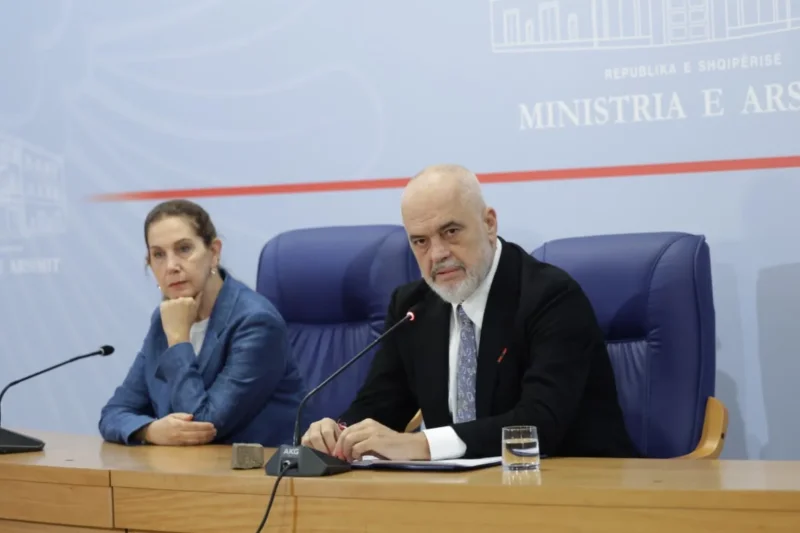
Prime Minister Edi Rama met with principals of Tirana’s high schools at the Ministry of Education, addressing recent violent protests, the role of students, and what he described as attempts to undermine the country’s European Union integration process.
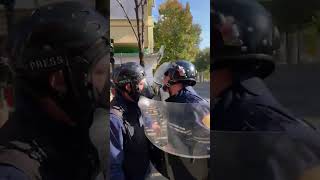
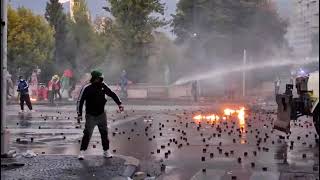
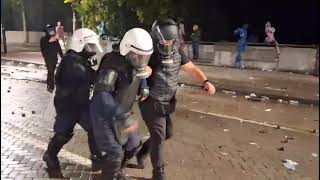
During his remarks, Rama condemned the use of stones against police officers, arguing that the violence had been used to portray the demonstrations as a movement in support of education and students.
“Citizens and students exercising their right to protest will never be the problem. That is an undeniable freedom. Here, we are talking about the use of violence,” Rama said.
The prime minister held up a stone allegedly taken from the street, describing it as a weapon capable of causing serious injuries or even fatalities. He said the object symbolized the dividing line between the right to peaceful protest and acts of violence.
Rama also warned that, in his view, the unrest could be linked to broader political efforts to disrupt Albania’s progress toward EU membership. He described the situation as a form of “hybrid warfare,” alleging that domestic and foreign actors were exploiting genuine social concerns to destabilize the country and hinder its European integration.
The prime minister acknowledged that public concerns over the cost of living, housing and the future were real, but argued that these issues were being used to fuel tensions and advance political objectives.
Rama Raises Concerns Over Students and Social Media
Addressing the role of young people in the unrest, Rama expressed concern over footage showing students vandalizing a book by prominent Albanian writer Gjergj Fishta. He said the incident highlighted a broader problem involving young people’s knowledge of their country’s cultural and historical heritage.
Rama also pointed to the influence of social media platforms, including TikTok, arguing that online algorithms could expose young people to harmful content and contribute to a decline in empathy.
He called on school principals, teachers and parents to work together to address the issue, emphasizing the need to strengthen social interaction and ensure that schools play a greater role in helping young people develop empathy and civic responsibility.
The prime minister said school principals had been asked to document the events of recent days in detailed, straightforward accounts. According to Rama, the purpose was not to initiate criminal proceedings against students, but to build a comprehensive record of what had happened and help authorities understand the underlying causes.
Dispute Over Police Conduct
Rama also rejected allegations that police had used disproportionate force against protesters, criticizing media outlets that he accused of exploiting the unrest for political and financial interests.
Citing figures he presented during the meeting, the prime minister said nearly 200 police officers had received hospital treatment for injuries, compared with approximately 80 injured protesters, fewer than half of whom he said were students.
He argued that these figures challenged claims that police had systematically used excessive force. The figures were presented by Rama during his remarks and were not independently verified in the information provided.
Rama maintained that the right to protest must be protected but insisted that violence against law enforcement and the destruction of public property could not be justified.
His remarks come amid heightened tensions surrounding the demonstrations, with the government emphasizing public order and the protection of Albania’s European integration ambitions.