The Maturity of Europe, Its Memory and Soul
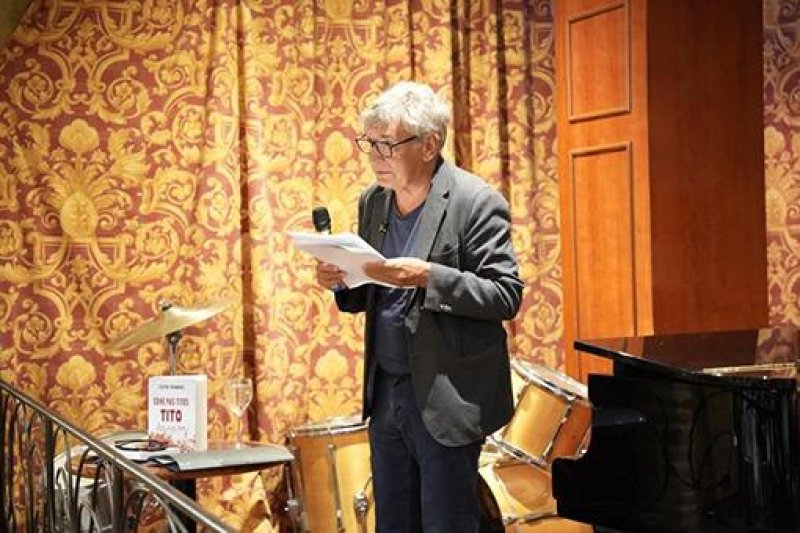
Some authors depict Europe as an institution, while others consider Europe merely a market. Zlatko Kramaric, however, aligns with a less common tradition by conceptualising Europe as a state of mind. He maintains a composed distance from the bureaucratic perspectives of Brussels, particularly regarding the clichés of a “shared geographical space,” “similar historical values,” and a “common cultural identity.” Kramaric’s conception of Europe is that of a community of shared imaginaries, where diverse peoples coexist, sharing memories and occasionally questioning themselves and the Other, asking: “What do you remember?” and “How do you remember me?”
In his recent essays and scholarly works, which commence with a series of reflections on the “European spirit” and extend to analyses of the Holocaust memory or Albania’s maritime relations, Kramaric is presented as a successor to an intellectual lineage that originates with Stefan Zweig (Die Welt von Gestern), traverses through Václav Havel (Evropa jako úkol), yet does not conclude with Milan Kundera (Un Occident kidnappé ou la tragédie de l’Europe centrale).
Having arrived at contemporary thinkers such as Jürgen Habermas, who considers the crises ofthe nation-state as inevitable, and Giorgio Agamben, who discusses “states of exception” as a normative governing principle, Kramaric disregards Europe as a geographical entity in order to attribute value to Europe as a condition of ongoing development - one that self-corrects through the critical intellect. In this context, he aligns with Zygmunt Bauman's concept of “liquid modernity,” which views Europe as a unique laboratory of coexistence, perpetually threatened by xenophobia and institutional crises.
At the core of Zlatko Kramaric's writings resides a notion that is both straightforward and challenging to justify: the current Europe, characterized by globalization and diverse rhythms, diverges from the former perception of a “selfish continent” solely concerned with its own interests. Such a Europe must now robustly demonstrate its ability to accept itself as it is. This concept permeates Kramaric’s analysis of Holocaust memory, examining our behaviors towards it and our handling of it. With equal dedication, the author also contemplates Albanian nationalism, communist isolation, and the populist temptations present in the contemporary Balkans.
What immediately strikes one in Kramaric’s articles is the rejection of triumphalist tones. Although he possesses rare stylistic abilities, this author keeps away from “maestoso” tempos. Kramaric is indeed a proven Europhile, but not a sentimental Europhile. His affection for Europe is conditional, because his ideas, in fact, become particularly interesting precisely because he sees Europe from its periphery, from its margins, in the spaces where everything is remembered and recorded.
Geographically, Zlatko Kramaric originates from a country within a region formerly known as Mitteleuropa. In this domain, borders have shifted more frequently than populations, and multicultural and multilingual empires have left more profound traces than states. Identity in these areas relentlessly questions, “Who am I? How am I?”, and seeks answers from others rather than inward. For the inhabitants of these regions, the neighbour holds greater significance than the empire, since empires are transient, whereas a neighbor across a border remains constant. This perspective partly explains why Kramaric’s essay of sharp observations, “The European Spirit: A Synthesised Overview”, stands as one of the most representative texts of his intellectual approach.
In Europe, it is characterised by a polyphony of tensions in which the thoughts of E. Husserl, W. Benjamin, J. Derrida, and other theorists of the post-colonial tradition, such as Edward Said, converge. All of them establish an agora of interlocutors, rather than a museum of prestigious names serving merely as decoration.
These names are not intended to protect the text; instead, they serve as a technique to clarify that the fundamental European paradox did not originate yesterday. Moreover, the civilisation responsible for the European Renaissance and universal rights also engendered colonialism, totalitarianism, and concentration camps. In this context, Kramaric aligns more closely with Benjamin than with Husserl. He recognises the merits of linear progress but espouses a stronger belief in memory and in what Europeans share.
A culmination of Kramaric’s thought is reached in his study of Albanian totalitarianism, in which he writes about the European Spirit in relation to the Albanian sea, isolation, and national imagination in post-totalitarian Albania.
Kramaric clearly comprehends and appropriately articulates that Albanian isolation was political, yet it was not solely political. It was, beyond that, a phenomenological isolation. Albanians had lived for centuries beside the sea, but not with the sea. Europe was seen by them, but not experienced. This ability to transform a geographical metaphor into a cultural category appears even more clearly in Kramaric's essay “Albania vs. the Sea”.
Here, the author achieves one of his greatest successes in articulating thought and marks a pinnacle in his stylistic progression. For Albanians, the sea is unquestionably more than a mere natural element; it also serves as a conceptual framework and a modus vivendi of presence amidst absence, as Derrida would articulate.
The Mediterranean, characterized by movement, dialogue, creative noise, and hybrid identities, presents a stark contrast to the continental, mountainous, and tribal model of Albanian history. The Sea in contrast to the Tower. The liquid bridge in opposition to the fortress. The Kanun of the mountains versus the ancient statues of medieval Albanian maritime cities. This schema delineates contrasts between the Mediterranean and the mountains, Europe and isolation, the city and rural life.
In his lectures, Hegel articulated that Europe is the “land of old history,” where civilisation has attained its full maturity. Spengler, in The Decline of the West, observes that European culture resembles an ageing organism, one that has passed its youthful phase and is approaching its decline. Kramaric positions himself between these two thinkers, aligning more closely with Paul Valéry’s perspective. Valéry asserted that Europe was becoming aware of its “ageing” and mortality as the central region of the world, whereas Kramaric underscores an “ageing without maturity.”
Is Europe truly mature? According to Kramaric, maturity is often merely a formal attribute in cultures that measure their maturity through illustrious history and the antiquity of ancient ruins. For him, a mature culture is one that can face its own history without illusions, euphoria, or feigned modesty, regardless of the nature of that history. Consequently, Kramaric persistently revisits memory and the European spirit, not only when discussing successes but also when addressing traumatic experiences such as totalitarianism, nationalism, and theemerging forms of populism and authoritarianism in South-Eastern Europe.
He recognizes that the absence or fragility of institutions poses a significant threat to Europe. However, an even more profound danger lies in the erosion of the capacity for self-reflection, which Kramaric equates with the “loss of the soul.”
Kramaric does not seek to invent a new theory of Europe. His merit lies elsewhere: he restores to the center a classical mode of European thinking, in which history, literature, philosophy and politics communicate with one another. For this reason, and for many others, the writings of Zlatko Kramaric, whether composed as essays or scholarly articles, deserve attention when read.
/AND
*Albanian intellectual, writer, poet, and publicist