
The Power of the Powerless
Last week, I was invited to speak at the Belgrade Security Conference. From meetings with civil society activists there, one can sense the atmosphere of liberation, but not yet the taste of freedom. Thanks to their disciplined organisation on the ground and in the digital sphere, bypassing the controlled traditional media, the students achieved an extraordinary victory. They demonstrated that it is possible to break the closed circle of unchecked power surrounding Aleksandar Vu?i?, who considered himself invincible.
To paraphrase Václav Havel, the elections in Serbia demonstrated how great the “power of the powerless” is, and how powerful civic resistance can be when social groups with entirely different perspectives come together. The Student Movement in Serbia resembles the Solidarno?? movement in Poland in the late 1980s. Both movements, despite their diversity in terms of values, helped overthrow the ruling regimes by securing support from different social groups. Just as the French Revolution changed the way political power was conceived, the students must now transform their bottom-up civic movement into a parliamentary and governing force.
The Student List constitutes an unprecedented experiment. It is a leaderless movement that combines internal democracy with secrecy and discipline in its dealings with external actors. Internal democracy ensures the participation and support of its members but slows down decision-making. The constituent factions of the Student Assembly have the power to veto candidates proposed for positions in government. The assemblies more closely resemble a conclave, whose members regard themselves as “shareholders” in Serbia’s future. The immediate challenge is to establish a mechanism that enables governance and reform, while the Student List remains involved in rebuilding the public sphere.
The pursuit of dignity and integrity will not be easy. The dismantling of the existing power structure has only just begun. Aleksandar Vu?i? has warned that, should he be arrested, one million people will take to the streets. It should not be forgotten that Vu?i? remained in power for 14 years, two years longer than Slobodan Miloševi?.
The transactional approach adopted by certain EU Member States towards his rule will complicate the new government’s relations with the EU. Nevertheless, EU engagement will be crucial in establishing the rule of law, combating corruption and organised crime, and freeing the media from political and oligarchic influence. Bringing the security and military intelligence services under control will be the most difficult challenge.
The students want to “put their own house in order” before addressing foreign and regional policy issues. In their view, domestic reforms will, over time, also lead to improvements in foreign and regional policy. The EU must not miss this opportunity, which is directly linked to the very transformative nature of the European integration process. The EU must support the Student List to prevent the influence of actors such as Russia, while, at the same time, ensuring that it does not compromise European values and standards, as it mistakenly did with Boris Tadi? and Aleksandar Vu?i?.
Serbia’s new leadership must be judged by its results, not its words. The rule of law, geopolitical alignment and the normalisation of relations with Kosovo must be regarded as complementary processes rather than as separate ones. At the height of the protests, the students travelled to Brussels and Strasbourg rather than to Moscow, as an indication of their European belonging. They must now demonstrate this belonging through the exercise of power.
The Europeanisation of the region is a transformative process, but also a generational matter. In the spring, Hungarians removed from power Viktor Orbán, the politician who had dominated political life since the collapse of communism and turned democracy into a façade. In the autumn, Serbs removed from power Aleksandar Vu?i? and Ivica Da?i?, who symbolise the generation of politicians associated with the wars in the former Yugoslavia.
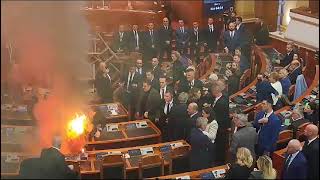
Despite the particularities of each country, the above examples offer grounds for optimism regarding civic resistance in Albania, conveying the message that the “power of the powerless” is greater than the power of any ruling authority.