Zvërnec Beyond Albania
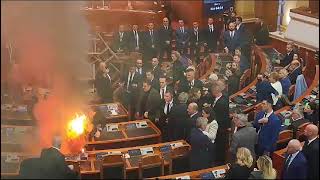
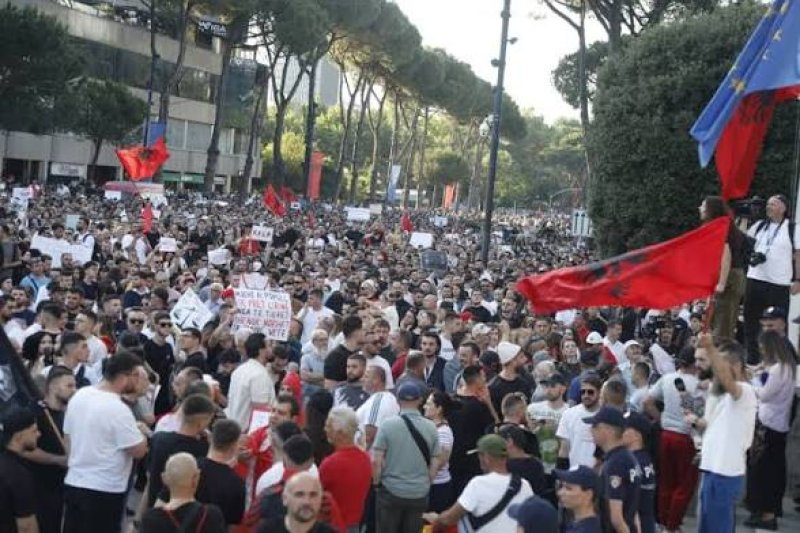
Some of the most important debates in a nation’s life never begin in the halls of power. They emerge on the margins, where a seemingly simple project scratches the surface and exposes the deeper wounds of a society. In the case of Zvërnec, this popular protest did not arise from grand theories or ideological manifestos. It began with a visceral reaction: the appearance of barbed-wire fences that instantly reminded many Albanians of the trauma of dictatorship-era borders, and the perceived arrogance of private security forces dragging away a citizen, evoking the same sense of outrage people feel when they witness communities being displaced from lands they consider their own. It was this sudden violation of human dignity that transformed an environmental concern into a broader uprising led by a new generation of activists and members of civil society, many of whom believe that traditional political parties have become increasingly detached from the public interest and overly dependent on entrenched power structures.
Mixed with a strong sense of national pride, the movement quickly adopted the poetic name “The Flamingo Revolution.” Yet beneath that romantic symbolism emerged a harsher political language, including calls for the imprisonment of leading political figures, raising concerns that the momentum of the protests could slide toward uncontrolled confrontation if neither the government nor the protesters demonstrated sufficient political maturity. As a result, this small and almost mystical stretch of coastline became the stage for narratives far larger than the Albanian Riviera itself. In a world shaped by the crises of the Middle East and increasingly bitter cultural debates across the West, Albania could hardly remain insulated from global tensions.
This local dispute soon began reflecting broader ideological conflicts, creating a political and emotional paradox for one of Europe’s most pro-American societies. Instead of remaining focused on the substance of the project, public attention rapidly shifted toward the personalities associated with it, particularly Jared Kushner and Ivanka Trump. Such a reductionist approach overlooked an important reality: the project is not backed solely by American private capital but by a far more complex international financial structure, in which the Qatar-based Khayat Group plays a significant role.
This detail removes the discussion from the narrow framework of American partisan politics and highlights a more important fact: Zvërnec has attracted major flows of global capital. In principle, that is often interpreted as a vote of confidence in a country seeking to overcome the long legacy of its post-communist transition. Yet it is precisely here that Albania’s deepest vulnerability resurfaces: legal uncertainty. The last three decades have been filled with examples of capital leaving the country not because of a lack of economic potential, but because of property disputes, institutional weaknesses, and the inability of the state to consistently enforce the rules of the game.
Zvërnec, therefore, is not an exception. It is merely the latest chapter in a long national struggle. The fundamental question should not be who is investing, but whether Albania’s institutions possess the integrity and capacity to protect the rule of law, safeguard the environment, and uphold the public interest simultaneously. No serious country can prosper by selling its assets without scrutiny, but neither can it develop by demonizing investors in the name of global ideological battles.
At its core, the debate over Zvërnec is not simply about nature conservation or the prominent names associated with a project. It is a test of whether Albania can pursue development without undermining itself through institutional paralysis or political turmoil. For many ordinary Albanians, the phrase “Flamingo Revolution” may sound elegant and sophisticated, perhaps even imported from foreign intellectual circles, yet it collides sharply with the realities of a society still struggling for economic dignity and fully aware of the distance separating it from much of Europe.
This protest movement not only sought to publicly challenge the reputation of the Trump family but also openly called for the cancellation of what would be the largest investment project in Albania’s history. But is that truly a position shared by Albanian society as a whole? An objective assessment invites skepticism. While the protests have undoubtedly become a vehicle for broader frustrations with political elites and the long, exhausting transition period that Albania has endured, the manner in which this investment has been portrayed and instrumentalized beyond the country’s borders raises important questions about how Albania presents itself to the international community.
A nation’s seriousness is not measured by its ability to threaten upheaval, but by the strength of its institutions to establish clear conditions and ensure that the law applies equally to everyone. The future is not built by turning one’s back on global markets and international partnerships, but by having the confidence to remain master of one’s own house while engaging with the world. As the fog of passionate debate continues to dominate public discourse, time alone will determine who was right in this historic controversy. What remains certain is that the outcome will reveal much more than the fate of a single investment project. It will reveal something fundamental about Albania itself.