
'Public Servants to Serve Public Interests'
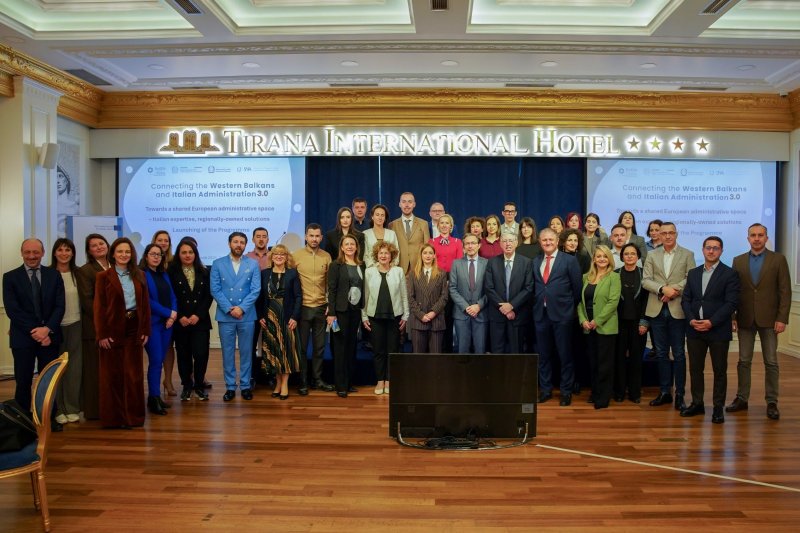
In recent days, Tirana hosted the third edition of the initiative named "Public servants' capacity building & Mobility Program 3.0", designed to foster knowledge exchange, institutional cooperation and administrative excellence between the Western Balkans and the Italian Administration. Young people at work, thanks to a project designed by R.e.SPA and S.N.A, and supported by the Italian Ministry of Foreign Affairs and the Ministry of Public Administration.
Despite it has received relative low visibility, we attach extreme importance to this initiative. High-performing public sectors are critical for implementing reforms, fostering innovation, and delivering quality services. Public servants are key for economic and social growth, well beyond the traditional view of them merely as an administrative cost. Today, the concept of public servant transcends national differences and relies on common principles of excellence and innovation.
Grace Hopper, a pioneer of computer programming, once said that “We've always done it this way" is the most dangerous phrase for humankind. It is true and applicable to the public sector.
Accordingly, the public servants’ capacity building project innovatively develops three concepts.
First: knowledge-exchange. In our hyper-digitized world, retaining knowledge means destroying it. Conversely, sharing knowledge accelerates skilling and re-skilling processes, by facilitating the exchange of expertise and a forward-thinking approach that goes beyond the idea of best practices, to explore next practices. Public servants’ growth mentality is a driver for modernizing a country, by shifting from rigid, risk-adverse compliance to flexible and user-centered solutions.
Second: competence, meant as intersection of technical expertise, emotional intelligence and ability to execute tasks, make decisions and lead teams toward excellence. Competence attracts competence. Far from just a functional requirement, it is a critical factor for establishing trust, credibility and high performance within organizations. Furthermore, competent public servants, and a result-oriented public administration, help break the incompetence-corruption nexus. Administrative incompetence creates gaps in monitoring and accountability, which enable corruption to flourish. Corruption, in turn, exacerbates incompetence, leading to systemic failure.
Third: open leadership. A future-proof public administration needs people able to combine transformational and transactional styles, to foster a culture of learning, innovation, and openness. The traditional command-and-control style is not wrong by itself. It is simply too slow for the fast pace of digitalization, while a shift to an open, more flexible leadership can bring public performance from average to excellence. Public servants must act as catalysts, by creating environments that mitigate knowledge hiding, reward ideas exchange, improve decision-making.
A true, solid partnership between two countries should be based on people, even before projects.
Italy is convinced of this. For this reason, we have supported, and we will continue to support, collaborative initiatives aimed at developing a servant leadership model in our public servants, since a mindset able to ensure high-quality service, public trust, and evidence-based policy implementation is a key pre-condition to cope with a complex and rapidly evolving environment.
*Mr. Marco Alberti is the Ambassador of Italy to Albania