Einhorn: Nobel Committee Forgets Its Founding Purpose, Disses Trump
For the second year in a row, the Nobel Committee has passed over the American president who has done more for peace than any other leader on the global stage.
Approximately two weeks ago, the world was shaken by an attempted terrorist attack aboard a Flydubai flight to Israel.
According to Emirati authorities, the co-pilot tried to seize control of the aircraft and crash it into Ben-Gurion Airport.
It was a chilling reminder of Sept. 11, 2001.
A decade ago, this particular attack could not have happened: That flight did not exist.
Donald Trump helped broker the peace agreement between Israel and the United Arab Emirates (UAE) that made trips to Dubai routine for hundreds of thousands of Israelis.
As recently as 2009, the UAE refused to allow an Israeli tennis player into the country to compete in an international tournament.
Yet President Trump’s persistence, working with regional leaders, opened a new chapter between their peoples.
Love Trump or hate him.
There are valid facts.
The Abraham Accords remain a historical diplomatic achievement. The agreement with the UAE explicitly established "peace, diplomatic relations and full normalization."
Those words became reality.
According to Israel’s embassy in the UAE, by the end of 2022, Israeli tourists had made a million visits since the accords were signed. Bilateral trade in goods reached approximately $2.56 billion that year.
Behind those figures are personal encounters, business deals and shared interests.
The more people benefit from peace, the more people have a stake in preserving it.
Why did that not earn Donald Trump the Nobel Peace Prize?
What else was required?
Membership in the right club - the elite that has captured international institutions and turned them into vehicles for mutual congratulation, regardless of results?
Yesterday, Navi Pillay won the prize.
What has she contributed to peace?
Where did she bring nations to an agreement?
We are told she has contributed to international criminal law.
Fair enough.
But we are supposed to believe that, three decades after Rwanda and apartheid, the committee suddenly remembered her because of her legal accomplishments.
It's hard to escape the suspicion that her selection owes more to her role leading the commission that accused Israel of genocide in Gaza.
To the international establishment, that apparently offers more compelling evidence of peacemaking than an actual peace agreement.
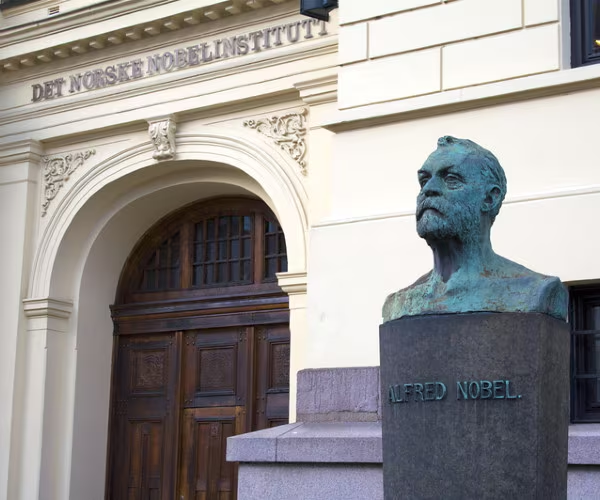
Alfred Nobel's will designated the prize for the person who had done the most or the best work for "fraternity between nations," alongside reducing standing armies and promoting peace congresses.
What has Pillay contributed to fraternity between nations?
More than Trump?
It's difficult to imagine a more tangible expression of that ideal than countries opening embassies, launching direct flights and allowing their citizens to get to know one another.
Had Trump been a little more critical of Israel, had he stood before the United Nations and declared that Israel’s response to the Oct. 7, 2023 massacre was excessive, I suspect a Nobel Prize would have been only the beginning.
They would have erected a statue of him in Oslo and made pilgrimages to it.
Instead, a president who helped deliver peace and supports the effort to destroy a terrorist organization that murders innocent people is cast as one of the "bad guys."
He does not speak the absurd woke language that has overtaken international law and made it a symbol of words replacing deeds.
He is a practical businessman.
He delivers agreements, not long-winded pronouncements.
This is a symptom of a bankrupt international system that has lost touch with its original purpose. The United Nations was established to advance peace.
Today, it increasingly looks like an extravagant waste of Manhattan real estate, housing a bureaucracy devoted to perpetuating itself.
Its charter opens with a pledge to "save succeeding generations from the scourge of war."
Where was that promise when Russia invaded Ukraine?
For conservatives, the fundamental failure should be obvious: An institution exists to serve a purpose and must justify its standing through results.
Its name, traditions, and good intentions do not exempt it from scrutiny.
When preserving the institution becomes more important than fulfilling its mission, meetings become substitutes for action, resolutions for achievements, and moral language for moral conduct.
Much of the international left has embraced this confusion precisely.
International institutions receive an almost automatic presumption of moral authority, while elected leaders must pass a test of style and ideological affiliation.
A Trump achievement consequently generates less enthusiasm than a statement from someone who speaks the approved political language.
Peace itself becomes secondary to deciding who is entitled to represent it.
The Abraham Accords offer another approach.
Israel and the UAE had not fought a direct war, and their agreement did not resolve the Israeli-Palestinian conflict.
But it expanded cooperation and demonstrated that progress was possible without first settling every outstanding dispute.
Conservatives should recognize the principle: Build on shared interests, secure achievable gains and allow a better reality to gather strength.
That should be the foundation of an international reform agenda.
The United States and its allies should condition support for international institutions on transparency, consistent standards, and serious scrutiny of results.
At the Security Council, they should pursue limits on a country’s ability to block action against its own aggression.
International courts should combine independence with accountability and the ability to enforce their decisions.
Peace prizes should give substantial weight to agreements that have actually transformed relations between nations.
Conservatism does not require preserving every institution in its present form.
It requires asking what purpose an institution serves, where it has gone wrong, and how it can be made to fulfill its mission again.
Trump doesn't need a Nobel Prize to make the Abraham Accords an achievement.
Awarding it would also credit the committee - an opportunity to demonstrate fidelity to its founding purpose.
Its failure to recognize his accomplishment raises an uncomfortable question: How much does peace itself still matter in Oslo?
Srulik Einhorn is the founder of www.perception.media, a strategic adviser and creative director to world leaders.
(source: Newsmax.com)