EU Special Envoy for Disarmament and Non-Proliferation Visits EU-Funded SALW Control Efforts Implemented by UNDP/SEESAC in Albania
H.E. Stephan Klement, the European Union’s Special Envoy for Disarmament and Non-Proliferation, visited Albania as part of a wider tour of the Western Balkans. The visit formed part of Ambassador Klement’s engagement with partners across the region to assess the tangible results of EU-funded efforts to strengthen small arms and light weapons (SALW) control and reinforce cooperation with institutions responsible for small arms management and security.
Since 2002, the South Eastern and Eastern Europe Clearinghouse for the Control of Small Arms and Light Weapons (SEESAC) — a joint initiative of the United Nations Development Programme (UNDP) and the Regional Cooperation Council (RCC) — has been implementing successive European Union Council Decisions supporting disarmament and arms control efforts across Southeast and East Europe, as well as two projects funded from the Regional IPA funded by the EU Commission.
SEESAC currently implements two EU Council Decisions: Council Decision (CFSP) 2025/2587 and Council Decision (CFSP) 2024/3006. Through this sustained engagement, the European Union has become the region’s largest and most consistent supporter of SALW control efforts, working through SEESAC to reduce the risks posed by illicit firearms, strengthen the security of state-held weapons and ammunition, and enhance the capacity of law enforcement and defence institutions to manage their arsenals safely, securely, and transparently.
Ambassador Klement’s visit provided an opportunity to observe first-hand how this long-term investment has contributed to improved security infrastructure, stronger institutional capacities, and enhanced implementation of international standards.
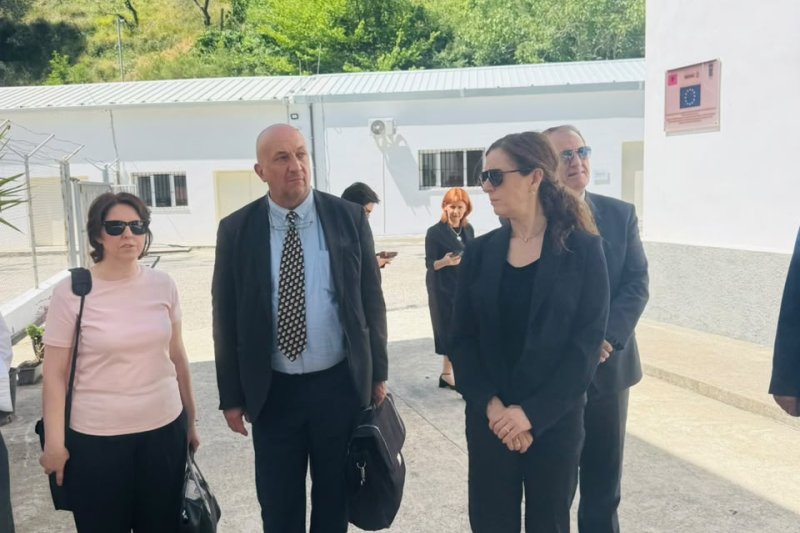
During his visit, Ambassador Klement toured the Albanian State Police’s Main Technical Supply Centre in Mullet, accompanied by Deputy Minister of Interior Xhemal Qefalia and UNDP Resident Representative Randi Davis as well as representatives of the State Police. The facility serves as the central storage site for small arms, light weapons, and ammunition held by the State Police.
With support from EU Common Foreign and Security Policy (CFSP) funding, complemented by assistance from the United States and implemented by UNDP through SEESAC, the facility underwent a comprehensive security upgrade. The improvements strengthened its physical security and storage capacity through enhanced infrastructure, access control, surveillance, and safety systems, in line with international standards for weapons and ammunition management.
The visit highlighted the practical impact of EU-funded support delivered through UNDP/SEESAC in strengthening the safe and secure management of state-held weapons and ammunition, while reducing the risks of loss, and diversion, within the Western Balkans SALW Control Roadmap.
The visit followed dedicated meetings with Minister of Interior Mr. Besfort Lamallari and with Deputy Minister of Foreign Affairs Ms. Fino discussing SEESAC’s contribution to the overall efforts of Albania in reducing the effects of misuse and proliferation of the firearms.
A Decade of EU–SEESAC Partnership with Albania
Since 2014, EU-funded SEESAC support has contributed to the development of a comprehensive SALW control system in Albania. Key interventions include the establishment of the National SALW Commission in 2017 and the adoption of three successive SALW Control Strategies, most recently covering the period 2025–2030.
EU support implemented by UNDP through SEESAC has helped harmonise national legislation with the EU acquis while strengthening the operational capacities of the Criminal Police, Border Police, Firearms Focal Point and Crime Scene Investigation units. Support has included capacity assessments, the development of standard operating procedures, specialised training, enhanced operational cooperation with partners such as FRONTEX and EMPACT, and the delivery of specialised equipment worth more than USD 1.2 million.
The donated equipment—including advanced optical and detection tools, thermal cameras, X-ray scanners, metal detectors, crime scene investigation kits, and IT equipment—has enhanced Albania's capacity to detect, investigate, and prevent illicit firearms trafficking. Targeted support to the Firearms Focal Point has further strengthened firearms intelligence, inter-agency information exchange, ballistic analysis, and evidence-based investigations, contributing to more effective national and regional responses to firearms-related crime.
Additional achievements include upgrading weapons storage and evidence management facilities in Qafë Molla, Tirana, and Durrës, destroying nearly 2,000 SALW in 2016, establishing a digital weapons registry, and integrating gender considerations into SALW control policies and firearms licensing practices.
These efforts are further supported through the ongoing project “Integrated Institutional Approach and Strengthening Cross-Border Cooperation on SALW Control (Phase I)” (2024–2026), funded by Germany, Sweden, France, the Netherlands, the United Kingdom, and Norway through the Western Balkans SALW Control Roadmap Multi-Partner Trust Fund, with support from the European Union and implemented by UNDP in Albania.
The project is strengthening the capacities of Albania’s Border Police, the Institute of Scientific Police, and the Kukës Crime Scene Investigation unit, while enhancing cross-border cooperation with the authorities in Pristina on firearms detection and trafficking. Activities include support for the development of a Weapons Management System and a feasibility assessment for ballistic data-sharing mechanisms.
Through continued EU–UNDP/SEESAC cooperation, Albania remains an important partner in advancing responsible arms control, reducing the risks posed by illicit firearms, and strengthening security across the Western Balkans.