FOR A NEW ALBANIA
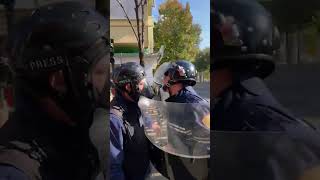
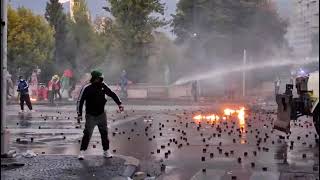
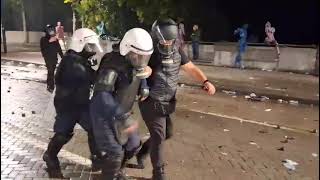
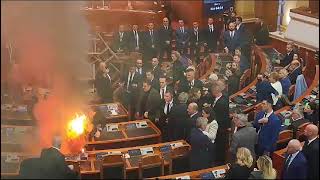
The unprecedented protests in Albania and in several cities around the world where Albanians live can be described as “protests of dignity.” To paraphrase the French philosopher Pierre Lévy, Tirana is presenting itself to the world as an “intelligent city,” where people do not gather around a political party or a power that does not represent them, but around shared values and concerns that go beyond political convictions, in search of a new Albania.
What began as anger over access to land and beaches and over the protection of our shared natural heritage soon turned into something larger that touches the very essence of democracy: the question of who should decide, and how, about Albania’s future. The protest is showing that the politics of the future is being understood better by those who are currently outside of politics.
Throughout the years of transition, we have seen how the country’s most precious assets have been handed over from above to a handful of people, while ordinary citizens and local communities are ‘informed’ only when the fences go up and the cement mixers arrive.
Tirana and the Adriatic–Ionian coastline are the most contrasting and exclusionary image of the country’s so-called development model, which has nothing to do with the European model of social cohesion, nor with respect for our shared heritage.
The unlimited domination of public goods has deepened the contradiction between the opportunities created by the market economy and their appropriation by a possessing minority that holds economic and political power. Society today is more divided than ever by the deep inequalities between those who accumulate wealth and power and those who fight every day to live with dignity, or simply to survive.
This is not a natural development of capitalism, but the result of a calcified partnership between politics, the oligarchy, the media and organized crime.
The flamingos are a symbol of accumulated anger at the treatment of the homeland as plunder, and not a protest against the country’s development. It is a protest against a merciless model built at the expense of past and future generations — consuming the contribution of the former, and destroying the heritage of the latter.
That is why genuine political reflection and action are needed. Above all, from the Socialist Party.
Denying reality, mocking the protesters, arguing on its numbers, chasing conspiracy theories, blaming neighbors or prestigious international media — all while sidestepping the core of the popular anger that has flooded the streets — resembles playing with fire, and puts Albania’s future in question.
Thirteen years ago, as we were closing the 2013 election campaign in Shkodër, Edi Rama and the Socialist Party pledged to Albanians that they would put an end to the corrosive phenomena of the transition, bringing to life the words of Father Gjergj Fishta: “To rule a state, cunning, deceit, intrigue, swindling, lies and betrayal are not enough. Honor, knowledge, wisdom and manliness are needed. That is what it takes!”
On the basis of this simple but powerful pledge, we asked Albanians for their trust to govern, not to rule. We pledged that we would be a party of ideas and ideals, and not of power as an end in itself; that we would work for social justice, the rule of law, and would represent the interests of the majority; that we would be a party measured against the expectations of citizens and not against the exploitation of our opponents’ weaknesses. A party and a governance distinguished by vision, by a plurality of ideas and political personalities, and not a party that suffocates political thought, narrative and action.
The protests of these days are the clearest mirror showing that we have not stayed faithful to the principles and pledges above. The censorship in the national media and the broadcasting of the protest — at first only on News24 and social networks, and later by prestigious international media — brought to my mind the difficult situation of 1990 and the tragic events of 1996–1997, when we could learn what was happening in Albania only through the Voice of America, the BBC and the newspaper Koha Jonë.
That is why it is essential to come out of the state of denial, to apologize for our mistakes, and to reflect on what must be done so as not to lose the reason why we exist — the undeniable legacy and contribution of the Socialist Party, since its founding, to the country.
Power as an end in itself
Political parties do not fail only when they lose elections, but also through disregard for the democratic rules of the game, an excessive concentration of power, and identification with the state.
Electoral victories are a blessing for any political force when they are accompanied by the democratization of that force and of society. But a long stay in power and the personalization of power creates the illusion that the model works, that accountability and corrections are unnecessary, that political personalities can be replaced by cardboard loyalty, that activists and citizens will keep believing indefinitely, so long as the political opponent is weak.
This is precisely where the slide begins.
One of the most dangerous transformations that occurs in political life is not the capture of the state by a party, a leader or a group of oligarchs. It is something more subtle than that: the moment when the state begins to adopt their logic and they begin to adopt the logic of the state. At first, this process seems harmless. The boundaries between the interest of the state and that of power become less distinct. What at first appears as stability turns into domination. Power comes to be regarded as the natural state of things.
The national media steps outside its mission and is treated as a lever of power. The aim is not to persuade people of the truth of the regime’s narrative, but to produce weariness and cynicism, to exhaust critical thinking, and to create a sense of powerlessness in people.
Energies are concentrated on side-lining and excluding collaborators who think differently. Power becomes an end in itself at the expense of the quality of governance. Corruption erodes every sphere of decision-making. Democracy, pluralism and the rule of law in the economy are undermined.
The axis of programmatic values and ideals around which people gather within a party is replaced by former opponents and opportunists who today represent power more than they represent the socialists. The whole thing resembles a market game rather than democratic logic.
This is precisely the trap before us.
We Albanians have not suffered from a lack of powerful leaders, but from a lack of wise and patriotic statesmen who sacrifice power for the state — who do not perform diplomatic pirouettes to survive politically, putting national security at risk.
The most golden moments of our history are tied to common efforts to submit to the rules of democracy. Democracy is not built on the idea of permanent power, but on the idea of limiting power at all levels. When power is personalized to the extreme, the greatest temptation is not to abuse it, but to normalize everything: to normalize the idea of equating the leader with the state; to normalize the idea that criticism of power is criticism of the country; to normalize the idea that expressing criticism is an obstacle and not a contribution; to normalize the idea that every segment of society must function in harmony with, and in the service of, power.
None of these processes happen overnight. That is precisely why they are hard to identify in time. They do not appear as spectacular deviations. On the contrary, they present themselves as practical solutions wrapped in aesthetic taste. Nevertheless, world experience shows that the result is inevitably the same: society begins to organize itself around the needs of power, rather than power around the needs of society.
At this point, the misuse of power ceases to be a series of individual cases and becomes a symptom of a larger problem. It does not arise because people with vices who cannot resist the temptation of power suddenly appear, or who act deceitfully behind one’s back. It arises because the political mechanisms that ought to restrain it have been dismantled by power. Alignment is valued more than integrity. Holding political responsibility and guaranteeing the integrity of public office are treated as heresy. The players are changed. The people are toyed through judicial processes that resemble Netflix episodes. Meanwhile, the game of old habits continues undisturbed.
To break away from this condition, it is essential to secure the separation of the state from power. It is also important to rediscover the forgotten word “we” — in decision-making as well as in the distribution of wealth and political power for the benefit of the people.
The lesser evil, and not the better alternative
In 2005, Edi Rama warned that the Socialist Party had erred when it measured itself against the weaknesses of the opponent then in opposition, rather than against the expectations of citizens. It was a valuable lesson back then. It is an even more valuable lesson for the situation that has arisen today.
A serious party must measure itself against the hardest question of all: are we improving people’s lives as much as they expect of us?
Since 2019, when the opposition entered a self-destructive spiral, those in power adopted the logic of the market in politics — taking yesterday’s opponents and promoting them to various positions of power. For a long time now, the socialists have not been part of decision-making.
The gap between the socialists and those in power is greater than ever. Within the party there is no programmatic debate, no accountability for the costs imposed on the country, no election or consultation — only events with scripts and tightly controlled direction.
The reaction of the socialists at the ceremony marking the passing of Fatos Nano, beyond being an expression of respect for a period in which a democratic and competitive spirit prevailed in the Socialist Party — one that gave the country political balance and social peace at critical moments — was also an expression of frustration with the current state of affairs.
Within the Socialist Party, the freedom to be heard has been lost. Because internal democracy is not the right to speak. Internal democracy is the right to be heard.
Parties that hear only applause lose the ability to understand reality. Political parties were not created to hold power, but to change society through a governing vision. When this relationship is inverted, when the greatest energy is invested in preserving power rather than in producing and realizing ideas, a party may look organizationally strong because of its identification with the state, but it is politically weak.
This is why, for a long time, we have not had a convincing answer to the backslide in democratic standards; to the middle class that for years has felt the pressure of dirty money in the economy; to inequality and social exclusion; to the impact of technology on the democratic system and the labor market; to the fair relationship between labor and capital; to the relationship between the center and the periphery; to an economy stuck in an outdated productive model; to workers and to small and medium-sized entrepreneurs who fight every day to survive; to housing, which has become a distant and unattainable dream for the majority of Albanian families; to the speculation in prices and property rents that prevents young couples from having a home, raising children and living with dignity. And all of this at a time when the abandonment of the country poses a serious demographic threat to our present and our future.
That is why the great social challenge today is not only economic growth through construction and tourism, but the guarantee of a life with dignity, free from the constant pressure of survival.
The need for a democratic renewal
Albania needs a democratic renewal — as a response to disappointment, anger, the corruption of headless national and social projects, injustice, inequality, and the crisis of democracy itself.
The battle for the country’s democratic renewal has never been easy, nor is it the effort of a single person. On the contrary, it is a daily collective battle that requires strategy, a concentration of forces, ethics, ideas and courage.
Albania needs a democratic plan that secures the separation of the state from power, an equal set of rules of the game, and democratic institutions. The best guarantee of this is the vigilance and engagement of citizens.
Albania needs a left with a new vision, bold and with a spirit that anticipates the needs of society. A left that embraces a new patriotism, inseparably linked to social justice. A patriotism that defends and promotes democracy in every sphere of power and society; that sets limits on the oligarchy and protects the public interest; at the heart of which lie the security of citizens, their rights, equal opportunities for all, solidarity and social cohesion.
Our homeland needs a shake-up and a dismantling of the partnership between politics, the oligarchy, the media and organized crime.
Our political system needs a new era that enables the renewal of elites, the representation of the people in decision-making, and preventive mechanisms against the concentration of both political and economic power.
Our economy needs a national reconstruction plan aimed at fair and sustainable development.
Our productive model requires a radical reorientation.
Albanians do not deserve to choose, again and again, between fear and disappointment. They do not deserve to vote against someone. They deserve to vote for a vision — to choose the alternative that gives them more confidence in the future, but also more security in the present.
This is precisely where the new left to which I aspire must be measured: against the demands Albanians make of us.
A left that would earn its place in history by changing people’s lives. If this mission is forgotten, we will lose something far more important: the reason why we exist. The challenge is not to hold on to power, but to deserve trust. Every day. From scratch.