The Mecca Agreement and Its Shadow Over the Balkans
There are agreements measured by their clauses, and there are agreements measured also by the place where they are signed. The Mecca Agreement between Saudi Arabia, Turkey and Pakistan belongs to the second category. Signing a defense pact in Islam’s holiest city is not merely protocol; it is a message. Riyadh, Ankara and Islamabad are saying that their security should no longer remain solely an imported product.
At the center of this development is Mohammed bin Salman. By receiving Turkish President Recep Tayyip Erdo?an and Pakistani Prime Minister Shehbaz Sharif in Mecca, the Crown Prince did not merely consolidate an agreement; he forced the region to recalculate its positions. Saudi Arabia is the political and economic center of the Gulf and one of the decisive actors in the global energy market. Few countries in the region can afford a complicated relationship with Riyadh. When that weight is combined with Turkey’s military capabilities and defense industry, as well as the strategic power of a nuclear-armed Pakistan, the Mecca Agreement acquires a dimension that goes far beyond the signing ceremony.
This ambition was articulated most clearly by Hakan Fidan, Turkey’s Foreign Minister and former head of Turkish intelligence, when he compared the mechanism of the agreement to the logic of NATO’s Article 5: an attack on one is considered an attack on all. If Egypt were to join this core in the future, as has been mentioned as a natural potential partner, then we would no longer be speaking merely of a Riyadh–Ankara–Islamabad triangle, but of the embryo of a much broader security architecture.
This is precisely what changes Iran’s calculations. For years, Tehran has projected influence through a network of militias, missiles and drones that allow it to exert pressure without necessarily crossing the threshold into open interstate war. The Mecca Agreement seeks to make that strategy more costly. Iran may dismiss it as a “paper tiger,” but the value of any alliance is not tested on the day it is signed; it is tested in the first crisis.
Yet the most interesting consequence may be political. For years, the United States has sought a Middle East gradually organized around Arab-Israeli normalization and the Abraham Accords. Mecca does not bury those accords, but it places beside them another model: a security mechanism that is not built around Israel and does not rely solely on Washington. For Jerusalem, this is a development that cannot be measured only in the number of tanks or aircraft. The question is where the political center of the future regional order will lie.
And this is where Mecca begins to cast its shadow over the Mediterranean and the Balkans. The connecting link is Turkey. An Ankara with more partners, greater capabilities and more strategic autonomy inevitably changes Athens’ calculations as well. Greece has no reason to believe that Saudi Arabia or Pakistan will become parties against it. But it does have reason to consider what this partnership may enable Turkey to do in the future.
This may accelerate another geometry of cooperation. Greece, Israel and India do not have a trilateral alliance, but their existing ties in defense, energy, technology, ports and maritime security provide the basis for deeper coordination. If Ankara–Riyadh–Islamabad consolidates, closer Athens–Jerusalem–New Delhi coordination becomes easier to understand. The risk is not necessarily direct conflict; it is the emergence of a spiral in which one side’s security is perceived as a threat by the other.
For Albania, this makes the equation delicate, but not unclear. Turkey is not merely a strategic partner; it is one of Albania’s most important supporters in the fields of security, defense and the strengthening of military capabilities. Greece, meanwhile, is a neighbor, a NATO ally and an important European partner. Tirana’s interest is not to choose between two axes, but to prevent the rivalries of the Middle East and South Asia from being imported into the Balkans. Albania’s compass remains Euro-Atlantic; precisely for that reason, relations with Ankara and Athens should be used to expand Albania’s strategic space, not to narrow it.
In the end, the Mecca Agreement reveals a change larger than the pact itself. The powers of the Middle East no longer want merely a seat at the table of the international order. They are seeking to build tables of their own. And when that happens, the shadow of new agreements does not stop where the signatures are placed. It stretches across the Mediterranean — all the way to the Balkans.
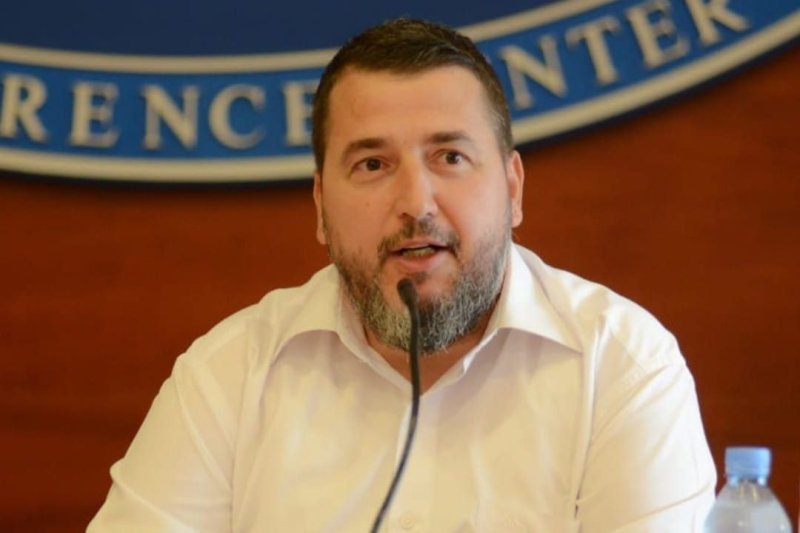
Dr. Arben Ramkaj is Chairman of the Interfaith Cooperation Center in Albania, Vice President of the European Muslim League, and Director of the Albanian Institute for Cultural and Religious Dialogue.