'Take Me to Your Village', The Night Dropull Brings Its Traditions Back to Life
Courrier des Balkans, Paris
From the balcony of Gorica, one of Dropull’s cliffside villages, dawn feels as if it belongs to another world. At this hour, when the sun still only grazes the peaks, the Drinos valley stretches out in an almost unreal silence. Sheltered by the massifs of Mali i Gjerë (“the Wide Mountain”), Mount Lunxhëria and Mount Buretos, it gives the impression of surveying the world from its rooftop. Rising some 1,800 metres above the region, Mali i Gjerë slopes gently down towards Gjirokastër and the stone villages of Dropull. The first rays of sunlight slide across the fields, orchards and church steeples, while in the distance the mountains trace the natural border between Albania and Greece.
Here, geography shapes identity. The mountains are more than a backdrop: they protect a land where cultures, languages and traditions have intermingled for millennia. Known in antiquity as Dhrinopoleos or Dheropoli, the region takes its name from Dryinoupolis, the “city of oaks.” Not far away once stood Adrianopolis, an important Roman city founded under the Emperor Hadrian, of which the remains of a theatre, baths and a temple can still be seen.
A threatened yet living heritage
Only a few kilometres from Gjirokastër, Dropull preserves one of the most unspoiled landscapes in southern Albania. Home to a significant community of the Greek national minority, the region captivates with its traditional villages, rich heritage, mild climate and serene scenery. As early as the beginning of the nineteenth century, European travellers—from François Pouqueville to Henry Holland—were already praising the fertility of this valley and the grace of its inhabitants. A few years later, Lord Byron, enchanted by Albania, found in these mountains and stone villages the image of an authentic and untamed land. More than two centuries after their passage, the polyphonic songs that still echo through the Drinos valley seem to carry the same emotion.
Around the hills, a constellation of 16th- and 17th-century Orthodox monasteries comes into view, their frescoes and iconostases bearing witness to an exceptional spiritual heritage. Long at the heart of village life, they also served as centres of education and solidarity. Since 2025, the monasteries of the Drino valley, in the municipality of Dropull, have been included on the World Monuments Watch, which recognises both their heritage value and the urgent need for their preservation.
Despite rural exodus, those who remain keep ancestral knowledge alive: the young girls’ dance of Dropull, inscribed on Albania’s intangible heritage list; the costumes embroidered in gold and silver; and the polyphonic singing recognised as one of the jewels of world polyphony. Carried by collective voices and gestures, these traditions form a “cultural passport” between Albania and neighbouring Greece.
For the past three years, the Dhropoli Cultural Association, founded by Amalia Millou and Evdhoksia Pasko, has been working to revive this outstanding heritage. Passing on skills, promoting costumes, songs and dances, and involving young people: its ambition is to turn Dropull into a territory of living memory.
“Take Me to Your Village”
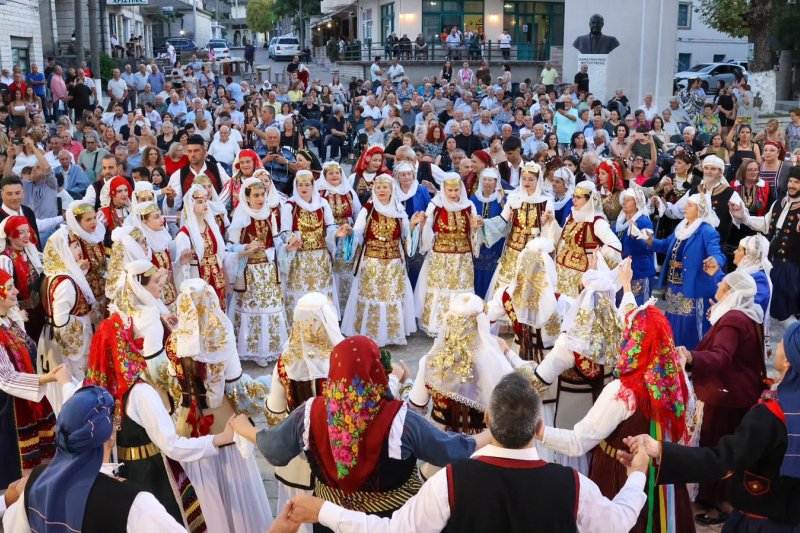
As the sun sinks behind the mountains, the central square of Derviçan begins to fill. It is 7 p.m. Locals settle at café terraces, families perch on the low stone walls, while children weave between the folk groups making their final preparations. Gradually the delegations make their entrance, each behind its banner. The traditional costumes draw every gaze: the white dresses of the Dropull women, embroidered with gold thread and adorned with coins, stand alongside the immaculate fustanellas of the men, the embroidered waistcoats of Epirus, and the colourful outfits from Crete or Greek Macedonia. Within minutes the square becomes a true mosaic of Balkan cultures.
This year, the third edition of the “Take Me to Your Village” festival brings together around ten ensembles from across the region: the cultural associations Dropulli, Pegasos and Pindos, the polyphonic group of Derviçan, the women singers of Selo, the dancers of Libohova, as well as ensembles from Zitsa, Grevena, the Cretan community of Macedonia, and artists from Saranda. All share the same stage, without competition, in a spirit of encounter and transmission.
When the first notes of the polyphony ring out, silence falls. The deep voices of the men answer the higher voices of the women in these centuries-old harmonies that have made southern Albania famous. Then come the dances. Hands join, circles form, the steps remain short, elegant, almost solemn—as in the celebrated Dropull dance, inscribed on Albania’s intangible cultural heritage list. Gradually, spectators leave their seats to join the dancers. The boundary between performers and audience melts away.
The costumes are a spectacle in themselves. Every embroidery, every headdress, every belt tells the story of a village and a community. The women of Dropull wear one of the most sumptuous traditional outfits in the Balkans, adorned with gold thread, jewellery and coins, while the men display the white fustanella, the embroidered waistcoat and the black woollen caps — symbols of an identity preserved across the centuries.
For Dhimitraq Toli, mayor of Dropull, the significance of the event goes far beyond folklore: “This is not simply a cultural activity; it is a celebration of tradition, of our history and of our identity.” A conviction shared by the founders of the Dhropoli Cultural Association who, for the past three years, have been multiplying initiatives to pass on the songs, dances, costumes and skills to the younger generations.
Long after night has fallen, the songs still echo beneath the plane trees (platanos) of Derviçan. In a region facing depopulation, this evening takes on a special dimension. More than a festival, it appears as an affirmation of existence: that of a territory which refuses to let its memory disappear and which continues, through music, dance and costume, to keep alive a heritage shared on both sides of the Albanian-Greek border.
*Director of Art & Heritage