Zelensky in Belgrade: Reading Beyond the Diplomatic Gesture
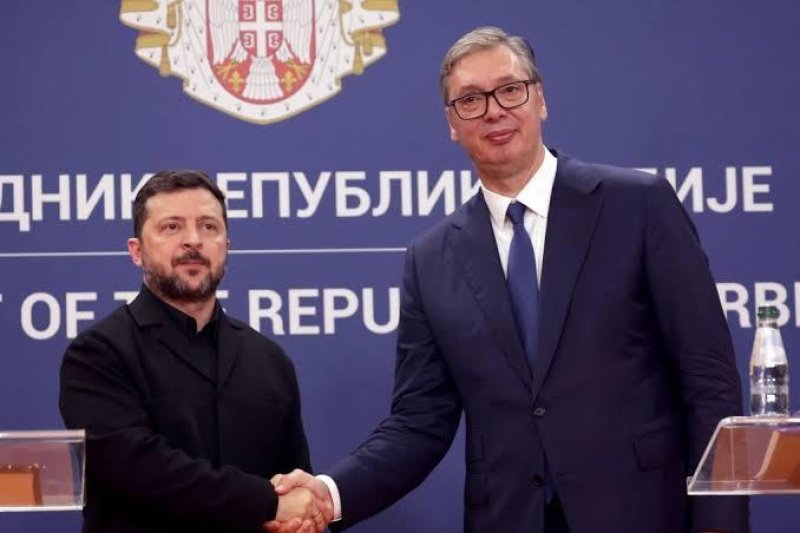
The significance of Volodymyr Zelensky’s visit to Belgrade cannot be adequately understood through the conventional vocabulary of diplomatic protocol. Its timing, coinciding with a critical phase of the war against Russia; its geographical destination, Serbia; its geopolitical weight; and the reactions it is likely to provoke together constitute the premises for a broader strategic interpretation. The visit is not merely an encounter between two presidents. It is a political signal addressed simultaneously to Belgrade, Moscow, Kyiv and other countries.
The most striking dimension lies in the destination itself: the Ukrainian president is visiting the capital of Russia’s most enduring political partner in Europe. The symbolism is difficult to miss. Yet symbolism matters because it interacts with interests, historical memories, and calculations of power.
Unlike Russia, Ukraine has not followed a historical trajectory that naturally converges with Serbia’s. The ideological foundations of Serbian loyalty toward Russia derive largely from a broader conception of Russian solidarity with Slavic and Orthodox peoples. In nineteenth-century Russian political thought, this solidarity was sometimes represented as a moral obligation to liberate kindred peoples, even at the risk of confrontation with Western Europe. In Serbia, this ethno-religious axis acquired unusual durability. From the emergence of the modern Serbian state to the present, it has survived changes of regime, international alignments, and European transformations more successfully than in most other Slavic societies.
This historical inheritance explains why Zelensky’s presence in Belgrade carries implications exceeding the immediate agenda. If the visit takes place while Russian missile strikes remain a daily reality, its purpose may be less theatrical defiance than a calibrated test of Russian influence in the Balkans. It may irritate the Kremlin, but irritation should not be confused with strategic transformation.
For Serbia, the encounter demonstrates an increasingly recognizable feature of its foreign policy: strategic dualism. Belgrade has refused to join the Western sanctions regime against Russia while simultaneously cultivating the image of a state that, under particular circumstances, has indirectly enabled Ukraine to obtain military supplies, including ammunition. Russian diplomatic and intelligence warnings have reflected Moscow’s awareness of this ambiguity, while President Aleksandar Vu?i? has repeatedly rejected the characterization that Serbia is assisting Ukraine in any deliberate or systematic manner.
This ambiguity is not necessarily incoherence. For a medium-sized state between competing geopolitical spheres, ambiguity can become an instrument of power. Serbia seeks relations with the European Union, historical links with Moscow, and room for maneuver between them. Such a policy is sustainable, however, only as long as the international environment permits contradictory commitments to coexist.
The reported agenda—economic cooperation, particularly in energy, alongside discussion of both countries’ European perspectives—acquires significance beyond bilateral relations. Serbia’s internal orientation remains deeply divided. A 2025 study cited in the original discussion indicated that 59 percent of Serbian respondents preferred an alliance with Russia, compared with 37 percent supporting their country’s European perspective. Whatever their methodological limitations, such figures reveal a political reality: Serbia’s foreign-policy choices cannot be detached from the collective representations through which a society understands history, identity, security, and belonging.
The Kosovo question adds strategic complexity. Zelensky has maintained Ukraine’s non-recognition of Kosovo’s independence, while Vu?i? continues to emphasize Serbia’s recognition of Ukraine’s territorial integrity. At first glance, the two positions may appear symmetrical. They are not necessarily equivalent. International politics often creates superficial analogies between conflicts whose historical structures, legal circumstances, and patterns of violence differ profoundly.
Three distinctions are particularly important. First, the extraordinarily strong support for Ukraine among Albanian population contrasts sharply with the comparatively powerful pro-Russian sentiment within Serbian society. Second, Serbia’s campaign of repression and violence against Kosovo Albanians, including acts widely characterized as having genocidal features, cannot simply be equated with the treatment of Russian-speaking populations in Donbas by the Ukrainian state. Third, Kosovo’s declaration of independence, supported by major Western powers that are also Ukraine’s principal military and political supporters, was examined by the International Court of Justice and found not to violate international law in the narrow question submitted to it. Historical analogies therefore require discrimination, not rhetorical symmetry.
The deeper question is whether Zelensky’s visit can contribute to the long-term transformation of Serbia’s strategic orientation. Here the answer is considerably less certain. Western policy toward Serbia for more than two decades has aimed, in different forms and with varying degrees of consistency, at anchoring the country within the Euro-Atlantic political order. A presidential visit cannot substitute for a transformation of strategic culture.
The eventual outcome of the war in Ukraine will matter enormously in this respect. It remains impossible to predict what political form Russia will possess when the conflict ends, or whether it will emerge as a continental, regional, or global pole of power. Yet the post-war configuration of Russian power will inevitably influence Serbia’s calculations. If Moscow’s capacity for projection declines substantially, Belgrade’s room for maintaining its present equilibrium may narrow. If Russia preserves significant power, Serbia may have stronger incentives to continue its policy of strategic ambiguity.
A genuine geopolitical reorientation of Serbia would therefore require more than diplomatic gestures. It would presuppose a process of political and sociological transformation within the country: a gradual reassessment by the political elite and a substantial part of society of the historical narratives, security perceptions, and moral assumptions that underpin foreign policy. Foreign-policy change becomes durable when external calculations are accompanied by internal changes in political consciousness. States rarely abandon established strategic identities merely because another alignment becomes materially advantageous; they do so when the meaning of national interest itself is reconstructed.
This is ultimately what makes Zelensky’s presence in Belgrade significant. The visit tests Serbian diplomacy can accommodate Kyiv without altering its deeper conception of Russia, Europe, and its historical identity. The answer will depend on the evolution of Europe’s security order.
There is also a contemporary dimension. Diplomacy operates through official channels, images, media narratives, digital platforms, and staged political gestures. Technology has accelerated the circulation of symbols, while strategic communication increasingly forms part of foreign policy. A visit can therefore be an event, a message, a test, and an instrument of influence at the same time.
Zelensky in Belgrade should consequently be read neither as a theatrical rupture nor as a diplomatic curiosity. It is a calculated movement within Europe’s larger strategic contest for influence. Its symbolism may unsettle Moscow; its practical value may offer Belgrade additional room for maneuver; but its historical importance will be measured by something much harder to achieve: whether Serbia’s strategic consciousness gradually moves closer to the political order toward which Europe has sought to orient it. / Albanian Daily News