How Lawfare Waged Against Donald Trump Became a Global Playbook
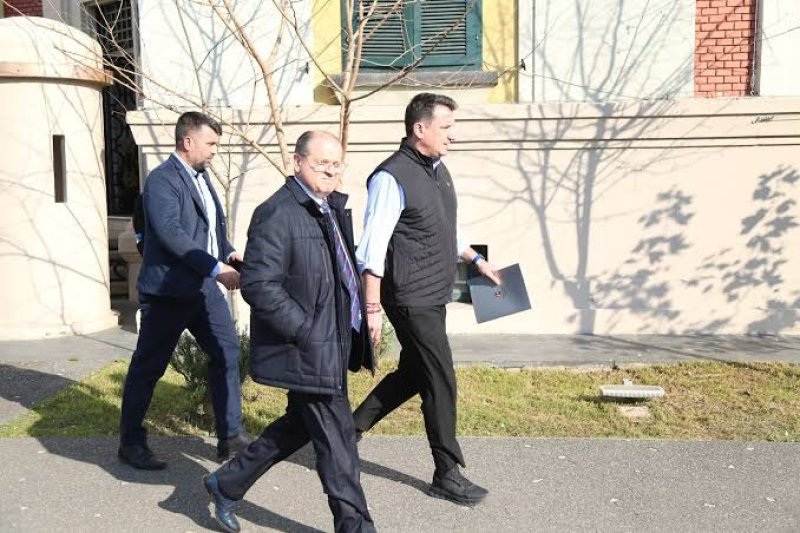
In February 2025, Albanian prosecutors arrested Erion Veliaj, the three-term mayor of Tirana. Eighteen months later, he is still in jail. He has not been convicted of anything. His detention has simply been renewed again and again while Albania's courts argue over whether it is lawful. The capital of a NATO ally is being run without the leader its voters chose three times.
Americans have a word for this. We call it lawfare: the use of prosecutors, courts and endless legal process to sideline a political opponent. The practice was never uniquely American. It is now running in country after country, and Albania has produced one of its starkest examples.
What makes the Albanian case stand out is who is doing it. The prosecutors seeking to keep the mayor in detention belong to the Special Structure against Corruption and Organized Crime, known as SPAK, created in 2016 with American and European backing as the centerpiece of a sweeping judicial overhaul. Albania needed that reform. Corruption ran deep in public life and criminal networks exploited weak institutions. The theory was simple: a stronger justice system would produce cleaner government, greater public confidence, more investment and a faster path to the European Union. Instead, an institution built to protect the rule of law is now the one raising the hardest questions about it.
A decade later, the results are hard to defend. Representative Keith Self of Texas, chairman of the House Foreign Affairs Subcommittee on Europe, has noted that the judicial backlog has grown from roughly 16,000 cases to an estimated 200,000. Citizens can wait up to 15 years for a final ruling. More than half the prison population is awaiting trial, one of the highest rates in Europe. The European Convention on Human Rights treats pretrial detention as an exceptional measure that must be justified case by case: risk of flight, interference with evidence or witnesses, or danger of new offenses. In Albania, it has become standard practice.
That is what happened to the mayor of Tirana. The Council of Europe's Venice Commission studied this exact practice across member states. Its conclusion was blunt: when jailing mayors before trial leads to their automatic suspension or replacement, it undermines the presumption of innocence, stifles political pluralism and strips citizens of the representation they chose. A detention order, not a verdict, has kept the elected leader of Albania's largest city from doing the job his voters gave him.
When prosecutors have credible evidence of wrongdoing, they should pursue it wherever it leads, including into city hall. They must also answer to the law themselves. An anti-corruption campaign keeps its legitimacy only as long as it respects due process, and holding a man in a cell this long without a verdict does not meet that standard. Albania's Constitutional Court has twice ruled in the mayor's favor, first protecting his elected mandate and then ordering a fresh review of whether keeping him locked up is justified at all.
I know this pattern well. I spent nearly a quarter of a century working for President Donald Trump, in business and then in the White House as his envoy to the Middle East. I watched from inside his orbit, as well as from the outside, as prosecutors and their political allies spent years trying to win through legal process what they could not win at the ballot box. In the end, the voters settled it.
Other countries are living through their own versions. Israelis have argued for years over the prosecution of Prime Minister Benjamin Netanyahu. Argentines are arguing today over the investigations aimed at President Javier Milei. The French spent the past year waiting to learn whether a court would keep Marine Le Pen off the presidential ballot. Brazilians are having the same fight over the imprisonment of former President Jair Bolsonaro. Each case has its own facts, and each country will judge its own. The pattern is what should worry us: across the democratic world, criminal charges have become weapons of political combat, and the targets are so often the leaders voters choose.
The West has a particular reason to watch Albania; it helped create SPAK, and its credibility stands behind it. When a justice system holds an elected mayor month after month without a conviction, it hands ammunition to every autocrat who claims Western talk about the rule of law is selective.
The damage is economic as well as political. My own work has recently drawn me toward the Balkans, where I have been cautiously exploring opportunities to see if it is a region my clients should feel comfortable doing business in, so I pay attention to how companies assess the country. The State Department's 2025 investment climate report credits Albania with broad economic potential, yet finds that investors still consider it a difficult place to do business, citing corruption in the judiciary and public procurement, weak contract enforcement, money laundering and shifting regulations. Executives do not need to follow Albanian politics closely. A headline about a mayor held for a year and a half without a verdict does that work on its own, and the investment, the partnership or the expansion quietly goes somewhere more predictable. The officials who sign the detention orders will not feel that loss. Ordinary Albanians will, in jobs never created and wages never paid.
Albania does not have to choose between fighting corruption and protecting the rule of law. The countries that succeed do both, because each depends on the other. A decade ago, Albania set out to take unchecked power away from the corrupt. The mayor of its capital sits in jail today, without a verdict, because that power never disappeared. It moved into the prosecutor's office. Albania should finish what the reform was supposed to accomplish: making everyone, including the corruption fighters, follow the law.