Kyiv Bridge Hit in Further Russian Drone Attack as German Chancellor Makes Surprise Visit
Major bridges in Kyiv have been hit by Russian drone strikes for four consecutive days, as Moscow ramps up attacks on critical infrastructure in Ukraine's capital.
Two people were injured when the Pivnichnyi (Northern) Bridge was struck on Sunday morning for the second day in a row, while the Pivdennyi (Southern) Bridge was hit multiple times earlier in the week.
The latest attack came as German Chancellor Friedrich Merz made a surprise visit to Kyiv in a show of support against Russia's continuing full-scale invasion.
Russia's military said it would be intensifying strikes on Kyiv and other Ukrainian regions. It earlier said it had hit the two bridges used to transfer Ukrainian troops.
Video footage of Sunday's strike, verified by the BBC, shows cars moving on Pivnichnyi Bridge as a drone crashes into it before exploding, creating a ball of fire. A cloud of black smoke can be seen rising above the bridge.
Other videos and pictures have emerged on social media showing a gaping hole in the middle of a traffic lane on the bridge.
Kyiv Mayor Vitali Klitschko said two people were injured in the latest Russian attack. He earlier said that the Pivnichnyi Bridge's roadway was hit.
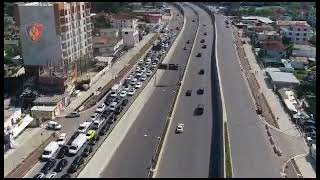
Kyiv's eight bridges across the wide Dnipro River link the western (right) and eastern (left) parts, and many of the capital's estimated three million residents rely heavily on the metro lines and trains to travel across the city.
Some 500,000 vehicles use the bridges every day.
The two struck bridges are still standing - but the damage and restrictions to traffic and public transport have caused gridlock in parts of the capital at times.
"To get from the left bank to the right one and back - it's just hell," Kyiv resident Roman told the BBC on Sunday.
Large numbers of commuters cross the river, especially on weekdays. Repair teams are working to fix the damage and officials say they are planning temporary pontoon bridges, ferry services and even a tunnel under the river to keep Kyiv connected.
Klitschko also said a separate Russian drone strike had damaged a heating main, adding that there would be a temporary lack of hot water in the north-eastern Desnyanskyi district as a result.
Ukrainian President Volodymyr Zelenksy said on Sunday morning Russian drones had also attacked a warehouse in the north-eastern region of Sumy, killing one person.
Meanwhile, in the central city of Dnipro, six people were injured after a communications facility was struck, he said.
Ukraine's Air Force said that overnight Russia had launched 135 drones, including 52 jet-powered ones. It said that 125 projectiles had been shot down.
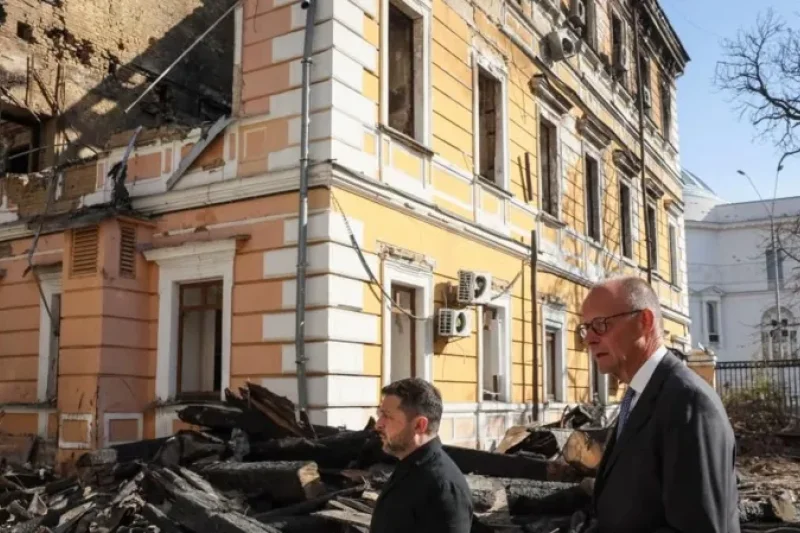
As emergency services responded to the incidents, Germany's Merz met Zelenksy in Kyiv. They laid wreaths to Ukrainian soldiers who have been killed in the war.
Merz reaffirmed his country's support for Ukraine, writing on X: "Ukraine is facing decisive weeks. That is why I travelled to Kyiv today with the message: You can rely on us.
"Germany's security also depends on the outcome of this war. That is why we are helping out of our own self-interest as well."
Zelensky later said that a new aid package worth more than €1.3bn (£1.1bn; $1.5bn) had been agreed with Germany.
"These are weapons that will help [us] right now, as well as support for our energy sector ahead of winter," he said.
As Merz was visiting Ukraine's Academy of Sciences building badly damaged in a Russian drone attack earlier this week, fresh air alert sirens were heard across the city. Two people were killed in that drone attack.
Since Merz became chancellor in May 2025, Germany has become the single largest donor to Ukraine.
He said the country "needs all our support in the coming weeks", adding: "If Russia is not stopped, its war machine will sooner or later turn against us."
Zelensky said there would be "important agreements" made between Ukraine and Germany.
The Ukrainian president has made repeated appeals for Western allies to provide more military support to the country, including supplying advanced interceptors that can shoot down new jet-powered Russian drones and also ballistic missiles.
The Russian defence ministry said on Sunday it would intensify its strikes across Ukraine in response to comments made by Zelensky earlier this week, in which he said Kyiv would ramp up its attacks on Russian oil refineries.
Russian President Vladimir Putin had earlier said his military was carrying out retaliatory attacks following Ukraine's strikes on Moscow's energy facilities, despite the fact that it was the Kremlin that had first launched such attacks.
Putin began a full-scale invasion of Ukraine in February 2022, and Moscow currently controls about 20% of Ukrainian territory.
The Russian foreign ministry on Saturday repeated a warning for foreign citizens, including diplomats, to leave Kyiv.
Responding to the warning, EU ambassador Katarína Mathernová wrote on X on Sunday: "The EU Delegation is staying. Threatening us will not stop Europe's support for Ukraine. It only reminds us why that support matters!"
German ambassador to Ukraine, Boris Ruge, reacted to Mathernova's post with: "Amen - we're staying".
Earlier attacks on the Pivdennyi Bridge prompted Kyiv's defence council to hold a crisis meeting on Friday.
Klitschko warned that the city was now in a "very dramatic situation" as Moscow was battering its "critical infrastructure, logistics, housing" and other key facilities.
Experts say Russian drones are unlikely to bring down the bridges - but repeated attacks will force their closure and risk weakening their structure, making them unusable.
(Source: BBC)