Lessons Albania Can Teach the World
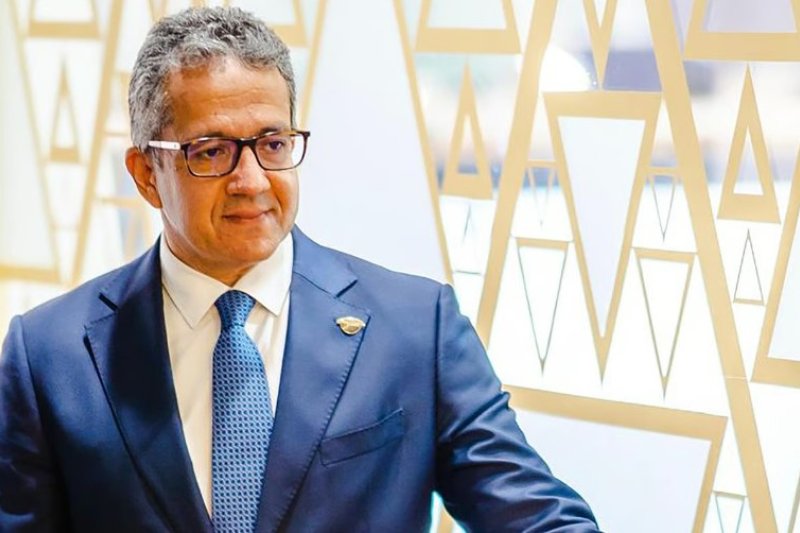
Dr Khaled El-Enany, former minister of Tourism and Antiquities in Egypt and candidate of Egypt, the League of Arab States and the African Union for the post of Director -General of UNESCO, visited the Albanian capital as part of his campaign for this important office. He met with top officials, including President Bajram Begaj, Speaker of Parliament Elisa Spiropali, and Education Minister Ogerta Manastirliu, to thank them for the support, and to present his vision for this key institution of the United Nations, which has recently given our country additional reasons to feel proud abut itself.
Albanian Daily News has the opportunity to conduct an interview on several topics with the distinguished visitor:
-Dr. El-Enany, you have visited over 60 countries since the start of your campaign. Why did you choose to come to Albania?
-Let me begin by expressing my sincere gratitude to the Albanian people and authorities for their warm welcome. It’s an honour to be here — in a country that, while small in size, carries an extraordinary richness of heritage, nature, and resilience.
This visit is part of a broader commitment I made at the very beginning of my campaign: to engage directly with Member States, on their soil, in their language, and with respect for their perspectives. I have travelled to over 60 countries — not to deliver speeches, but to listen. To engage in honest conversations. To better understand what Member States expect from UNESCO, and to explore how we can build solutions together and truly adapted to local contexts.
Coming to Albania today is also deeply symbolic. At a time when the international landscape is marked by fragmentation, polarization, and conflict — when differences are often exploited rather than respected — standing here, in a country where multiple religions and traditions have coexisted peacefully for centuries, is a powerful reminder of what is possible. Albania shows us that diversity does not have to mean division. It can mean dignity, dialogue, and shared identity.
I was particularly honoured to meet President Bajram Begaj during this visit. I was struck by our shared vision of multilateralism, one that is inclusive, principled, and responsive to the world’s most urgent challenges. I deeply admire Albania’s commitment to dialogue, peace, and regional cooperation. Its voluntary role towards the United Nations system, and its clear orientation toward openness and shared responsibility, reflect the kind of leadership we need more of today.
That is why I came. Not just to listen and to learn but to stand here, in a country where peaceful coexistence is not just an aspiration but a lived reality, and to say that this is the kind of message the world needs right now. If elected, I want UNESCO to carry that message with clarity and courage. To be a platform that elevates examples of harmony. And to ensure that every Member State, including those that are often less visible, sees itself reflected in the work, the values, and the future of the Organization.
-Your visit comes at a time when Albania is at the center of several debates about the preservation of its natural heritage and the development of tourism. What role do you see for UNESCO in supporting these transitions?
-This is one of the most critical transitions facing many countries today — and Albania is at the forefront of it. The country has seen an extraordinary surge in tourism over the past five years. It now welcomes more than 10 million visitors a year — nearly four times its population. That success is impressive, but it brings complex questions: how to grow responsibly? How to protect what makes Albania special, its heritage, its landscapes, its identity, while also embracing its place on the global tourism map?
I say this not just as a candidate, but as someone who has lived this dilemma firsthand. As Egypt’s former Minister of Tourism and Antiquities, I was responsible for both welcoming millions of visitors and protecting some of the world’s most fragile archaeological treasures. It required constant balance, constant negotiation, and above all, constant listening to local communities, to experts, to environmental realities.
In Albania, this means addressing the risks of uncontrolled development such as the pressure on the Vjosa delta or the cultural overload in historic sites like Berat while supporting efforts to create more sustainable models. It also means investing in people: in training, in heritage professions, in youth. Because what we preserve is not just stones and landscapes — it’s know-how, memory, and future opportunities.
I want to take this opportunity to salute Albania’s efforts to protect its natural heritage - in particular, its decision to propose the Vjosa River basin as a UNESCO Biosphere Reserve, and the creation of the world’s first Wild River National Park. These are not symbolic gestures. They reflect a strategic commitment to long-term conservation, grounded in science, community participation, and international cooperation.
I also commend Albania’s work with the United Nations Environment Programme to integrate biodiversity conservation into its tourism strategy. Through this partnership, Albania is showing that it is possible to reconcile ecological integrity and economic opportunity.
This is precisely the kind of concerted approach we need, where UNESCO, another UN agency (UNEP), and national governments work hand in hand to support transitions that are holistic, inclusive, and locally owned. I believe UNESCO has a crucial role to play, not in issuing directives from afar, but in helping countries design integrated strategies, foster dialogue between sectors, and adapt global standards to national ambitions.
UNESCO must be there not just as a standard-setter, but as a partner. A partner that listens, supports, and helps turn challenges into opportunities for the generations to come.
-Albania is a country marked by the coexistence of multiple religions and traditions. In your view, how is this model relevant for UNESCO and for building a culture of peace at the global level?
-What I see in Albania is deeply meaningful, not just for the country itself, but for the broader vision of peace and mutual understanding that UNESCO stands for. Albania’s history of interreligious coexistence is not just a matter of law or policy. It’s lived. Here, Muslims, Catholics and Orthodox Christians share the same cities, often the same families, and celebrate one another’s holidays. It is a living example of what tolerance can look like in everyday life.
This resonates with me on a very personal level. On January 10, 2020, I experienced a day that remains etched in my memory. That morning, I inaugurated the Al-Fath Mosque in Cairo after more than three years of restoration. That same afternoon, I traveled to Alexandria to visit Saint Mark’s Cathedral, the first seat of the Coptic Orthodox Church and a cornerstone of Christian history in Egypt and Africa. And before the day ended, I joined the reopening of the Eliyahu Hanavi Synagogue, one of the oldest and largest Jewish temples in the region.
That day, three religions, three communities, three histories all part of one national identity. For me, this is the essence of cultural heritage: it teaches us not just about the past, but about how to live together in the present.
UNESCO must do more to highlight these experiences not as exceptions, but as sources of strength. In a world where division is often amplified, places like Albania remind us that peaceful coexistence is not a dream. It is a practice, a culture, and a responsibility we must protect. And it is through heritage, education, and dialogue — the very pillars of UNESCO — that we can ensure it endures.
-The Balkans are a region deeply shaped by history and cultural intersections. In your view, how can Albania play a leading role in promoting intercultural dialogue within UNESCO?
-The Balkans are often described through the lens of their past — a history of empires, of transitions, and at times, of conflict. That history is real, and it continues to shape perceptions. But it would be a mistake to reduce the region to that alone. What we’re seeing today — and I’ve seen it clearly here in Albania — is a desire for openness. A readiness to engage more actively with the international community, to contribute, and to be seen as full partners in shaping global agendas.
This is where UNESCO, and the multilateral system more broadly, has a responsibility. These countries don’t ask for special treatment. But they do ask to be listened to. To have their realities acknowledged. And to be given the space to contribute not only as beneficiaries of international programmes, but as actors with ideas, with culture, and with something to say about peace, development, and education.
I believe the Organization must do more to integrate the voices of regions like the Balkans — not as a matter of balance, but as a matter of relevance. Because the future of multilateralism will depend on our ability to make space for all stories, not just the dominant ones.
-You come from a non-traditional background — tour guide, professor, museum director, minister. How has this shaped your approach to leadership within an institution as complex as UNESCO?
-What connects the different chapters of my professional life is a deep belief in people — in their capacity to learn, to preserve, to create meaning together. I began my journey as a tour guide, not in an office or a lecture hall, but in the streets, on archaeological sites, in dialogue with visitors. That experience taught me that proximity isn’t just a method — it’s a mindset. You cannot protect heritage or promote education without first understanding the people who live it, carry it, and transmit it.
Later, as Minister of Tourism and Antiquities, I had the honor of leading large-scale national initiatives, from major museum openings to international cooperation projects. Managing over 35,000 staff taught me that leadership is never about control — it’s about trust, clarity, and building coalitions. Success, in that context, depends on your ability to listen, to adapt, and to empower others.
I believe that UNESCO, as a global institution, needs that same grounded approach: one rooted in consultation, responsiveness, and shared responsibility. We often talk about impact — but impact only happens when programmes reflect the realities and priorities of those they are meant to serve. That’s why I believe leadership today must be less vertical, more dialogical, and relentlessly focused on implementation.
If I am entrusted with the role of Director-General, I will bring that spirit of collaboration and realism with me. In my first 100 days, I will initiate a cycle of direct conversations with every Member State — not to speak, but to listen. Only then can we build a roadmap that reflects the diversity of our shared mission and is ready to deliver — not in principle, but in practice.
That is the leadership I believe UNESCO needs: inclusive, pragmatic, and anchored in the lived experiences of the people it serves.
-What does it mean to you to make UNESCO a “field-based organization” — particularly in a context like Albania?
-Being a field-based organization is not just about geography — it’s about how we work, and more importantly, who we work for. It means placing Member States — all of them — at the very center of UNESCO’s priorities, not through abstract declarations, but through meaningful dialogue, co-creation, and shared responsibility.
Too often, programmes are designed far from the realities they are meant to address. In countries like Albania, where local heritage, environmental priorities, and community needs are closely intertwined, that distance can lead to missed opportunities. I believe we must reverse that logic. Start from the ground. Build from lived experience. And empower local voices to shape the Organization’s responses.
This calls for stronger, more agile UNESCO field offices — offices with the mandate, the resources, and the legitimacy to act as true bridges between Paris and the field. But it also calls for a cultural shift: one in which every Member State feels that UNESCO is not something distant, but something they help shape and something that belongs to them.
In a context like Albania, this means ensuring that the Organization listens more attentively and supports more flexibly. It means creating space for local knowledge, for national ambition, and for shared solutions. That, to me, is what a truly field-based UNESCO looks like.
-Finally, what message would you like to send to Albanian youth — artists, researchers, teachers — who are working to bring culture, science, and education to life in their country and beyond?
-My message to the youth of Albania is simple: your voice matters. Your creativity, your research, your teaching — they are not just national assets. They are part of a broader fabric of global progress and peace.
You are growing up at a time of profound uncertainty with war at the gates of Europe, climate change accelerating, and disinformation eroding public trust. But you are also growing up in a country that believes in its future, that draws strength from its culture, and that aspires to be a full part of the European and international community.
I want you to know that UNESCO sees you. That your knowledge, your questions, your innovations, your artistic expressions are central to what the Organization must stand for in the 21st century. Culture is not a luxury. Science is not abstract. Education is not just a system. They are tools of sovereignty, resilience, and hope.
If I have the honour of serving as Director-General, I will work to ensure that UNESCO becomes more open to your ideas and more connected to your ambitions. Because the future is not something we inherit. It’s something we co-author. And I believe that young Albanians — like so many of your generation — are ready to help write it. / ADN