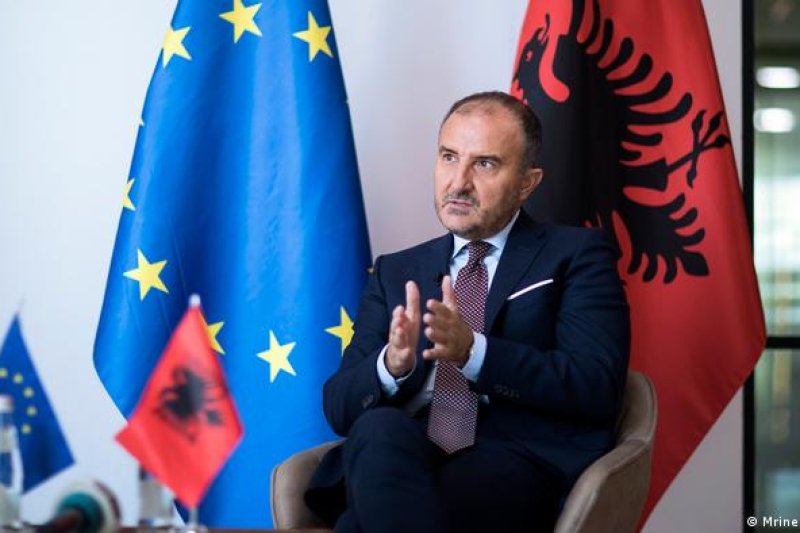
Soreca Suggest Significant Arrests Must Continue in Albania

The Ambassador of the EU Delegation to Albania, Luigi Soreca, emphasizes in an exclusive interview for Deutsche Welle that the EU membership process requires a credible history in the fight against corruption.
DW: Mr. Ambassador, the Albanian parliament recently voted to extend the vetting deadlines until 2024. In your view, is this postponement a failure or success of justice reform?
Soreca: Vetting institutions have closed over 500 vetting cases in the first instance, including all priority files, out of a total of 804 magistrates subject to vetting. Let me remind you that the vetting process consists of verifying the assets, training and professional qualifications of the appraised. Overall, more than 60% of the vetting files processed so far have resulted in dismissals or resignations. These figures speak for themselves and are the best proof that this process was absolutely necessary. The extension of the mandate of the vetting bodies was necessary for the regular continuation of the vetting process, a key pillar of justice reform. This has been confirmed by the opinion of the Venice Commission on this issue.
Therefore, the EU welcomed the approval by an overwhelming majority by the Albanian Parliament, on February 10, 2022, of the constitutional amendments for the extension of the mandate of the vetting bodies. Parliament showed strong cross-party determination to move forward towards EU accession. This was a crucial moment towards the completion of the justice reform and consequently for the future of Albania in the EU. It is now important that vetting bodies continue their work with the highest professionalism and integrity to ensure successful and rapid finalization of the process.
DW: Various actors of Albanian politics, but also the public opinion, continue to be skeptical when it comes to the results of the justice reform so far and are critical of the slow pace at which this reform is moving. Is the European Union satisfied with the work done so far, as a direct investor of this reform?
Soreca: The EU considers that justice reform, unanimously approved by parliament in July 2016, has produced generally good results, which are now becoming tangible.
Among the concrete results that the reform has brought so far, I would single out:
-Establishment of fully functioning independent justice institutions - eg, the High Judicial Council and the High Prosecutorial Council, the High Inspector of Justice, the -General Prosecutor's Office and the Special Structure against Corruption and Organized Crime (SPAK) which are yielding results every day.
-Criminal proceedings have been instituted against a number of former magistrates fired by the vetting, including former judges of the Supreme Court and the Constitutional Court.
-There has been an improved record of criminal assets seized and confiscated.
-There has been an increasing number of effective joint international investigations and police operations involving Albanian law enforcement authorities. This clearly shows the growing trust that law enforcement agencies in partner countries have in their Albanian counterparts.
-There have been several high-profile arrests by the SPAK.
-The Constitutional Court and the Supreme Court are also making important decisions.
-More than five years of reform have also shown its complexity. For example, the vetting process has mechanically resulted in staffing shortages, which have temporarily slowed down the administration of justice.
But while lessons must certainly be learned, the necessity and absolute legitimacy of this justice reform have been confirmed many times, especially by the Venice Commission and the European Court of Human Rights. We have already entered a new phase of consolidating justice reform. At this stage, the focus should be on completing justice reform and increasing the efficiency of the justice system, so that Albanian citizens can clearly see the improvements that the reform has brought. This will require consistency, competence and leadership skills from the new authorities and justice institutions. Last week's vote in parliament on extending the term of the vetting bodies is a strong indication that there is a strong political will to move forward on this path.
DW: A few days ago, the Special Court against Organized Crime and Corruption sentenced former Interior Minister Saimir Tahiri to 3.4 years in prison for the criminal offense of "abuse of office". Do you think this is a sufficient decision?
Soreca: We do not comment on ongoing proceedings in individual cases. However, I want to emphasize that looking at some of the recent decisions of courts and prosecutors, we see stronger independence of the judiciary and this is good news for the consolidation of justice reform.
DW: Croatia, a Western Balkan country and member of the EU since 2013, has proven that it took the fight against corruption seriously, a key priority for being part of the Union, handcuffing former Prime Minister Sanader. Do you think that there will be arrests of top politicians in Albania as well?
Soreca: As part of the accession process, candidate countries like Albania are required to establish a credible and consistent track record of investigating and prosecuting corruption cases, especially at high levels, and to ensure proper seizure and confiscation of criminal assets. This requires great effort and clear political will.
In Albania, the vetting of the judiciary and the establishment of a Special Structure against Corruption and Organized Crime (SPAK) are already yielding the first tangible results in the fight against corruption. We have seen several high-level arrests and convictions in recent months. These efforts must continue.
DW: Finally another question about the membership process. When will the Intergovernmental Conference be held and will Albania be separated from North Macedonia on its path to the EU?
Soreca: Albania has met and continues to meet each of the conditions for holding the first Intergovernmental Conference. The Council conclusions adopted by our member states in December 2021 recognize these achievements. The EU is determined to move forward with membership talks and I believe the first Intergovernmental Conference will be held this year as soon as possible.