KfW Offers EUR 50M for Water Supply, Sewage
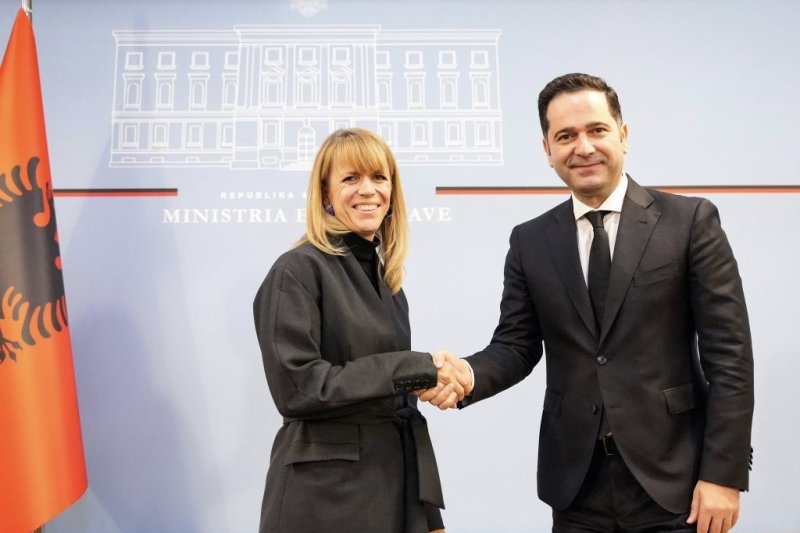
Minister of Finance, Petrit Malaj, held a meeting with the director of the KfW office, Mara Drochner, in which they signed the financing agreement for the “Municipal Infrastructure V – Phase II” Program.
The program provides for a loan of Euro 47 million and a grant of Euro 3 million, which will support investments in Shkodra, Lezha, and Saranda.
The funds will be used for the rehabilitation of sewage networks and the expansion of wastewater treatment plants. “This investment aims to improve drinking water service and environmental protection for these communities,” Minister Malaj emphasized in a post on social networks.
The Municipal Infrastructure V – Phase II is part of the "Water Sector Performance and Investment Programme" in Albania, a project financed by the Albanian Government, KfW (German Development Bank), the EU, and Switzerland.
This program, building on prior phases (I-IV), focuses on implementing priority investments in water supply, sewerage, and wastewater treatment infrastructure in up to 10 Albanian municipalities. The overall objective is to ensure sustainable access to safe drinking water, adequate sanitation, and improved performance of the water utilities.
The objective at the outcome level was to ensure a reliable, hygienically safe water supply at cost-covering and socially affordable prices and to guarantee acceptable residential hygiene through proper sanitation. At the impact level, the aim was to contribute to the efficient use of water as a resource, to environmental protection, and to improve the living, working, and health conditions of the population. The aim was to create a structural impact for the sector by professionalising the utility service providers (UKs).
At the time of the project proposal in 2011, improving Albania’s water and wastewater disposal was already one of the priority concerns of both the Albanian government and the international donor community. In addition to improvements in the living conditions of the Albanian population, progress in the sector is also of particular importance in terms of bringing the country up to the standards of the European Union.
Accordingly, the project was in line with the development policy objectives of both the Albanian and the German government, formalized by the priority area strategy paper adopted as part of the 2010 intergovernmental negotiations. In terms of content, the evaluated phase follows on from the first phase of the program. In the first phase, comparable investment measures were implemented at other locations in Albania.
According to an evaluation report by KfW, despite significant progress, the still insufficient economic efficiency is an obstacle to the further development of the UKs, which usually lack the opportunity to invest (or maintain their operations) from their own funds. The forthcoming reform may be able to achieve further professionalization and profitability in the sector by merging utilities into larger, supra-regional units.