
Modern China Through the Eyes of the Balkans
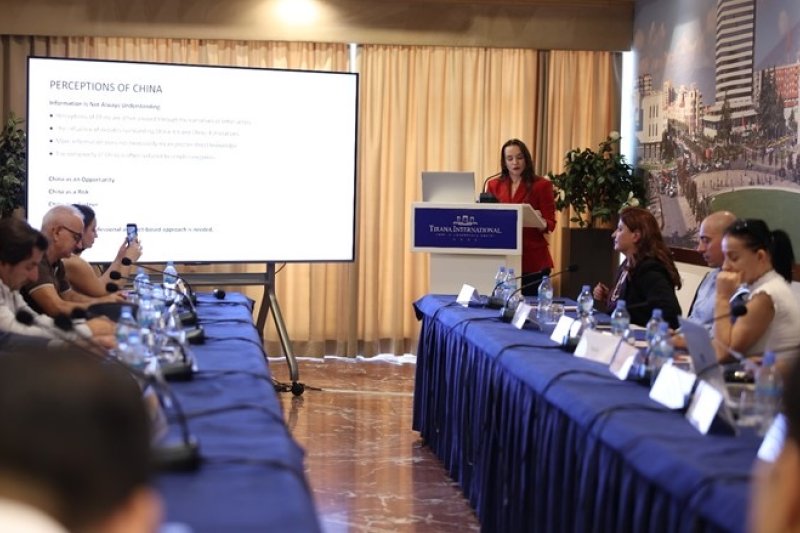
Academics, diplomats, researchers, and experts from Albania, China, Italy, and North Macedonia gathered in Tirana on September 18 for the international conference "Observing Contemporary China from the Balkans: Dialogue and Reflections." The event, also attended by Albanian Daily News’ chief editor Alqi Koçiko, aimed to discuss developments in modern-day China, the history of its relations with countries in the region, and new prospects for cooperation.
Discussions covered topics ranging from the history of China-Balkan relations and the role of information and narratives in shaping perceptions of China to political and economic developments, as well as opportunities and challenges for expanding cooperation amidst a transforming international order.
The conference was organized by the Albanian Institute for Globalization Studies (AIGS) and the Embassy of the People's Republic of China in Albania, with the online media outlet Argumentum.al covering the event as a media partner.
The forum brought together diverse perspectives—spanning the history of Albania-China relations and the perception of China within Balkan societies to academic cooperation, city-to-city diplomacy, artificial intelligence, digital sovereignty, and the dilemmas faced by small states amidst great-power rivalry. At the heart of the forum was an idea echoed in various forms by several speakers: China cannot be understood through a single narrative, and relations with the country cannot be built without understanding, dialogue, and expertise.
Opening the forum, Dr. Marsela Musabelliu, Executive Director of the Albanian Institute for Globalization Studies, emphasized the need for a more open discussion regarding contemporary China. According to her, this question is particularly relevant at a time when China is changing rapidly, while its relations with Europe, the global economy, and other international actors are simultaneously undergoing transformation.
She also touched upon several concepts China promotes in its international policy, including the idea of “a community with a shared future for mankind,” multilateralism, mutually beneficial cooperation, and opposition to the Cold War mentality. “How are these ideas understood here, in Europe and especially in the Western Balkans? How do they align with the way China is discussed and perceived in our societies?” asked Musabelliu.
Ambassador Pang Chunxue: China’s Four Initiatives in a Changing World
The forum was addressed by Ms. Pang Chunxue, Ambassador of the People's Republic of China to Tirana.
In her remarks, the ambassador focused on shifts in the international order, the growing role of Global South nations, and China’s approach to global developments.
Pang highlighted that the world is undergoing rapid change, while international uncertainty and risks have increased. According to her, the collective rise of Global South nations is a key factor driving the world’s shift toward multipolarity.
In this context, the ambassador presented four global initiatives launched by China:
• The Global Development Initiative, aimed—according to her—at addressing the development gap and promoting sustainable development;
• The Global Security Initiative, grounded in common, comprehensive, cooperative, and sustainable security;
• The Global Civilization Initiative, promoting dialogue among civilizations, respect for diversity, and mutual learning;
• The Global Governance Initiative, which, according to Beijing, aims to strengthen sovereign equality, the international rule of law, multilateralism, and cooperation.
Pang presented these initiatives as interconnected and as part of China's approach to changes in the international system.
At the conclusion of her remarks, she invited scholars and experts to continue the discussion on contemporary China, China-Albania relations, and cooperation between China and the Balkan countries.
Prof. Kong Fanjun: Perceptions of China in the Balkans are diverse
Prof. Kong Fanjun, a professor of International Relations at the School of International Studies at Peking University, focused on how China is perceived in the Balkan countries. Drawing on his experience from numerous trips to countries in the region, Prof. Kong highlighted the considerable plurality of attitudes toward China across academic, societal, and political circles. According to him, the knowledge and perceptions of China formed in the Balkans do not always reflect the complexity of the Chinese reality.
In this context, he noted that the perception of China can be a selective and, under certain circumstances, even instrumental process—particularly regarding how bilateral cooperative relations are constructed and interpreted.
However, according to Prof. Kong, this must also be viewed in relation to the complexity of China itself. He described China as a multidimensional phenomenon, emphasizing that its analysis cannot be reduced to a single dimension.
Prof. Liang Zhanjun: Four periods in Albania–China relations
Prof. Liang Zhanjun, History professor and Director of the Center for Global and Regional Studies at Capital Normal University in China, presented a historical overview of relations between Albania and China, categorizing them into four main periods.
The first period, 1949–1955, was characterized by the establishment and consolidation of diplomatic relations and the creation of the first institutional ties between the two countries, within the context of socialist solidarity.
The second period, 1955–1971, marked an intensification of Albanian-Chinese relations. Political, economic, and ideological cooperation developed against the backdrop of the Cold War and a context strongly defined by communist ideology. Relations between Tirana and Beijing assumed special importance in the foreign policy of both countries.
The third period, 1971–1978, marked the deterioration and eventual rupture of relations, alongside major shifts in Chinese foreign policy.
The fourth period, 1978–1990, according to Prof. Liang, was characterized by a cessation of cooperation while diplomatic relations were formally maintained.
Prof. Liang noted that the 1990s saw a renewed interest in re-establishing and developing Albanian-Chinese cooperation, a period marked by profound changes following the end of the Cold War.
Turning to the current situation, Prof. Liang described the Albania-China relationship as delicate and complex. In this context, he also cited public statements by the Albanian Prime Minister, who has spoken positively regarding the absence of Chinese investments in Albania.
According to Prof. Liang, this stance reflects a new reality in bilateral relations—one that, in his view, must be viewed against the backdrop of major geopolitical shifts and Albania's new foreign policy orientations.
Gianpaolo Camaggio: 40 years of friendship between Guangzhou and Bari
Prof. Gianpaolo Camaggio, Scientific Director of the Master’s Program in International Business in China at LUM – "Giuseppe Degennaro" University in Bari and founder of Sinoglobal Investments Advisory, presented a concrete example of relations between cities.
His topic was "Viewing China from the Perspective of Sister Cities: 40 Years of Friendship between Guangzhou and Bari." Camaggio focused on the 40th anniversary of the twinning relationship between the two cities, which began in 1986. Guangzhou and Bari share several characteristics: they are port cities, gateways to their respective countries, and important hubs for trade and international trade fairs.
However, according to Camaggio, for about three decades, the relationship remained largely limited to reciprocal visits.
The shift occurred when the Municipality of Bari adopted a more professional and sustainable approach, involving experts with knowledge of China and Chinese culture.
This paved the way for cooperation across universities, art academies, conservatories, theaters, and media outlets.
Camaggio emphasized that city-to-city relations can help overcome prejudices and mistrust, while also creating opportunities for economic cooperation that benefits local communities.
Dr. Ylber Marku: History is not merely the past
The discussion continued with Dr. Ylber Marku, a researcher at the Institute of History of the Academy of Sciences of Albania. His topic was "The Echoes of History in China–Southeast Europe Cooperation." He argued that the Albanian-Chinese relationship during the Cold War was a unique and asymmetric one, in which both sides held distinct yet intertwined interests.
Albania provided political support to China, while China offered Albania economic and military aid. One of the lessons Marku drew from this period was that asymmetry does not necessarily imply dependency.
According to him, even a small state can pursue its own interests, although its size limits its scope of action and makes strategic calculation all the more important.
Another key element was diversification. He noted that Albania can today develop economic and academic ties with China while simultaneously maintaining its European orientation and its relationships with the United States and other partners.
He also emphasized that contemporary relations need not be built on ideological affinity, but rather on concrete and enduring interests—citing the economy, education, academic research, culture, tourism, infrastructure, and diplomatic dialogue. In this context, Marku described mutual understanding as a strategic asset.
According to him, Albania needs specialists who study China not only through official statements but also through independent research and academic analysis.
"Academic exchanges should not be considered peripheral to bilateral relations," he argued.
Marjana Doda: Albania–China Relations in the New International Order
Marjana Doda, an international affairs analyst and expert on geopolitical developments, focused on Albania–China relations and new opportunities for cooperation amidst the changing international order.
In her presentation titled "China–Albania Relations in the New International Order: Perceptions, Challenges, and Opportunities," Doda addressed three dimensions: relations between the two countries, how China is perceived within Albanian society, and potential new opportunities.
"Today's China is vastly different from the China of the 1970s, the 1990s, or even the China of 2017," Doda said.
One of the questions she raised was whether Albania has fully leveraged the potential of its relationship with China. She referred to major Chinese economic and infrastructure initiatives, including the Belt and Road Initiative and the China–Central and Eastern Europe cooperation mechanisms. According to Doda, the potential of these relations remains partially untapped.
However, one of the most significant points of her address concerned the distinction between information and understanding. “Today, we have far more information about China, but that does not automatically mean we know China better,” was the essence of her argument.
Doda emphasized that the goal should not be to create a positive or negative image of China, but rather to foster conditions for a more informed understanding based on facts and evidence.
In this process, according to her, the media plays a crucial role. “Media cooperation is far more than just a mechanism for conveying messages; it can contribute to how societies understand one another,” Doda said.
“The challenge is not simply to bring China and Albania closer together. The challenge is to build a relationship that we know better, understand more clearly, and are able to develop on concrete foundations that are mutually beneficial," said Doda.
Ermir Hajdini: Artificial Intelligence and Digital Sovereignty
Moving beyond history and geopolitics, the forum turned to one of the most significant challenges of our time: technology. Dr. Ermir Hajdini, a cyber law strategist and technology policy advisor, presented a paper titled "The Cost of Denial: How Rationalizing the Decline of Hegemony Hinders Real Policy Reform."
Hajdini argued that the global digital order is undergoing a structural shift and that the development of artificial intelligence is creating new opportunities for middle-income and developing nations.
The discussion focused on the concept of digital sovereignty.
According to Hajdini, nations should not evaluate technologies solely based on their geopolitical origins, but also on cost, functionality, data control, and the capacity to manage them independently.
He also introduced the concept of "Digital Sovereignty as a Service"—a model allowing states to utilize technological infrastructure while retaining control over their own data and systems.
Regarding Albania and the Western Balkans, Hajdini highlighted a dilemma: on the one hand, European integration and alignment with the EU regulatory framework; on the other hand, the need to develop one's own technological capabilities.
According to him, merely passing laws on artificial intelligence is not enough; infrastructure, computing power, local expertise, and human resources are simultaneously required.
Hajdini also addressed the impact of artificial intelligence on the labor market.
In his view, public policies should aim for automation to boost productivity and empower workers, while simultaneously addressing the social consequences of technological transformation.
Marsela Musabelliu: Albania Facing Great Power Rivalry
At the conclusion of the forum, Dr. Marsela Musabelliu presented a paper titled "Deepening Cooperation Amidst and Despite the Spirit of the Times: Geopolitics, Politics, and People." She placed Albania within the context of an international system where great-power rivalry is becoming increasingly defining. "If you are not at the table, you are on the menu"—this was one of the phrases she used to describe the dilemma faced by small states.
Musabelliu referred to the concept of the "Lilliputian Dilemma," whereby small states seek relationships with great powers to increase their own influence, yet simultaneously face the risk of having their room for maneuver restricted.
Regarding the Albanian case, she focused on the weight that great powers have historically played in the country's developments and in the strong Euro-Atlantic orientation of its foreign policy.
However, according to her, changes in international relations seek to ensure that small states preserve their room for maneuver.
How is China perceived in Albania?
Musabelliu argued that the debate regarding China often centers on influence, security, economic dependence, and the concept of the "debt trap." Citing a national study involving over 1,800 respondents across 15 cities, Musabelliu noted that more than 62% of those surveyed held a positive view of China.
According to her, this perception has been shaped over decades through industrial projects, technical exchanges, education, historical memory, and people-to-people contacts.
For this reason, she argued that the Albanian perception of China cannot be explained solely through the lens of the current US-China rivalry.
Musabelliu also referred to the concept of "two chessboards" to describe the dimensions of the US-China rivalry. In such an environment, she noted, small states face pressure to position their policies vis-à-vis the great powers. Against this backdrop, she highlighted dialogue and patience as central elements of the Albania-China relationship.
"There is a long history between China and Albania; it cannot be cast aside, nor will it be," she stated.
Quoting former Australian Prime Minister and Sinologist Kevin Rudd, Musabelliu also cited the phrase: "China's superpower is patience."
On September 18, the Tirana Forum brought together history, diplomacy, geopolitics, economics, technology, and academia in a shared space. Above all, however, the discussion centered on a question that remains open: How should the Balkans understand 21st-century China?
From history to the future, and from state-level relations to people-to-people contacts, the forum’s message was clear: mutual understanding requires continuous dialogue, expertise, and the ability to look beyond ready-made narratives. It was a discussion aimed at better understanding the present and thinking more clearly about the future. /ADN