
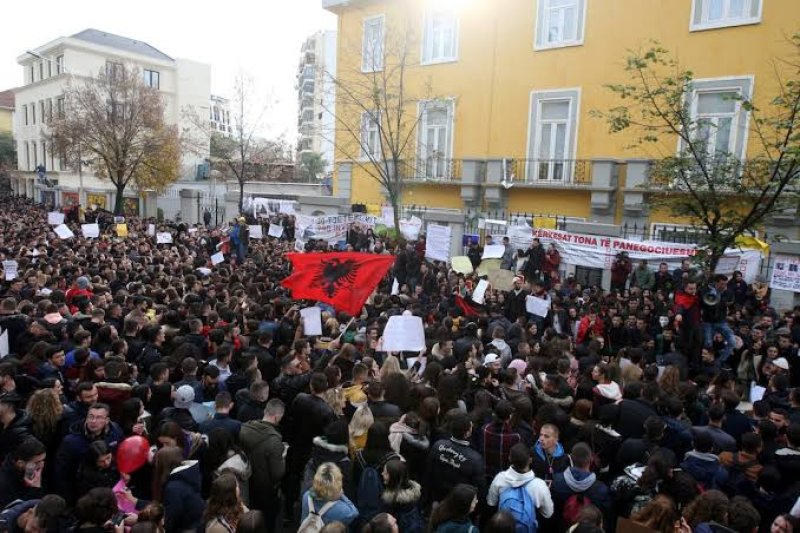
Tensions from Protests Boost Risks to Economy
Protests and social tensions have increased risks to the Albanian economy. In its fourth-quarter Monetary Policy Report, the Bank of Albania assesses that new information has shifted the balance of risks upward for inflation and downward for economic growth.
Prolonged or escalating geopolitical tensions, along with potential disruptions to energy supplies, could increase cost and price pressures. Furthermore, such developments could weaken economic activity in partner countries, thereby negatively affecting foreign demand. Meanwhile, within the domestic economy, social tensions represent an additional source of uncertainty.
The continuation or escalation of protests could undermine the confidence of consumers, businesses, and investors, influencing their decisions regarding consumption and investment. Depending on their duration and intensity, these developments could negatively impact economic activity, particularly within the tourism and services sectors.
At its November meeting, the Supervisory Council decided to keep the base interest rate unchanged at 2.5%. According to the Supervisory Council, this stance provides room to better assess the nature, intensity, and persistence of external shocks, as well as the impact of domestic uncertainties on economic activity and inflation.
In the third quarter of the year, average inflation reached 3.2%, up from 3% in the previous quarter, primarily reflecting increases in the prices of oil and unprocessed food products.
Conversely, a slowdown in rental inflation contributed to a moderation in core inflation - which fell to 2.8% in the third quarter - as well as a deceleration in headline inflation, from 3.4% in July to 2.9% in September. Meanwhile, the appreciation of the Lek has partially cushioned the pass-through of rising international prices to the domestic market, while medium-term inflation expectations remain anchored near the 3% target.
According to the Bank of Albania, external inflationary pressures have intensified due to geopolitical developments - specifically tensions in the Middle East and Russia’s war against Ukraine. Rising energy and raw material prices have exerted pressure on global inflation, affecting partner economies as well. Looking ahead, the Bank of Albania expects inflation to gradually converge toward the target, supported by the anticipated normalization of energy prices and supply chains, in line with signals from international markets. Meanwhile, a more balanced dynamic between demand and supply, alongside well-anchored inflation expectations, is expected to keep domestic inflationary pressures at levels consistent with the target.
Economic growth is expected to be driven primarily by domestic demand, bolstered by rising incomes, an expansion in lending, and favourable financing conditions. Furthermore, foreign demand is expected to continue supporting service exports. Overall, the Albanian economy is projected to grow near its potential, maintaining a stable balance between the expansion of economic activity and price stability.