'Resolutions Need Implementation'
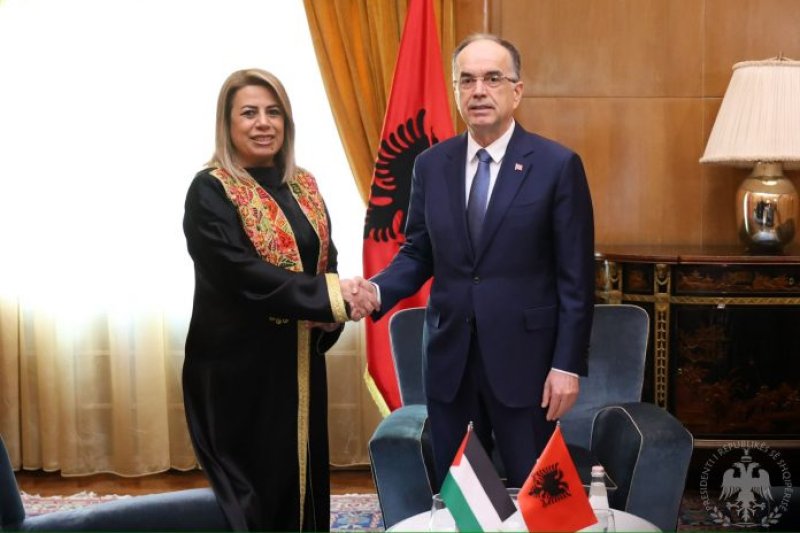
The new Ambassador of the State of Palestine to Tirana, Rana Abusibaa, has been on diplomatic duty for six months. During this time, she has been quite active, holding various meetings with government representatives and heads of state institutions. In our lengthy conversation, a summary of which is presented in the following interview, she focused particularly on the endless suffering of Palestinian civilians and children in Gaza, calling for it to end as soon as possible and for the implementation of the basic conditions for a return to normal life to begin.
“What happened to the Palestinian people in Gaza is genocide,” Ms Abusibaa emphasised. “We condemn violence against civilians of any nationality. The problem is that much of the world has stripped the situation of its historical context. History did not begin on October 7, 2023. Palestinian lives are no less valuable than any other human lives.”
Albania officially supports the two-state solution, the ambassador said, but as time passes and international pressure on Israel remains lacking, this solution becomes increasingly impossible to achieve.
“What happened in Gaza is being repeated in the West Bank, with violence, killings, and the eviction of Palestinians. Israel’s leaders have openly declared that they will not implement the two-state solution and aim to turn the territories where Palestinians live into enclaves disconnected from one another.
“Palestinians want to live in peace, in their own state and alongside Israel, to be able to work, raise their children, and dream. Not as they have until now, when they do not know what tomorrow will bring or whether they will still be alive. I do not think we are asking for too much,” Ambassador Rana Abusibaa declared.
-Madam Ambassador, first of all thank you for this conversation with Albanian Daily News. Could you tell us about your initial impressions of Albania, and how do you see the prospects for further strengthening relations between our two countries?
-My initial impressions of Albania are positive. I have great respect for Albanian people, their history, their cultural identity and their resilience.
I would like to stress, that the historical bonds between our two peoples provide a solid foundation for stronger and more meaningful partnership. As for relations between Palestine and Albania, we believe that there is a considerable potential to strengthen and expand our bilateral cooperation. At the same time, I believe that the strength of our historical friendship should be reflected more consistently in our political relations and in positions taken at the international level, particularly within the UN.
I hope that, during my mission, we will be able to build on our existing ties, deepen political dialogue, and to expand cooperation in areas such as culture, education, trade and tourism.
-Earlier this year, several countries-including the United Kingdom, Canada, Australia, and Portugal-announced their recognition of the State of Palestine followed by other Countries at the UN. How do you assess this development, particularly in light of the increasingly complex situation not only in Gaza but also in the West Bank?
-Recognition of the State of Palestine is extremely important, but must not be an end in itself. It must be accompanied by concrete measures to make such step meaningful and to preserve the viability of the two-state solution. In line with the Security Council resolution 233, this requires states to reject and prevent annexation and settlement expansion, distinguish in their relations between Israel and the Palestinian territory occupied since 1967, take effective measures against settlement expansion and settler terrorism, protect the Palestinian people and their institutions, ensure the release of Palestinian tax revenues, and support the Government of the State of Palestine in exercising its authority through the OPT. Accountability for genocide, war crimes, crimes against humanity and other violations of international law through credible, independent and effective international mechanisms. Concrete measures by states to ensure that they do not aid or assist internationally wrongful acts and that they fulfil their obligations under international law, including their obligations relating to the prevention of genocide and to respect and ensure respect for international humanitarian law.
-Looking beyond the immediate circumstances, what, in your view, would a sustainable and lasting peace look like for Israelis and Palestinians?
-Sustainable and lasting peace requires us to move from managing the conflict towards addressing its root cause, the unlawful occupation. This requires the implementation of the established framework of international law and the relevant United Nations resolutions including Security Council resolutions 242, 1515 and 2334, which affirm the inadmissibility of the acquisition of territory by force, the vision of two States living side by side in peace and security, the illegality of settlements, and the need to reverse the negative trends threatening the two-State solution.
We cannot speak of lasting peace while the occupation continues, settlement expansion, settler terrorism, annexation, and the Palestinian remain deprived from their inalienable rights, home demolitions, forced evictions, land confiscation and forcible displacement, and all measures intended to alter the demographic composition character and status of the Occupied Palestinian Territory (OPT), including East Jerusalem.
Lasting and just peace must be built on justice, equality, mutual respect and accountability under international law. It means freedom, sovereignty and the establishment of an independent Palestinian State on the 1967 borders with East Jerusalem as its capital.
Accountability and full implementation of international law, relevant UN resolutions, applicable binding orders of the international Court of Justice and the legal consequences arising from the Court’s Advisory opinion concerning Israel’s unlawful presence in the OPT.
-I would like to return to a question I have raised before. The Current situation followed Hamas’s attack on Israel and Israel’s subsequently military response. From your perspective, how do you assess the decision made by Hamas’s leadership at that time, and what do you believe were the main consideration behind them?
-We condemn and reject the targeting of civilians from all sides. Our position is clear and principled: all human lives are equally precious and no life is worth more than another. The problem is that much of the world has stripped the situation of its historical context. The history did not start on October 7, 2023. Palestinian lives are no less valuable than any other human lives.
The suffering of the Palestinian people did not begin on October 7, 2023. It is rooted in decades of occupation, dispossession, displacement, massacres, and systematic violations of their fundamental rights, including their inalienable right to self-determination.
The question to be asked in this regard is how to end the occupation and the Palestinian sufferings. This requires addressing the root causes of the conflict, ending the occupation, realizing the Palestinian people’s right to self-determination, and pursuing a credible political process leading to a just and lasting peace.
There are no shortages of political framework, the New York declaration, the President Trump’s Plan and the UN Security Council resolution 2803, those have established tangible steps towards Palestinian self-determination and independent statehood, peace and regional integration. What is missing is the implementation.
-Madam Ambassador, Palestinian President Mahmoud Abbas has announced that legislative elections will be held on November 28, which would be the first such vote in 20 years. What are your expectations regarding these elections, and what significance could they have for the Palestinian political landscape?
-I see these elections as an important opportunity for democratic renewal, strengthening our national institutions and restoring public confidence in the Palestinian political system. They provide an opportunity to renew political life, strength the pluralism and advance national unity. The elections must be held throughout the Palestinian Territory (the West Bank, The Gaza Strip and East Jerusalem).
In this regard, these elections must be part of a broader process of institutional reform. And we are doing reform. Reform is a Palestinian national interest and essential part of strengthening of the institutions of the State of Palestine. Consequently, the Palestinian government continues to implement a comprehensive reform program as a national priority.
Our reform agenda is comprehensive, structured and measurable, built around 4 pillars:
-Fiscal policy and public financial management
-Governance and the rule of law
-Investment and the business environment
-The provision of basic services
All that cannot be done without having enabling environment. The need to overcome Israeli restrictions affecting preparation, particularly in East Jerusalem.
There is a fundamental contradiction that our partners must address: Palestinian cannot be asked to build stronger institutions while Israel is permitted to systematically deprive those institutions of their revenues, jurisdiction, territorial access and ability to serve their people.
Reform and ending the occupation must therefore proceed together. Reform cannot become new precondition for indefinitely postponing Palestinian self-determination.
-How do you assess the role and position of Arab countries throughout the current conflict? Do you believe there is greater scope for them to contribute to diplomatic efforts toward a resolution?
-Arab countries have played an important role in supporting the Palestinian cause, particularly through diplomatic engagement, humanitarian assistance, mediation efforts and mobilizing international support for an end to the war and the realization of Palestinian Statehood. Palestinian leadership has consistently expressed its appreciation for these efforts, particularly those of Egypt, Qatar, Jordan as well as the broader Arab diplomatic role led by Saudi Arabia. We commend Saudi Arabia’s Leadership alongside France in convening the International Conference that led to the New York declaration. This initiative helped strengthen the international consensus around the two-state solution and the establishment of an independent Palestinian state. We welcomed these efforts as an important step towards ending the war, ending the occupation and realizing the legitimate national rights of the Palestinian people.
This international momentum culminated in the convening of the High-Level International Conference on the Peaceful Settlement of the Question of Palestine and the Implementation of the Two-State Solution, held at the level of foreign ministers in July and subsequently at the level of heads of state and government and other leaders in September, under the co-chairmanship of the Kingdom of Saudi Arabia and the French Republic. A further milestone was the adoption by the United Nations General Assembly of the New York Declaration, which outlined concrete and irreversible steps towards the establishment of an independent and sovereign State of Palestine and the realization of a just, lasting and comprehensive peace in the region.
The efforts undertaken by the Arab-Islamic Committee, under the chairmanship of the Kingdom of Saudi Arabia, marked the beginning of a broad-based international mobilization. These efforts helped lay the groundwork for the formation of an international coalition dedicated to advancing the implementation of the two-state solution.
The convening of the Conference was accompanied by a wave of international recognitions of the State of Palestine, as well as the adoption by a significant number of countries of concrete measures aimed at bringing an end to the aggression against our people and ending the Israeli occupation of our land.
The genuine efforts undertaken by the United States, Board of Peace and the mediators to secure a cease fire in the Gaza Strip.
Egypt and Jordan have consistently upheld a firm and unequivocal position in support of the Palestinian cause and the legitimate rights of the Palestinian people, foremost among them their right to establish an independent Palestinian State along the 4 June 1967 borders, with East Jerusalem as its capital. The steadfast positions of both (Egypt and Jordan) have constituted a strong safeguard against any attempts to forcibly displace the Palestinian people or the erasure of the Palestinian Cause.
In this context, we must underscore Egypt’s pivotal role, which it has played and continue to play, in supporting efforts to achieve Palestinian reconciliation and foster consensus among the Palestinian factions. The historic Hashemite Custodianship over Islamic and Christian holy sites.
In conclusion:
The role of the Arab Countries is important in continuing their diplomatic efforts, mobilizing international support, supporting the Palestinian government and institutions, ensuring the reconstruction of Gaza and taking effective measures to uphold international law and prevent the erosion of the two-state solution, and advancing a credible political process towards ending the Israeli occupation and realizing the two-state solution in accordance with International law, relevant UN resolutions and the Arab Peace Initiative.
-Finally, how would you assess the current state of relations between Albania and Palestine, and what priorities would you like to pursue during your diplomatic mission in Albania? What contribution would you hope to make toward further strengthening the relationship between our two countries?
-I would describe Palestinian-Albanian relations as relations with a longstanding foundation of friendship and mutual respect. We appreciate Albania’s historical ties with Palestine and its support for the two-state solution. This support must be accompanied by concrete measures to preserve the viability of the two-state solution in line with the Security Council resolution 2334, this requires to reject and prevent annexation and settlement expansion, take effective measures against settlement expansion, settler violence, protect Palestinian people and their institutions, ensure the release of Palestinian tax revenues, and support the government of the State of Palestine in exercising its authority through the OPT.
At the same time, I would like to give greater substance to our bilateral relations by promoting economic and trade cooperation, exploring opportunities for tourism and investment, and strengthening cultural, educational and institutional exchanges.
Ultimately, I see my mission as an opportunity to build on the positive foundation that already exist.
/Albanian Daily News