Agricultural Products' Exporters Going Bankrupt due to EUR's Depreciation
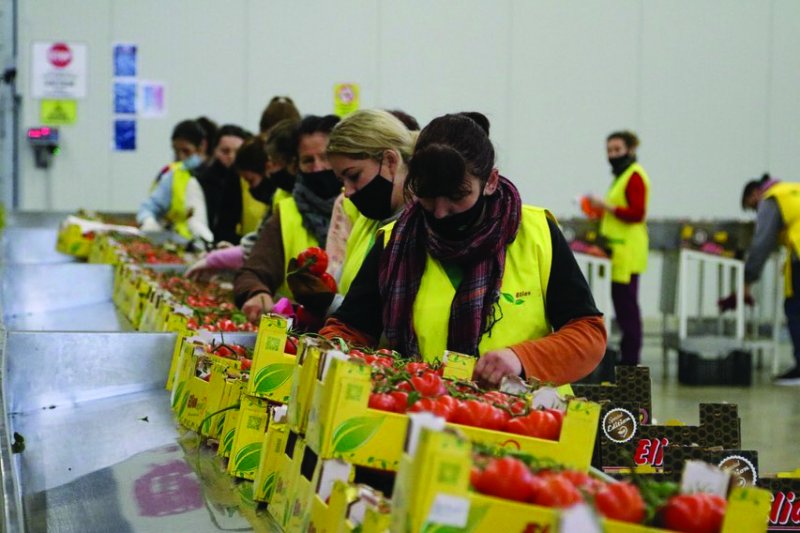
Lack of products due to bad weather in the countries of the region has resulted in higher prices this year for Albanian agricultural products, but exporters are facing high losses from the exchange rate.
"Export companies are in a big crisis because of the exchange rate. Almost 30% of exporters have gone bankrupt," said Laurat Mulliqi, Chairman of the Association of Agricultural Products Exporters.
He said that farmers are paid with daily prices, while payments from subcontractors abroad are made almost 45 days late.
"Here, the euro is falling day by day and from the export of goods to the collection of invoices, the losses are very high", he said. When the season started, the Euro was 117 ALL, while today it is 102 ALL, as the decline continues.
Exporters of agricultural products show that they are the most vulnerable part of the export chain and are often prey to prejudices and work in a high-risk sector, dependent on the quantities of production and its quality.
Last year, the average exchange rate of the Euro with the Lek was 118.9 ALL, while on July 21 it was 100.9 ALL, with a downward trend.
On the other hand, importers are profiting tirelessly only from changes in the exchange rate. Economic logic dictates that gains from the exchange rate should translate into cheaper prices in domestic markets.
The history of these 30 years of transition has shown that the Albanian market is inelastic in terms of the transmission of the exchange rate to the downward side of prices. Prices in retail items are staying high with measurable reductions only for some food products than oil and flour while for others they are the same.
Exporters are concerned that the Albanian economy is becoming increasingly uncompetitive for the manufacturing sector.
Exporters' losses due to the exchange rate have become stable, as the decline continues at a high rate from year to year. In the spring of 2016, 1 euro cost about 140 ALL.
Since that time, the euro has depreciated against the Lek by 40 Lek or 28%. To this extent, the income of exporters has also fallen.
Albanian agricultural products are strengthening their links with the market from year to year, but the lack of subsidies and loans for current farms is reducing the sector's potential for higher benefits.
Currently, subsidies from the state budget for support for seeds/seedlings and other inputs are worth up to 200,000 ALL per ha per season and not for more than 2 seasons, for the cultivation of vegetables, table grapes in greenhouses and/or strawberries planted area not less than 1 (one) ha and not more than 1.5 million ALL per applicant.
However, these conditions exclude the majority of farmers since they have less than one hectare of greenhouse area.
Internal budget funds are very low. Official data from the Ministry of Agriculture show that in the first 4 months of 2023, in the program of "Rural Development supporting Agricultural, Livestock, Agroindustrial and Marketing production, products with an actual cost of 396 million ALL (3.5 million euros) were realized .
This amount, which also includes subsidies to farmers, was used to draft the legal basis for the support measures of the Agriculture and Rural Development Program.
The Ministry of Agriculture explained that in the first four months of this year, a total of 68,657 applicants applied, of which 54,691 applied for the oil support scheme for agriculture, and 13,966 applied for national support measures.
The largest number of applications with around 62% is observed for livestock measures, followed by support for beekeeping with 28%.
"The IPARD II program is in the phase of completing the evaluation and disbursement of applications. Currently, 25 contracts have been disbursed. After the approval of IPARD III, the work on the accreditation of the measures has begun," explained the Ministry of Agriculture.
Meanwhile, an investigation by the European Commission through the anti-corruption office (OLAF) found irregularities in the use of funds and suspended their disbursement.
Studies show that Albania has very low support with agricultural subsidies. But even the few funds that are given suffer from a high level of corruption and are not helping the agricultural production sector.
Access to finance is a major obstacle for farmers, especially small farmers, who are conditioned by the lack of collateral to be financed by banks.
Loans are mainly provided by microfinance institutions that offer very high interest rates. Another big problem is the lack of agricultural insurance for farmers.
Lack of insurance creates risks for business. A large operator, who is also a large point-of-sale producer, despite high profits, stated that he was willing to sell his business if he could, as he felt constantly threatened by climate change and risks the other carried by the sector.
A relatively large farm, having up to 25 ha of vegetable land, producing under contract to a processor was bankrupted by floods and later by drought despite being very profitable.
(Source: Monitor)