Albania’s Challenges in Waste Services
In recent years, municipalities across Albania have increasingly turned to public enterprises to deliver essential services, acknowledging their potential to support local development. These enterprises are entrusted with responsibilities ranging from urban waste management and public transportation to local markets, sports facilities, and public lighting. As Albania undergoes profound institutional reforms, local public enterprises (LPEs), particularly those responsible for waste management, operate in a fragmented legal and operational landscape. In contrast, European Union (EU) member states such as Germany and France offer more mature and legally consolidated models, where public enterprises are structured for efficiency, transparency, and accountability. Unlike commercial private-sector companies, LPEs are driven by public interest rather than profit. Their primary mission is not revenue generation but the delivery of quality services for citizens. However, balancing public service obligations with operational sustainability remains one of their core challenges. Too often, the lack of profitability undermines their long-term efficiency, while insufficient regulation weakens public trust.
The Public vs. Private Dilemma in Waste Management
Currently, the data from the Agency for the Support of Local Self-Government (AMVV) indicate that around 54 LPEs operate in Albania as commercial entities wholly owned by municipalities. These entities cover a broad range of services, including agriculture, market regulation, parking administration, and urban waste. In many cases, municipalities co-own enterprises, particularly in the water and sanitation sectors, or for managing infrastructure like the Maliq landfill or the Elbasan incinerator.
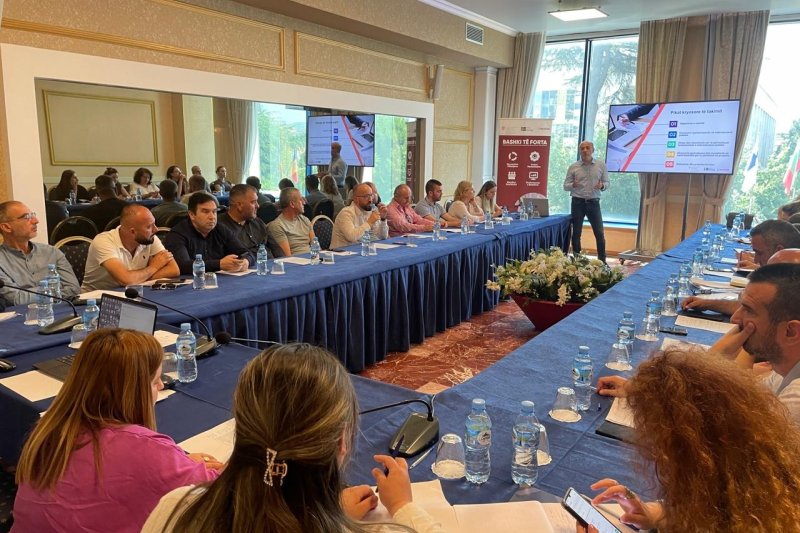
To better understand these challenges, ‘Bashki të Forta’, a project of the Swiss Agency for Development and Cooperation (SDC) and Government of Sweden, implemented by Helvetas, held a roundtable discussion with municipalities and local public enterprises managing waste services. The event came at a time when debates on the effectiveness of LPEs and the need for legal reform are increasingly urgent.
Figure 1 Municipalities that participated in the online survey
Feeding the national dialogue, Bashki të Forta also launched an online questionnaire to assess the operational reality of LPEs engaged in waste management. Findings showed that 62.5% of the LPEs were established by municipal council decisions, functioning as autonomous municipal entities, while 37.5% operate as internal municipal departments. The number of employees varied significantly, from 5 to 65 in municipalities with in-house departments, and from 19 to 274 in those with fully structured LPEs.
According to the 2024 AMVV report “Municipal Performance Indicators: A Decade of Transformation Post Territorial Reform,” municipalities using outsourced services (subcontracting) for waste management performed better than those relying solely on public service delivery, both in terms of coverage and cost recovery. This was largely attributed to the greater technical expertise and operational capacity of the private sector.
Legal Inconsistencies and Accountability Challenges
Albania’s legislative framework for LPEs is primarily governed by the Law on Local Self-Government and the Law on Commercial Companies. Municipalities employ various formats for organizing waste services, including administrative units, budgetary departments, limited liability companies (sh.a./sh.p.k.), and public-private partnerships (PPPs). Some units operate informally without a tax identification number (NIPT), while others function as commercial companies under unclear accountability frameworks. This inconsistency complicates oversight and weakens service delivery. The problem becomes particularly acute when companies intended to function commercially, such as sh.a./sh.p.k., are expected to deliver universally accessible services like waste collection. The tension between public obligations and commercial logic undermines quality, pricing transparency, and service coverage. Many municipalities that provide their waste management services believe that the municipality knows better the service provision and, thanks to the public form of provision, it has more control over it, flexibility, and is open to innovations and piloting compared to the private sector. Schemes related to the application of circular economy concepts, such as source separation, composting, or recycling, are hindered by the private sector, as it is more focused on ensuring rigorous contract implementation and does not show caution and has no incentives towards these practices.
Transparency and Performance Gaps
Another critical issue is the lack of transparency. Many enterprises do not publish financial data, service coverage rates, or environmental performance metrics. External audits are rare, and the appointment of managers is often politically influenced. In several cases, LPEs function more like clientelist structures than professional public service providers. Despite these issues, municipal staff continue to express a strong preference for public service delivery under municipal control. According to the survey, 63% rated their enterprise’s performance as “good,” while 87% reported having a “very good” or “good” relationship between municipality and public enterprises. However, this confidence is not always reflected in outcomes. Investments remain limited, operational planning is often reactive, and service quality falls short of EU standards. Moreover, many LPEs lack the legal and financial standing to apply for international grants or donor assistance. Of the 24 municipalities surveyed, only 54% had an internal procedure for monitoring and reporting on service performance. Alarmingly, 21% had no performance tracking mechanism in place at all.
In terms of public engagement and transparency, 79% of the surveyed enterprises had no digital platform for communication, and very few had initiated any waste separation at source.
To improve this situation, Albania needs an open and professional discussion on whether we need or not a new dedicated legal framework that clearly defines the roles, governance, and reporting obligations of LPEs, which could standardize organizational models, enhance inter-municipal cooperation, and allow enterprises to access external funding opportunities. Waste management affects more than just city services. It impacts the environment, people’s health, and public trust. Albania’s public enterprises can play a transformative role in this sector, but only if empowered by clear mandates, competent management, and robust public oversight. /ADN
*Arben Kopliku is solid waste management expert; Dr. Valbona Karakaçi is BtF strategic advisor