Europol Supports Takedown of Cocaine Trafficking Network Linked to Los Lobos Cartel
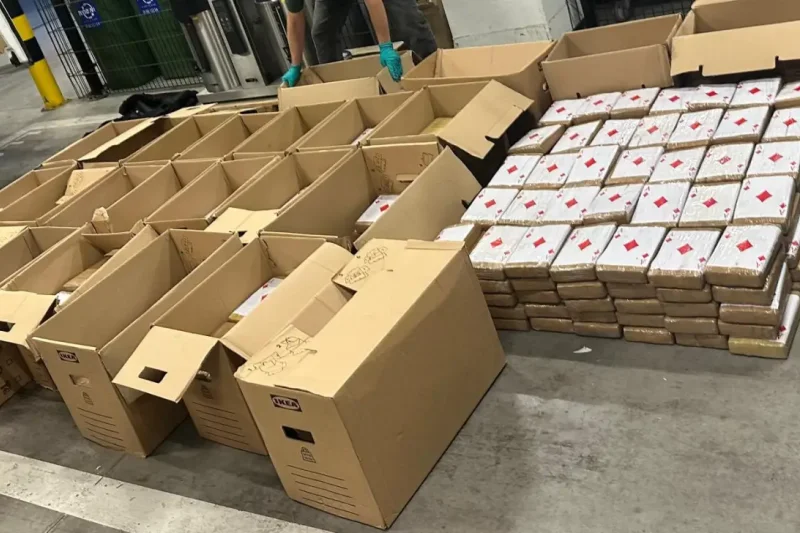
Europol supported law enforcement authorities from Belgium, Ecuador, and the Netherlands in dismantling a large-scale international drug trafficking network linked to the Ecuadorian ‘Los Lobos’ cartel. The investigation, which started in January 2025, resulted in the arrest of 16 suspects - including a high-value target (HVT) - and the disruption of a complex money laundering and corruption scheme. Authorities cited four more suspects for questioning at a later stage. More than 100 police officers were involved in the action together with 40 representatives of the judicial authorities.Leading up to this action day, around four tonnes of cocaine were seized by law enforcement on several occasions:
- 572 kilograms in Ecuador;
- 2.6 tonnes in February 2025 in Vlissingen, the Netherlands;
- 1.1 tonnes on 2 June 2025 in Rotterdam, the Netherlands;
- 3.165 tonnes in Belgium.
Overall, today’s action day led to the following results:
- 16 persons arrested;
- 4 cited for questioning;
- 26 house searches;
- 4 hand guns and 2 rifles seized;
- USD 810 000 in cash seized;
- several vehicles seized.
The investigation was led by Ecuador (Unidad Nacional de Investigación de Sustancias Químicas) and supported by Europol, Belgian and Dutch law enforcement authorities as well as the U.S. Drug Enforcement Administration (Guayaquil Resident Office, The Hague Country Office, and Bucharest Country Office).
Together, the authorities targeted an Ecuadorian criminal network led by a person considered a HVT and operating out of Guayaquil and Machala. It was responsible for the large-scale trafficking of cocaine to Europe, using fruit-exporting companies as cover for their illicit activities. The drugs were concealed within legitimate export cargo, particularly refrigerated fruit containers, and strategically positioned within other shipments to evade detection.
Alerts on suspicious containers
Ecuadorian authorities, with the support of Europol, issued multiple alerts regarding suspicious containers en route to Europe. These warnings led to targeted inspections and seizures at the ports of Vlissingen in February 2025 (approximately 2 600 kilograms) and Rotterdam on 2 June 2025 (approximately 1 100 kilograms) in the Netherlands as well as surveillance and searches in Belgium. In total, 18 house searches, 17 vehicle seizures, and three company searches were conducted as part of the operation.
The investigation revealed that the Ecuadorian network was cooperating with an Albanian drug trafficking organisation, with members travelling to Ecuador to negotiate deals and secure large-scale shipments. The cocaine entered an extensive logistical network upon arrival in Europe, with the shipments rapidly divided, transported inland, and distributed across multiple countries.
Europol as information hub
Europol played a decisive role in the operation, providing analytical support and facilitating the exchange of intelligence and investigative data. The Agency’s support included coordination of operational meetings as well as deployment of staff to the operation's command centre in Guayaquil.
A dedicated Operational Task Force (OTF) hosted by Europol fosters multi-agency collaboration and ensures smooth progress across jurisdictions. It’s focus lies on disrupting criminal networks involved in cocaine trafficking between Latin America and Europe.
The Global Drug Intelligence Network (GDIN) project, led by Spain's Guardia Civil with the support of Portugal's Polícia Judiciária and funded by the European Union, also played a crucial role in the operation. The project aims to reduce illicit drug trafficking towards the EU and dismantle drug trafficking organised crime networks.
The operation is part of Europol's ongoing efforts to combat large-scale international cocaine trafficking and to disrupt the activities of organised crime groups. A recent Europol report titled ‘Diversification in Maritime Cocaine Trafficking Modi Operandi ’ shows that organised crime networks are increasingly adapting to law enforcement pressure by using more complex maritime routes, smaller ports, at-sea transfers and sophisticated concealment methods to traffic cocaine into Europe. These findings underscore the need for strengthened international cooperation to detect and disrupt these evolving tactics.