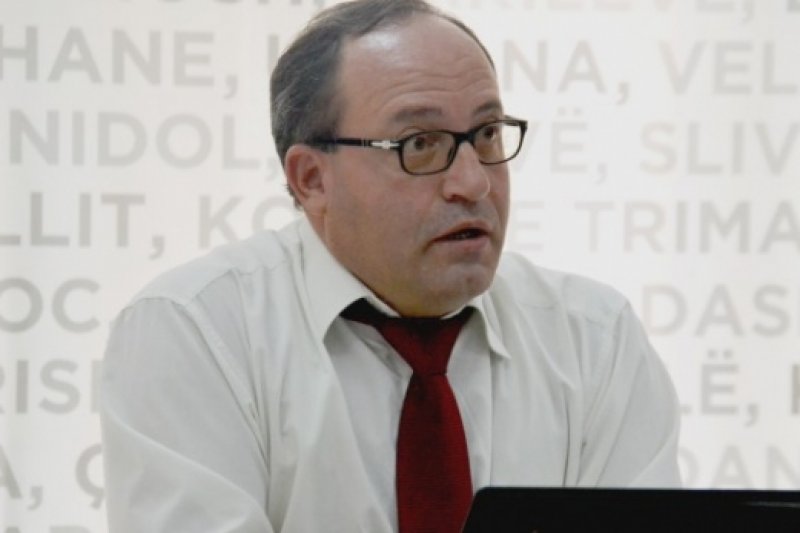
Ramabaja: My Truth about ‘People’s Eye’
Almakos.com carried out an interview with Professor Sadri Ramabaja, who spoke about the challenges in his life, the current political situation in Kosovo and other important issues.
ALMAKOS: Professor Ramabaja after 3 years of imprisonment on serious charges as part of a terrorist group, plan to assassinate the highest leaders of Kosovo politics and as the brain of the organization People’s Eye, you have been released while the trial against you continues, can you tell us after 3 years what is your opinion about all this story?
Ramabaja: First, our new Republic did not need a story of this nature at all. But, unfortunately, its ochlocrats needed court spectacles and mega histories with tragicomic elements, which in many ways are reminiscent of the Stalin era. The process against me as a whole was mounted, it was politically motivated and remains so. The Court of Appeals, having found that with its judgment, the Basic Court of Prishtina has violated the criminal procedure, on the one hand, while, on the other hand, has found that the judgment is not based on evidence and facts has returned the case for retrial.
The soap opera “People’s Eye†continues. It seems to go on for as long as this caste of ochlocrats will be at the head of the Republic.
ALMAKOS: It is clear that your position in Vetevendosje (Self-Determination Party) may have had a political impact on the accusations, but on the other hand you can not deny that with some of these political members in question you have had old friendships and acquaintances, what happened between you?
Ramabaja: Since Plato's theory of the state, there is also the hypothesis that any form of government can take on one of two qualities intertwined with political vision: One that is oriented towards the pursuit of prosperity and the other that is based exclusively on the interests of rulers. The ruling caste in the Republic of Kosovo, no matter how formally it has accepted the principles of a democratic society, it has constantly diligently served to deepen the extreme polarization and, instead of compromises and debate, has imposed only its will. In this case we are dealing with the second sign of democracy: what the Greek historian Polybius (200 to 120 BC) described as OCHLOCRACY - government by the mob.
In Kosovo, the debris of society de facto rule. It is true that i knew some of these ochlocrats while I was an illegal activist, a member of the People's Movement for the Republic of Kosovo; respectively as one of the participants in its founding Meeting (1987).
In that organization in 1986/87, when I was released from prison, I was even the de facto coordinator of the dispersed illegal structures at the level of Kosovo and the Albanian areas in the former Yugoslavia. Upon fleeing to Switzerland, I went to the editorial office of "Zeri i Kosoves", the only clandestine newspaper at that time that continued to be a light in the information darkness of Kosovo.
Let me say on this occasion, a fact that I have learned in the meantime, one of the ‘screenwriters ‘for my imprisonment was exactly the former editor-in-chief of “Zeri i Kosoves", recently a quasi-diplomat in Switzerland!
However, the complete script and the whole drama with pronounced elements of Shakespearean tragedies have been written in the Office of the President of the Republic. The main motive was political revenge against me, as editor of Murat Jashari's book "The Unfinished War" and the intention to associate the “People’s Eye“, which is turning out to be an organization run by Kosovo Intelligence Service, alias Democratic Party of Kosovo, with the Self-Determination Movement !
ALMAKOS: During the process against you, you asked many politicians to testify, who were they and why this strategy was chosen.
Ramabaja: Yes, that's right, I had listed a full 19 defense witnesses in the list I had submitted to the Trial Panel. At the top of the list was Ramush Haradinaj, then prime minister, followed by Ahmet Isufi, chairman of the AAK parliamentary group and continued with Hydajet Hyseni, Bardhyl Mahmuti, etc.
Let me remind you of an absurd fact. The Prosecution had summoned 47 witnesses, among whom were: the President of the Republic (Hashim Thaci), then the Speaker of Parliament (Kadri Veseli), the Deputy Speaker of Parliament (Xhavit Haliti), the chairman of the PDK parliamentary group (Elmi Recica ), former Minister of Finance and former Chairman of the Parliamentary Group of PDK, Adem Graboci, former Minister of Justice (Hajredin Kuci) etc. The entire State Nomenclature on December 28, 2018 had landed in room no. 17 of the Basic Court of Prishtina, accompanied by their advisors and the powerful escort of the Police Unit for rapid intervention.
It was felt a tense atmosphere of state terror in the whole space of the Court, in the corridors and the hall.
Aware that I was dealing with a very dangerous scenario, I was determined to call witnesses all those of my former friends (with Ahmet Isufi for example and Nuhi Berisha, now the hero of Kosovo, I was in the first illegal cell - 1981), but also others with whom during the war and after it, I had to work either within the editorial office of the ‘Zeri i Kosoves’, in the Office of the Prime Minister as I was Senior Political Officer ( 2004-2006), but also work colleagues at the Universities where I lectured (2008-20017).
The court was aware that if it allowed the defense witnesses to come, that is, my witnesses, together with my word, we would overturn the process, turning it into a real trial for SHIK leaders, who have been holding the Republic hostage for 20 years now, disallowed this strategy of action, hindering my witnesses.
ALMAKOS: 3 years have passed and the process continues, how do you expect the continuation of this process and how long will it continue?
Ramabaja: The justice system in Kosovo, as well as the whole Republic, has been captured by this handful of ochlocrats.
The process has been deliberately delayed and only because of me. The court, aware that there is a lack of evidence to convict me, initially delayed the hearings beyond the legal deadlines provided by the Code of Criminal Procedure, then the ruling and the judgment of the Court of Appeals.
Aware that I am a hostage of state terror, in my first exhibition I called on the US Embassy and the EU, respectively its mission in Kosovo - EULEX, to follow the process, as I was clear that what awaits me.
The process, as I stated, is a political issue, consequently its continuation will depend on the course of political events.
I am convinced that, if VV in the parliamentary elections of October 6, 2019 would not have the result it had, in January 2020 the arrest of Albin Kurti, Glauk Konjufca, Xhelal Sfecla, Albulena Haxhiu and a considerable number of activists of VV would follow. Let me remind your respected readers of a fact. In the session of December 28, 2018, Hashim Thaci had extended his lawsuit, accusing me, Albin Kurti and Glauk Konjufca as the founder and trailblazer of the “People’s Eye“!
That day he made it clear what he intended to do. In any case, the leaders of this gang, known by the acronym sometimes as PDK and sometimes as SHIK, wanted to declare Vetevendosje Movement as an illegal organization, as they were aware that only VV could endanger their power.
ALMAKOS: Prof. Ramabaja, Kosovo is already facing the Special Tribunal, can you give us your opinion on this tribunal while VV has been against the establishment of this Tribunal and why do you connect the establishment of this tribunal with the case against you?
Ramabaja: On 2 and 3 May 1998 the famous four: Xhavit Haliti, Azem Syla, Hashim Thaci and Kadri Veseli, of course assisted by their many vassals, had exercised a partial coup within the People's Movement of Kosovo (LPK), while a full one within the KLA.
The rise of this gang at the head of the KLA has a specific history that is related to the French military service, but also to other services, which in the meantime are becoming more and more clear.
This march of these puppets has not passed without blood. One of the first to suffer in this fierce political battle was my friend Behadin Hallaqi, the former political leader of the LPK in Kosovo (1992-1998).
For your readers, let me also bring a characteristic clue about Behadin. He was a passionate researcher of sociology, had completed postgraduate studies at the University of Zagreb in the field of Sociology. He was a close friend of Professor Ukshin Hoti. He visited me twice illegally in 1990 and 1991 in Basel, Switzerland.
Eyewitnesses of his arrest by a KLA Military Police unit, of course by order from above, in May 1998, claim that he was immediately sent to the Klecka prison, which was under the strict control of the KLA Headquarters. In his book, Murat Jashari brings the most authentic testimony to the tragic fate of Behadin Hallaqi. In July 1998, Ismet Jashari, Murat's brother, known as Commander Kumanova, called Murat on the phone and told him that Behadini was also in Klecka prison. Murat gave the proper instructions, guiding him at the end to take care of him until the matter is clarified. Alarmed, Murati first called Xhavit Haliti (since he was his cell mate) and immediately after him also called Ali Ahmeti, since the latter at that time was the Organizational Secretary of LPK.
Behadini was handed over to Hashim Thaci and Kadri Veseli by the prison officials. The end of Behadin is already known.
It was precisely this sequence of the book that prompted me to edit it, and write its preface. In the text of the preface, among others, I emphasized the importance of the book for scholars of the political history of Kosovo and especially those of the LPK and the KLA. It seems this fact has been the boiling point for political revenge against me. This was also confirmed to me by the investigators (two close associates of Ilmi Recica) during the investigation process.
The Specialized Chambers of the Kosovo Court based in Copenhagen, known briefly as the Special Court, were established following the published report of the Swiss Senator to the Council of Europe, Dick Marty. In that report, as well as in the indictment published by the Special Prosecution, Hashim Thaci, Kadri Veseli, etc. are accused of over 100 murders, mostly civilian, during the war, of opponents and political opponents after it. It seems that the case of Behadin Hallaqi occupies a central place in this indictment.
Vetevendosje Movement as it is known, has been from the beginning (2015) against the establishment of this court. The reasons are of a purely political nature. The court will deal only with alleged KLA crimes, while leaving silent the Serbian genocide against the Albanian population during the war in Kosovo (1998-199). This Court will severely damage the image of the KLA, Kosovo, but also the Nation as a whole. However, it is already known that the main driver for its establishment by the Assembly of Kosovo (fifth legislature), was Hashim Thaçi. It seems that at that time he was promised that he would be amnestied from any charges.
On June 24, 2020, the Specialized Prosecutor’s Office that our political system produced, castrated by ochlocrats made public the bomb nows, making known some of the inhumane deeds of the leaders of our ochlocrats. This news would be followed by a wordless "counter-news" - the posting of the KLA emblem, its misuse as a shelter by Hashim Thaci.
The insistence on hiding behind the emblem of the KLA is another additional effort to DEHUMANIZE FREEDOM.
This logical conclusion of our ochlocrats was the result of two dynamically essentially immoral forces: The greed and ignorance that characterizes this handful of ochlocrats.
The Special Court and the trials that will soon begin against most of the KLA "commanders" are a heavy burden for the Republic.
The KLA and the Nation as a whole owed no one this Trial of Shame, which somehow I can associate with Kadare's Chamber of Shame.
But, if the reaction of the totalitarian State was applied through the "Chamber of Shame", so that the citizens could learn the "lesson from the scandalâ€, the Court of Shame that will be applied through the Special Court, will be, first of all, a lecture on puppets such as H. Thaci and Kadri Veseli with a C.
The documented history of the Trial of Shame, should be exhibited in the future in the Museum of the KLA War, which should be set up in Prekaz.
The Court of Shame imposed on Kosovo, however, must be used on a positive level. There, in the museum in question, in the documentary about this sui generis Trial, future generations will learn that, unlike the classical patriots, who bear the badge of betrayal forever, puppets, throughout our history, not infrequently have been left in oblivion. In many cases even worse has happened, they have been rehabilitated (Ahmet Zogu, Muharrem Bajraktari, Xhafer Deva, Rexhep Mitrovica,…).
However, I am inclined to see the Special Court as a product of the clash of modern geopolitics, while for Kosovo it will serve as a kind of Vis Major.
ALMAKOS: Mr. Ramabaja, an agreement was signed in Washington between Serbia, Kosovo and the USA, as a professor of international relations, how do you see this agreement?
Ramabaja: The agreement as it is published is not legally approximated according to the criteria of the Vienna Convention on the Law of Treaties and as such, it is not binding. It remains in the domain of the political will of the agreed parties whether the issues will be realized or not. The less it obliges the government that will succeed Hoti, alias Isa Mustafa’s and Hashim Thaci.
This agreement, however, was preceded by a mission that Hashim Thaci had. Thankfully that mission was interrupted. Thaci’s interrupted mission, as it seems, had several objectives.
-First, he sought to tinker with the Serbian plan for the partition of Kosovo in the name of the ethnic definition (razgranicenia) trumpeted by Aleksandar Vucic.
-The second, with this act, paved the way for Russia's positioning on the banks of the Ibar, in Mitrovica, thus guaranteeing the full return of Russia to the Balkans.
-Thirdly, as a result of the second objective, to seriously harm the interests of the EU, first of all of Germany, at a price that also caused the deepening towards the EU split, since in this context was also talked about the temptation of Hungary to leave the EU.
But, the agreement signed by the illegitimate Prime Minister Abdullah Hoti, was initially defined, putting Lake Ujman on the table in the meantime, and offered as a gift to Belgrade, the entire Albanian space top to bottom.
The regional Schengen agreement de facto re-established the new Yugoslavia, without Croatia and Slovenia, but with the Republic of Albania. Meanwhile, the position of Kosovo in this new creature will not be better than that of the so-called autonomous Russian republics in the former USSR!
As can be seen, being tolerated by the people, our ochlocrats together, will go further and further, defactoring the Nation as a whole!
ALMAKOS: Do you personally continue to believe in the National Union or are you for a European integration of the whole region and the whole Nation.
Ramabaja: Albanian politics needs the development of a new method of thinking, namely a political doctrine, which would enable the recognition of global political tendencies, putting them in the service of national interest.
If the Anglo-Saxons after the Second World War were focused on building this method of political thinking, taking into account geo-strategic aspects and interests, while the French in addition to focusing on the settlement of thought on spatial interest, had cultivated, through social and political sciences, the component philosophically and ideologically, Albanians for the realization of the project of the Albanian Federation and the expansion of influence in the region, need a combination of both of the above schools, adding to this the military concept of thinking.
This concept would make the Albanian Federation more important in the eyes of our geopolitical allies, first of all the USA and Germany.
In this case, to our geopolitical Alliance (NATO) instead of giving refugees, citizens fleeing from misery, from our failing Republics, as we are doing now, we would approach a serious partnership, as we would be a a developed and prosperous republic for citizens, consequently we would give generals and soldiers to the Alliance.
The Albanian Federation must be created and I believe I expect it to be created either a few years before the region's integration into the EU, or together with it. It is already becoming a necessity.
ALMAKOS: Mr. Ramabaja, but you can not deny that today Albanians, except Kosovo and Albania, are crucial in Macedonia, even Montenegro and very important people in the South of Serbia, we Albanians have never been so important, what do you think that should be done better?
Ramabaja: Precisely because the Albanians over time will be a political factor in Southeast Europe, they are allegedly forced to impose obstacles on the regional Schengen.
Our nation continues to be divided, without its will, into two Albanian republics, the third Republic (North Macedonia), while in Montenegro the Albanian minority is gaining more and more weight, but this cannot be said for our minority in Serbia. And when we talk about the Albanian minority in Serbia, we dare not mention only the three southern municipalities (Presevo, Bujanovac and Medoka (Medvedja), but there are also Albanians in Sandzak. Their position, it is known, is that of the largest minority oppressed in Europe, they are subject to gradual assimilation policies on a daily basis.
ALMAKOS: Let us talk about you, will you resume your activity, writing, university lectures, travel and political activity?
Ramabaja: During the time I was in prison (October 6, 2017 - June 22, 2020), I survived by reading and writing.
I have a wonderful wife and two sons. They have constantly provided me with new literature in the field of political thought. Of course I had most of it in German. I owe the, a lot and I express my deepest gratitude to them publicly. Thanks to them I have written two books during this time and read an entire library.
Meanwhile I am editing the book that has a slightly specific title: Republic in the clutches of ochlocrats. I look forward to submitting it to the press in November.
I would gladly return to university amphitheaters and university lectures anyway. I expect this to happen as soon as the academic year begins. It already depends on the leaders of the university where I was. If they are subjected to SHIK pressure, I may remain unemployed.
Meanwhile, I started my political activity when I was 17 years old (1979) and I can stop it only when old age will make it impossible for me. I am the kind of political activist intellectual that our renaissance has as an example. I will remain like that until the end.
ALMAKOS: Lastly, how is life in the prisons of Kosovo, how did you spend your life there and what are the conditions in general in the prisons of Kosovo and can you compare them with the prisons of the former Yugoslavia as a former political prisoner of that time?
Ramabaja: In the beginning I had it harder, especially on the psychological level, than during the time I was a political prisoner in Serbia (1983-1986). The consequences, however, are in health, as I need detailed medical examination at the cardiologist and specialized treatments in thermal waters.
Over time, as the security officers accompanying me to the Prosecutor's Office and the Court, but also due to the fact that the public began to realize that I was a political hostage of its kind, their attitude changed positively. For the last two years I have used the prison library (as a space) from 5-6 hours a day and I have continued to deepen my studies in the field of International Relations.
Lipjan prison had less light and less air. This bothered me a lot.
Gjilan Prison, where I was for the last six months, is in extremely good condition, but with a very strict management staff, as almost all of them were former SHIK officers.
Let us not forget the fact that SHIK has captured the State in every cell of it, from nurseries and kindergartens to the highest institutions. Kosovo prisons do not dare to make an exception. However, there are also officers and executives who are guided by human and professional principles. They enabled me to use the library, but they also had an extremely humane approach, so we do not dare to compare the prisons of the Republic with those of Serbia.