SP Launches Divisive Rhetoric for Tirana Unrest
Just 24 hours after receiving instructions on the modus operandi in dealing with the escalating protests dubbed as the “Flamingo Revolution,” Albanian government officials have launched an organized attack on the Kosovo leadership for funding demonstrators to travel to Tirana and contribute to inciting public frustration over Edi Rama’s 14-year rule, widely perceived systemic corruption, and controversial foreign luxury development projects in protected coastal areas like Zvërnec.
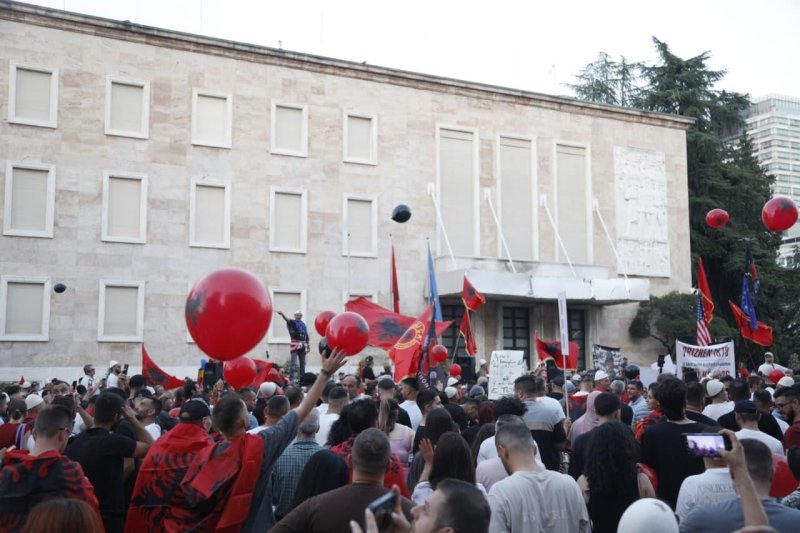
Prime Minister Edi Rama lit the beacon for his subordinates to target the mobilization of individuals traveling from Kosovo, as well as from North Macedonia, to participate in the Tirana rallies – taking note that they shouldn’t be confused with “diaspora”. In a statement on Sunday, Rama sought to clarify that diaspora does not consist of citizens of neighboring countries who have their own independent states. He also openly criticized the flying of the KLA (Kosovo Liberation Army) flags at the protests, describing it as a “desecration” of historical liberation symbolism for political purposes.
In later posts on social media, Rama targeted Vetëvendosje, Kosovo’s largest political party led by PM Albin Kurti, but took care to rule out Kurti’s responsibility for “chaotic” actions of specific individuals linked to his party. He explicitly stated that he does not hold Kosovo PM responsible for the actions of specific groups or individuals participating in the Tirana rallies. Holding Kurti accountable for their behavior would deeply insult his intellect, Rama noted.
The two leaders share a complex relationship characterized by personal cordiality but stark political differences as their varying approaches to regional integration and diplomacy with official Belgrade have frequently caused public friction.
Interior Minister Besfort Lamallari was the first to join PM Rama’s narrative, dismissing the participating “pan-Albanian” protesters as diaspora. He underlined that the term “diaspora” refers to Albanians living abroad, not those making a short trip from Prishtina or Tetovo, urging them to “save the weak emigrant refrain”. While highlighting that Kosovo is independent and Albanians in North Macedonia are a state-forming factor, the minister argued they are not disenfranchised outsiders saving the country. He also reminded protesters that it was Edi Rama who defended Kosovo’s independence in Belgrade.
Meanwhile, a more aggressive approach was adopted by Socialist majority MPs through their direct calls on the Kosovo government to distance itself from the protests in Albania.
Ulsi Manja, former justice minister and SP lawmaker, actually stated there is “no greater foolishness” for individuals from Kosovo to come to Tirana with the intention of overthrowing the Albanian government. He went on to question why Kosovo’s Prime Minister, Albin Kurti, has not formally distanced his government from these protesters. According to him, such actions not only fail to change the government in Albania, but instead provide political ammunition to “Kosovo’s enemies,” who can portray Kosovo Albanians as inherently confrontational, even toward their own nation.
Ardit Bido, another Socialist MP, was even more confrontational towards Kosovo’s leadership, demanding answers after a photo circulated on social media showing his name written on a trash can. Bido tagged Albin Kurti directly on social media, asking what business Vetëvendosje activists have intervening in Albania and denigrating its members of parliament. He went as far as to label the stunt as a “Goebbelsian” smear tactic designed to defame him, though he emphasized that his reputation remains clean and firmly pro-Albania. In his sharp critique, Bido advised Kurti to focus on governing and forming a stable government in Kosovo rather than staging protests in Albania.
Pirro Vengu, former defense minister and SP MP, has joined the show, warning that destabilizing the capital undermines Albania’s essential geopolitical role as the “mother state” for Albanians across the Balkans. He advised those traveling from Kosovo and North Macedonia to protest, not to confuse “love for the nation with tutelage over Albania”. Vengu emphasized that while Albanians already possess two states (Albania and Kosovo), are a state-forming nation in North Macedonia, and act as a Europeanizing minority in Montenegro and Serbia, they all share exactly one strategic center of gravity: a stable and strong Albania.
While facing massive calls for resignation over corruption allegations and a controversial, Jared Kushner-linked luxury resort project, the Rama government is actively trying to delegitimize the third consecutive week of massive protests in Tirana by blaming external actors, foreign interference, and an organized disinformation campaign.
*Political editor, ADN