
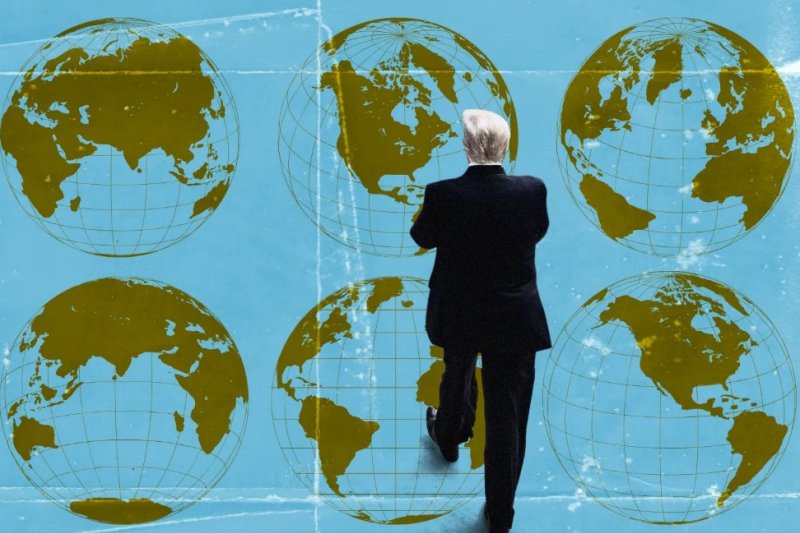
The Recalibration of American Sphere of Influence
The contemporary international system is once again entering a phase of structural transformation. Its contours evoke, by analogy, the nineteenth-century constellation of great powers, when international relations were shaped by rivalry among empires whose competition was at once continental and global. Then, Europe constituted the primary epicenter of strategic competition, while colonial possessions and imperial projections extended these rivalries across distant geographies. Today’s world, though governed by different legal, technological, and normative frameworks, reveals a similar dialectic: a system defined by the interaction of ascending poles, each seeking security, influence, and strategic advantage within an increasingly complex global arena.
In the nineteenth century, the balance of power was sustained through a delicate equilibrium among European powers whose influence radiated outward. Competition in Europe was existential, but its pressures were often displaced into colonial theaters, where imperial ambitions could be pursued with fewer immediate constraints. This system was neither static nor harmonious; it rested on constant adjustment, diplomacy, and the occasional use of force. Stability, when achieved, was provisional and dependent on the willingness of major actors to recognize limits as well as opportunities.
The present international environment reflects a comparable logic, albeit under conditions of globalization and technological acceleration. The American pole remains the central reference point of the system, not merely because of its military reach, but due to its enduring geostrategic depth, institutional resilience, and technological leadership. Yet this primacy is now contested by the rise of rival poles whose ambitions, capacities, and strategic cultures differ markedly.
Foremost among these challengers is China, whose ascent constitutes the defining rivalry of the present and the foreseeable future. Unlike the imperial competitions of the nineteenth century, this rivalry is not primarily territorial but systemic. It encompasses trade routes, technological standards, financial architectures, and increasingly the domains of artificial intelligence and advanced military capabilities. China’s power projection is methodical and cumulative, rooted in long-term planning rather than abrupt confrontation. As such, it recalls the patient strategies of continental powers that once sought gradual predominance within Europe before extending their reach beyond it.
Russia represents a more uncertain pole, its trajectory largely contingent upon the outcome and long-term consequences of the war it is currently waging in Ukraine. In the nineteenth century, declining or revisionist powers often sought to arrest their perceived loss of status through decisive action. Today, Russia’s position reflects a similar dynamic: a determination to redefine its sphere of influence in the face of strategic contraction. Whether it will emerge as a consolidated pole or a diminished regional actor depends on the durability of its political system, its economic adaptability, and its capacity to absorb the strategic costs of prolonged confrontation.
India, by contrast, embodies a different model of ascent. Its emergence as a pole is grounded less in immediate military projection than in demographic weight, gradual technological advancement, and sustained economic development. India’s strategic culture favors flexibility and autonomy. It exhibits a pronounced inclination toward soft power and strategic hedging, calibrating its actions in relation to other poles rather than seeking overt dominance. This behavior mirrors, in certain respects, the cautious diplomacy of secondary powers in nineteenth-century Europe, which maneuvered among great powers to preserve independence while expanding influence incrementally.
Europe, meanwhile, finds itself compelled to reconsider its role. The attempt to act as a geopolitical and military pole is not merely aspirational but increasingly imposed by circumstances. The reemergence of a Russian threat has exposed the limits of Europe’s reliance on external guarantees for its security. As in the nineteenth century, when continental stability depended on the capacity of European powers to assume responsibility for their own defense, today’s Europe confronts the imperative of strategic consolidation. Whether it can translate economic strength into coherent geopolitical agency remains an open question.
Against this backdrop, the recalibration of the American sphere of influence assumes particular significance. The United States continues to enjoy a decisive geostrategic advantage, rooted in its geographic insulation, alliance networks, and technological-military superiority. Yet the nature of its influence is evolving. The core of American strategic interest remains anchored in the Western Hemisphere—Canada, Central America, and Latin America—reviving, in updated form, the logic of the early Monroe Doctrine. This hemispheric focus does not imply isolationism; rather, it reflects a prioritization of stability in the immediate strategic environment as a foundation for global engagement.
At the same time, the American sphere of influence is inherently transcontinental and transregional. It extends across the Atlantic and the Pacific, encompassing key nodes rather than contiguous territories. In this context, American interests are increasingly ranked according to strategic relevance rather than ideological affinity alone. Regions and states are assessed through a prism that combines geostrategic positioning, technological relevance, and their role within broader systemic rivalries. Within this framework, the Albanian space—symbolized by the broader Albanian question—will continue to fall within the American sphere of influence in Mediterranean Europe. Its significance lies not in material power but in strategic geography, alliance alignment, and its role within the architecture of regional stability. As in the nineteenth century, smaller political entities often derived importance from their position within the balance of power rather than from intrinsic strength.
The global rivalry now shaping international relations is distinguished by its multidimensional character. Geostrategic competition is inseparable from technological and economic rivalry, increasingly centered on artificial intelligence, data dominance, and innovation ecosystems. In such an environment, the modus operandi of American foreign policy is likely to evolve. The tendency will be toward a more sober, realist assessment of circumstances, privileging concrete interests and strategic feasibility over the traditional impulse toward ideological mission. This does not signify an abandonment of values, but a recalibration of their application within a more contested world.
Transatlantic cooperation, accordingly, will no longer be purely linear or structurally automatic. The United States and Europe are likely to move toward greater autonomy in their respective theaters, adjusting to regional imperatives while maintaining a shared awareness of their common democratic heritage. This relationship will be less hierarchical and more transactional, shaped by mutual necessity rather than unquestioned alignment.
In this sense, the emerging order bears a strong resemblance to the nineteenth-century balance of power: plural, competitive, and contingent. Stability will depend not on the elimination of rivalry, but on its management. The recalibration of the American sphere of influence is thus not a retreat, but an adaptation—an effort to align enduring power with changing realities. In a world of rising poles, influence will belong not to those who seek universal dominance, but to those capable of discerning limits, prioritizing interests, and navigating complexity with strategic restraint. / AND
*The author completed a PhD-dissertation in the history of international relations at the University of Vienna, Austria; an MA in Geopolitical Studies at the University of Toulouse, France; and a degree in International Relations from the University of Graz, Austria.