
A 'Construction Economy', Production in Free Fall
Albania’s economy continued to expand in 2025, but the structure of this growth points to a reliance on sectors that generate high turnover without creating productive capacity to the same extent.
Gross domestic product reached Lek 26.5 trillion, or around Euro 27 billion, while the economy grew by 3.66%, the lowest growth rate since the post-pandemic recovery period, according to data published by INSTAT.
For the second consecutive year, a significant share of growth came from public administration and net taxes, driven mainly by higher public-sector wages. Excluding these two activities, the expansion of the private economy in 2025 was only 0.86%.
In the real economy sectors, growth was concentrated in a few activities. Construction contributed around 0.5 percentage points, real estate 0.42 percentage points, while trade, transport, accommodation and food services contributed 0.47 percentage points. On the other hand, industry and agriculture made negative contributions of -0.5 and -0.38 percentage points, respectively.
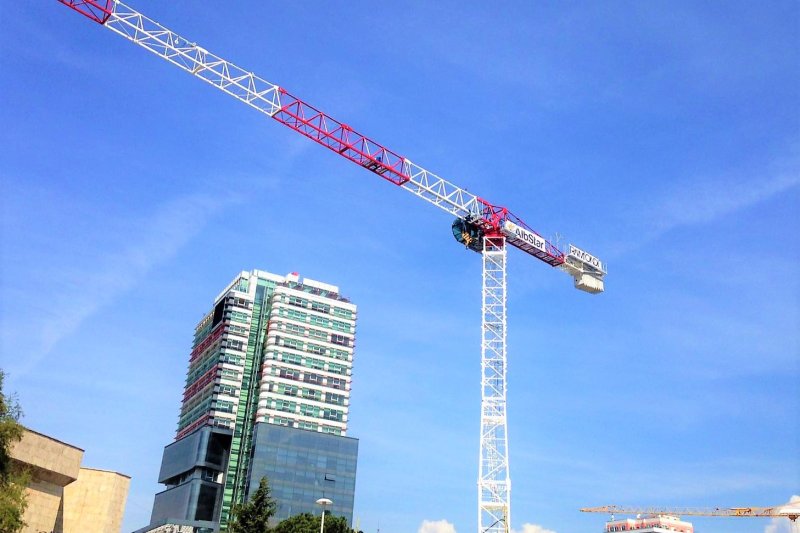
Construction has become one of the main pillars of the Albanian economy. The increase in housing investment, tourism developments, and infrastructure projects has expanded activity in the sector, but at the same time has increased the economy’s dependence on it.
In Albania, construction accounts for 12.6% of GDP, the highest share not only in the Western Balkans but also compared with the European average. In other countries in the region, the sector’s share is significantly lower: Kosovo 7.8%, North Macedonia 6.6%, Bosnia and Herzegovina 4.8%, Serbia 4.6% and Montenegro 3.8%, while the European average is around 5%.
Over the past three years, the sector has expanded faster than the rest of the economy, increasing its value added from around Lek 260 billion in 2023 to around Lek 290 billion in 2025, or by approximately 11%. Over the same period, manufacturing moved in the opposite direction, declining from around Lek 216 billion in 2023 to around Lek 214 billion in 2025, a decrease of 1.1%. The gap between the two sectors points to a gradual shift in the Albanian economy away from productive activities and toward construction and services.
The growth of construction has provided a strong economic boost, but the model has its limitations. The sector is closely linked to the investment cycle, housing demand, and developments in the real estate market.
This financing model makes the sector more dependent on continued sales and the pace of collections. If demand for property slows or the sales cycle becomes longer, pressure could spill over into companies’ liquidity and the supplier chain. For this reason, the high concentration of investment in real estate is seen as a potential source of vulnerability for the economy, particularly in a market where part of project financing passes outside traditional banking channels, which, according to investigations by SPAK, has served as a channel for the infiltration of informal money into the economy.
In contrast to construction, industry is going through a prolonged period of weakness. The sector has entered a downward cycle, while manufacturing has been contracting for nine consecutive quarters since the end of 2023 – the longest period of decline for the sector since the 1990s.
The weakening of industry has also reduced its share in the country’s economic structure. Industry as a whole accounts for around 10.1% of GDP, with the largest share coming from manufacturing at 6.46%, followed by electricity at 2.15%, extractive industries at 0.94%, and water supply and waste treatment at around 0.52%. This is significantly lower than in some regional economies, where manufacturing accounts for 14.3% of GDP in North Macedonia, 12.5% in Serbia and around 12% in Bosnia and Herzegovina.