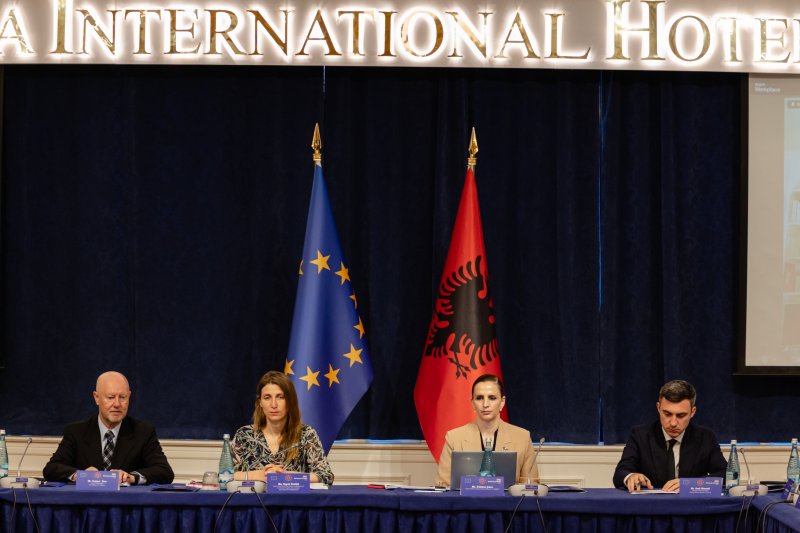
Annual IPA Monitoring Committee Meets in Tirana to Assess EU Pre-Accession Assistance
The annual Monitoring Committee on the implementation of EU funds under the Instrument for Pre-Accession Assistance (IPA) convened today in Tirana, bringing together senior representatives from the Government of Albania, the European Union, civil society, EU Member States and donors and partners community. The meeting reviewed progress on the programming of IPA funds as well as the implementation of approximately 150 ongoing IPA-funded projects, which support institutional reforms related to Albania’s EU accession process and bring real benefits to citizens.
The Committee, co-chaired by Ms Eridana Çano, National IPA Coordinator and General Director of the State Agency for Strategic Programming and Aid Coordination (SASPAC), and Ms Sigrid Brettel, Head of Unit at the European Commission’s Directorate-General for Enlargement and Eastern Neighbourhood (DG ENEST), reviewed the positive outcomes achieved to date and discussed the need to address ongoing implementation challenges. Valentina Superti, Director responsible for the Western Balkans in DG ENEST, opened the event, addressing the audience online. She thanked the Albanian authorities for their partnership and the commended the progress achieved:
“The EU remains the biggest donor in Albania with over EUR 1.9 billion in financial assistance provided so far through pre-accession grants since 2007. In addition, EU supported grants and loans leveraged overall investments estimated at EUR 4.7 billion since 2008. In 2024, EUR 197 million IPA funds were committed to assist Albania in the areas of anti-corruption, local governance, food safety, environment, energy, digital economy and society, and employment and social inclusion. I encourage authorities to continue managing EU funds diligently for maximum impact, strengthening structures and resources in order to manage EU funds independently as well as to build capacities and complete all necessary recruitment to prepare for accession.”
Eridana Çano, National IPA Coordinator and SASPAC General Director, emphasised the political importance of this moment, noting that Albania is now closer to the EU than ever before:
“The Instrument for Pre-Accession Assistance IPA has been more than just a funding tool. It is a transformative driver that enables changes: in how we govern, how we invest, and how we grow as a society. It helps us to align with the EU acquis, modernise our institutions, build infrastructure, develop human capital, and apply innovation in all areas of public policy. We must treat the upcoming period 2025-2027 for programming of new IPA funds as decisive. We hope that by the end of this programming cycle, we will have not only advanced reforms, but also concluded accession negotiations by 2027. IPA funds are seen as a final, decisive push before Albania becomes a full member of the European Union.”
In June of this year, Albania ratified three EU Operational Programmes, under which the EU entrusts Albanian institutions with independent management of funds, through the so-called indirect management modality. These programmes represent a joint investment of €186 million, 30% of which is co-financed by the Albanian Government, supporting youth employment, digitalisation of public services and the green energy transition and preparing Albanian institutions for the management of EU funds upon accession.
Implementation Challenges Remain
The Committee took place in the context of continued progress made by Albania over the past year, particularly the opening of four out of six clusters as part of the EU accession negotiation process, the roll-out of the EU Growth Plan for the Western Balkans and Reform and Growth Facility, and Albania related Reform Agenda, as well as preparations by Albanian institutions to manage EU funds independently in preparation of future membership.
Despite solid progress, the Committee acknowledged that further improvement is needed in several areas. Strengthening SASPAC’s capacity and coordination role is essential to implement and align funding from partners more effectively. Faster procedures for the signing of financing agreements are recommended to avoid implementation delays.
While Albania participates in 13 EU programmes—including Erasmus+, Horizon Europe, and Creative Europe—large capacity gaps remain. Expanding access and improving project design are needed to maximise the country’s participation and benefits for citizens.
The Committee also noted the need to strengthen capacities for cross-border cooperation programmes, particularly at local, regional, and national levels.
A key priority identified by the Committee was for the Albanian authorities to improve communication about the impact of EU assistance—both through IPA and the EU Growth Plan.
The upcoming Monitoring Committee under the Reform and Growth Facility, set to take place in Tirana in September, will be an important opportunity to communicate progress and involve a broad range of stakeholders.
Finally, participants highlighted the urgency of accelerating infrastructure investments under the Western Balkans Investment Framework (WBIF), addressing delays in negotiations with international financial institutions, and reinforcing financial control systems to ensure efficient and transparent use of EU funds.