Exclusive, Alberti: Time for Albania to Make Tough Choices!
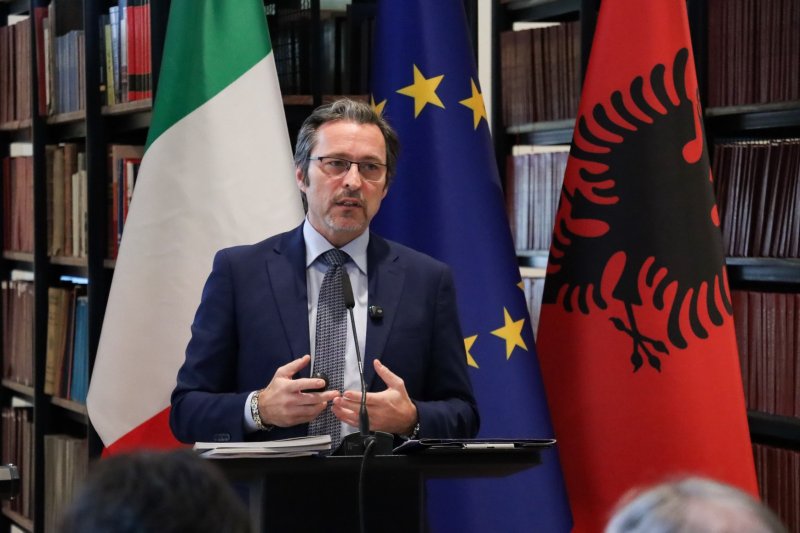
The best way to celebrate the Italy–Albania friendship is to make it operational, says the Ambassador of Italy to Albania, Mr. Marco Alberti. This was the motto with which he began his diplomatic mission in Tirana a full year ago. The year concluded yesterday with the holding of the high-level forum on Corridor VIII, with the participation of the Italian Deputy Prime Minister and Minister of Foreign Affairs, Antonio Tajani.
In this interview with Albanian Daily News, Ambassador Alberti takes stock of the progress of Italian–Albanian relations in various fields, focusing on several concrete projects, while also discussing what is expected to happen in 2026.
Meanwhile, Albania’s membership in the European Union seems closer than ever, but Ambassador Alberti emphasizes: “My assessment is ‘now or never.’ The enlargement window will not stay open for long. Albania managed to open all the clusters in record time and has made huge progress. Yet the job is not done; the country is now realizing that joining the EU is more complicated than simply checking off a list of requirements.” Read Ambassador Marco Alberti’s interview below.
-Your Excellency, yesterday Albania hosted a high-level Forum on Corridor VIII. Italy was represented by Deputy Prime Minister and Minister of Foreign Affairs, Hon. Tajani. Tell us something about this event.
-To "play hard", or to compete aggressively and achieve significant, high-impact objectives, we need to move beyond simple, repetitive effort, and focusing on strategic, high-leverage projects. Corridor VIII addresses long-standing connectivity gaps in the Region, linking Adriatic and Black Seas through Albania, North Macedonia, Bulgaria e Romania. Such corridor has a geopolitical, industrial and security relevance. Besides, it aligns with EU enlargement policy and NATO commitments, responding to the need for wider and deeper regional cooperation in the Western Balkans. With yesterday's event, our countries reiterated their will to turn geopolitical and security relevance of the Corridor into projects. The political session was followed by and economic one, to avoid the risk for the corridor of remaining theoretical. Minister Spiropali confirmed the strong commitment of the Albanian government, while Hon. Tajani’s presence in Tirana proved the clear support provided by Italy to the Corridor VIII, and clarified that announcements must leave room for execution. The path will be long and uphill, but the basis for a good work is out there.
-Ambassador, yesterday's event falls at the end of your first year of your mandate in Tirana. What have been the main spotlights?
-A very intense year. Since my arrival, I thought the best way to celebrate the Italy-Albania friendship would be to make it operational. We took three steps.
First: focusing on what our bilateral relations were still missing, rather than on what we already had.
Second: designing some actionable ideas to fill the gaps.
Third: articulating this vision into a plan and creating a compelling narrative. We never had an intergovernmental Summit: the first one was held in Rome last November. We had not a G2G Agreement, to establish a set of priorities: one was signed at the Summit, along with 16 agreements reinforcing political, economic and cultural cooperation. We missed some Italian big players investing in Albania in key-sectors: some are landing, in the Defense, Cyber security, healthcare and energy sectors. Albania had not a Development Bank: one was born, with the support of the Albanian government and the Italian CDP. One year after, I am more convinced that diplomacy should act as a force-multiplier rather than as a direct force, by enhancing, leveraging, and directing a country’s tangible influence to achieve greater results.
-Among the new agreements, can you tell us something more about the one between KAYO and Fincantieri?
-Soft power matters, but projection and promotion of Italy worldwide must also rely on industry. KAYO and Fincantieri, both private companies participated by respective governments, decided to deepen their cooperation. The agreement concerns the renovation of Pashaliman shipyard to build naval units. It links the need of Albania to modernize its defense system with the excellence of Fincantieri in naval industry. Once fully in force, the deal is expected to create job opportunities and to develop related industries. It will also expand Fincantieri and KAYO shipyard capacity through a multi-faceted strategy of infrastructure investment and international partnerships. Many are skeptical, and they wonder if the deal will work: while I am sure that KAYO and Fincantieri will cultivate well the sown seeds, we will do our best to make it happen, step by step. Italy-Albania cooperation does not need big transformation. Consistent actions, and incremental steps, drive progress and success. Success breeds success. Small victories energize people.
-What plans are there for 2026?
-Large goals are intimidating, it is better to break them down into smaller, manageable tasks. In 2025 we set our priorities into stone. In 2026 we will try to be more execution-oriented, more focused on shorter-term goals. For example: supporting the implementation of the deals struck in Rome; advancing Corridor VIII and the relevant opportunities that it offers; organizing an Italian business forum in Tirana, tentatively first half of 2026; planning 4-5 high level institutional visits, one for each priority sector; reinforcing our knowledge exchange initiatives; executing a package of projects in agriculture, justice, women empowerment, sustainable energy and education, designed to accompany Albania in its path towards the EU accession. On the cultural side, we are shaping an appealing program. More than 80 events, ranging from pop music to cinema, from opera to design, from literature to visual arts. Several initiatives will revolve around the concept of mosaic. Italy and Albania, indeed, are mosaic-countries, made up of diverse peoples, cultures, traditions. The Western Balkans are a Mosaic-Region. The EU is a mosaic-community: each member State is a different “tile” that, combined with the others, form a clearer image, an identity.
-Speaking of EU negotiations. What is your assessment on Albania?
-My assessment is “now or never”. The enlargement window will not stay open for long. Albania managed to open all the Clusters in a record time, and made huge progress. Yet, the job is not done; the country is now realizing that joining the EU is more complicated than checking off a list of requirements. This process involves moving from established, traditional mindsets toward new, often more adaptive, perspectives. A strong "now vs. then" narrative, that highlights the benefits of new behaviors, can facilitate such change. This is the time for Albania to make hard choices, with the support of both the majority and the opposition, the civil society and the business community. Albania in the EU, hopefully by 2030, is not only a legacy of the current government, but a milestone for the whole country toward a prosperous and peaceful future.
-What does it mean concretely?
-Reforms are needed to align the country with democratic, economic, and legal standards of the EU. They also help “bridge the gaps” between people and politics, between State and civil society. Such deep reforms have three main features: they are necessary, urgent and non-negotiable, especially those referred to Cluster 1, Fundamentals and Rule-of-law. In any country, an independent and effective judiciary system is a pre-condition for sound democracy and for an attractive business environment. Equally important for the balance of powers is reinforcing democratic accountability and preventing the system from any risk of “judicialization”. Rules are rules, and must be respected, especially in view of the EU accession. Yet, history reminds us that, sometimes, a bit of flexibility can help. The tale of Procrustes speaks of that. In the ancient Greece mythology, Procrustes was famous for his hospitality: however, if a guest was too short for the bed, Procrustes stretched them on a rack until they fit. On the contrary, if the guest were too tall, he would amputate the overlapping limbs. In either scenario, the guest died.
-Ambassador, how is your personal life in Albania? Are you happy?
-My purpose in life, and in Albania as well, is not just spending some years in a country, but getting fully immersed in the place where I have the privilege to live. Diplomats are nomads, and nomads learn how to cherish every moment, since they know that, sooner or later, they will have to pack and leave, in search for another destination, following another adventure. As I said once, my nightmare is getting bored, and this is really impossible in Albania, particularly in this time in history. It is enough for me to be happy! / ADN