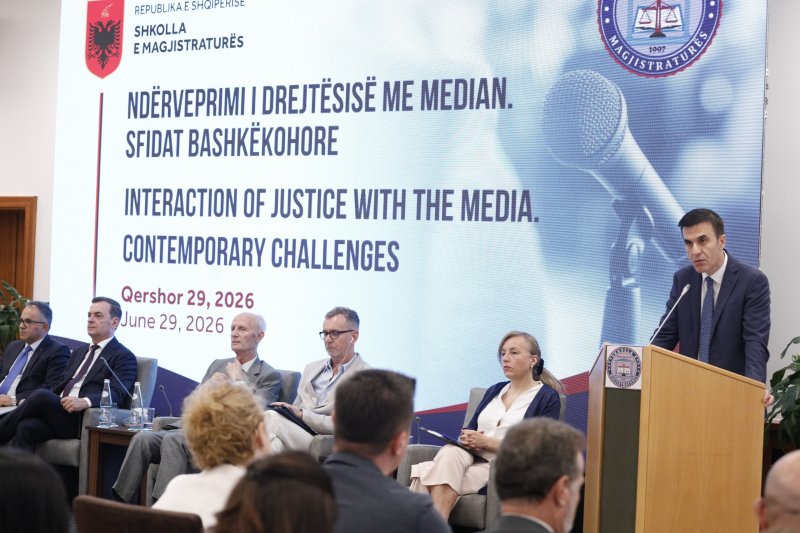
GP Addresses School of Magistrates Conference on 'The Interaction Between the Justice System and the Media: Contemporary Challenges'
In his address, the General Prosecutor highlighted the modernization of communication methods and strategies as being an imperative. The implementation of standards that, on the one hand, safeguard the confidentiality of investigations and the protection of personal data, and, on the other, ensure transparency and effective public communication, will continue to constitute a major challenge in a reality where perceptions increasingly tend to relativize facts.
The issue we must address today, perhaps more than ever, is the extent to which we are able to preserve the integrity of our institutional role in the face of pressure and the temptation to be seen as popular or well-liked, in a new reality where impressions are formed at extraordinary speed in virtual spaces, where emotion often prevails over reason, and where the speed of reaction is valued far more highly than the depth and thoroughness of objective analysis.
Every magistrate, as well as the institution where they serve, must remain a guarantor of constitutional and legal standards in the discharge of public responsibilities. The information conveyed to the media and the public must not be intended to enhance popularity or approval ratings; rather, it should reflect the outcome of due legal process, serving both the public interest and the protection of fundamental human rights and freedoms.
Full speech below
Honorable participants,
Living at a time of profound change in the means and forms of communication worldwide, and considering the relationship that individuals and societies have with information, we are confronted with the challenge of understanding the impact these epochal transformations have had on institutional activity and conduct, and of identifying the most appropriate ways to establish new balances in communication between institutions and the public.
Karl-Heinz Koch, a former German politician who also served as Minister of Justice of the State of Hesse, once remarked: "What is not found in the Frankfurter Allgemeine Zeitung has not happened." By this, he sought to highlight the extraordinary influence that the newspaper exercised in post-war Germany. Yet I believe this aphorism extends well beyond the time and place to which it originally referred. Its underlying message remains relevant today, reminding us of the powerful role that the media continues to play in shaping public awareness and perception.
There was a time when the traditional media served as the primary bridge between public institutions and public opinion. Information reached the public through established media outlets, which determined not only what was reported, but also how it was presented, guided by their understanding of the role of the press in a democratic society. The analogue era naturally limited both the volume of information in circulation and the pace at which public opinion evolved.
The development of digital technology has fundamentally disrupted the traditional model. Today, vast amounts of information circulate and spread at extraordinary speed, on a scale that was unimaginable only a few decades ago. The global reach of social media has given rise to virtual arenas of public debate that easily transcend physical borders. The intensity of interaction among users on these platforms generates complex and often unpredictable dynamics that increasingly shape public life. As a consequence, shifting patterns of public perception frequently influence the direction of policy and, at times, the course of significant decisions.
Within this context, I believe it is equally important to examine the relationship between justice institutions and the public, with the media playing a vital intermediary role in this process of communication. It is not an easy task for traditional institutions to keep pace with such rapid and far-reaching social transformations. This challenge is even more pronounced for judicial institutions, which, while required to carry out functions that often demand a high degree of discretion, must at the same time ensure the transparency that is indispensable in a liberal democracy. Striking this balance becomes even more complex when one considers the need to preserve and strengthen public trust, a goal that is closely and inevitably linked, among other factors, to the way these institutions communicate their activities to the public.
Our justice system is still in the midst of a complex process of structural transformation, facing several challenges that continue to affect the quality of the services it provides. Public perception has been at notably low levels over the past 10–15 years, and rebuilding trust will require sustained effort. The backlogs are likely to continue affecting performance for a significant period, even though public expectations remain high. While progress is underway and will continue, it is unlikely to advance at the pace required to fully meet the scale and urgency of the challenges facing the country.
Against this challenging backdrop, modernizing our communication methods and strategy has become a necessity. In this regard, the Prosecutor General’s Office has taken several concrete steps that have contributed to a much more open and transparent institutional approach towards the media. We have established a vertical coordination mechanism to improve the quality and consistency of public communications. This system includes the Media Advisor at the Prosecutor General’s Office and media liaison prosecutors in each prosecution office. In 2025 alone, around 220 press releases and notifications were issued across all levels. We also maintain a very active website where we regularly publish key activities and communications on matters of public interest. In addition, each prosecution office has its own webpage, where selected announcements and activities are published. During 2025, our website recorded approximately 696,000 visits, with an average engagement time of 3 to 5 minutes per visit.
At the same time, there have been more than 1,700 posts in Albanian and English on the X platform since July 2022. The objective has been to ensure that we communicate with the public both through the media and directly, in a more immediate and accessible way. In April, a new Public Communication Strategy was adopted to further strengthen and institutionalize our relationships with both the media and the public, while also contributing to greater public trust in our institution.
Despite these important steps forward, significant challenges remain. Raising awareness among prosecutors about the importance of public communication of the institution’s work will not be easy, partly due to a long-standing tradition of relative hesitation in engaging with the media, often in the name of protecting investigative secrecy. Ultimately, the challenge lies in applying, in a balanced and consistent manner, the standards that protect the confidentiality of investigations and personal data, while at the same time ensuring transparency and meaningful communication with the public in a reality where perception too often outweighs fact.
The issue we must address today, perhaps more than ever, is the extent to which we are able to preserve the integrity of our institutional role in the face of pressure and the temptation to be seen as popular or well-liked, in a new reality where impressions are formed at extraordinary speed in virtual spaces, where emotion often prevails over reason, and where the speed of reaction is valued far more highly than the depth and thoroughness of objective analysis.
Every magistrate, as well as the institution where they are serving, must stand as a steadfast guarantor of constitutional and legal standards in the exercise of public authority. The media and the public must be provided with information that is not designed to enhance popularity or approval ratings, but that instead reflects the integrity of due legal process, while safeguarding both the public interest and the fundamental rights and freedoms of individuals.
The magistrates graduating today will undoubtedly bring a modern spirit positively shaping institutional engagement with the media and the public. Yet they must never lose sight of the fact that service to the country is rendered only through the faithful performance of their duties in compliance with the Constitution and the law.
Accordingly, in closing, I would like to extend my sincere wishes for every success as they embark upon the path ahead, and to express my confidence that their contribution will be decisive in the development of a justice system fully aligned with the highest European standards.