Poland as a Solidarity Superpower

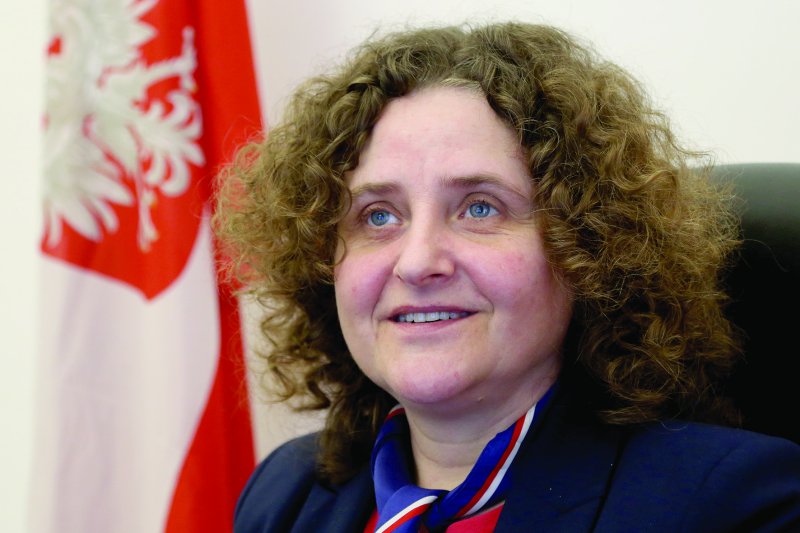
This interview with the Ambassador of Poland to Albania, Mrs. Monika Zuchniak-Pazdan is unusual. Arriving in Tirana in May 2021 as the Covid-19 pandemic was still developing, another crisis was slowly looming on the borders of Poland. Only that this one was artificial, provoked by Belarus, with the help of Russia, which had gathered unfortunate immigrants from countries at war and started pushing them towards the Polish borders to enter the European Union.
With the help of Ambassador Zuchniak-Pazdan, in December 2021, Albanian Daily News interviewed the Polish Deputy Minister of Interior, Bartosz Grodecki about this issue. But no one could have foreseen that this moment would be but a rehearsal of what would come next and that today has frightened, but even more so, mobilized the whole democratic world; the Russian aggression against Ukraine.
It is a fact that Poland has taken the heaviest burden among EU countries with regards to the direct consequences of this attack, demonstrating unparalleled humanitarian solidarity in aid of Ukrainian refugees. But what does this event mean for Poland, Europe, and the world; what is the role of Belarus; how is the country coping with the bloody crisis at the EU doorstep; should Brussels change anything in its attitude towards the Western Balkans? Below is the interview with the Ambassador of the Republic of Poland to Tirana, Mrs. Monika Zuchniak-Pazdan:
-Madam Ambassador, your first interview with Albanian Daily News comes at a highly critical time for your country, the continent and the world. The Russian invasion of Ukraine has put Poland at the frontline of a very dangerous crisis. Could you share with us your viewpoint on what this aggression means, as well as any latest development regarding your country’s response and efforts?
-What we are seeing today is the result of many years of appeasing the megalomaniac Vladimir Putin in Crimea, Donbas, Georgia, Belarus, Syria, Moldova, and Transnistria. Western countries have finally realized that, like in 1939, appeasement and leading from behind does not work and merely whets the aggressor’s appetite. We are absolutely horrified by Russia’s invasion of Ukraine. It is beyond outrageous that a permanent member of the Security Council, a nuclear weapon-equipped state launched an overwhelming and utterly unprovoked military attack on another country. This is an assault not only on Ukraine, but also on the international, rules based order.
We condemn Russia’s aggression in the strongest possible terms.
Our relentless efforts, including Polish OSCE chair’s initiative, to solve the outstanding issues with Russia through diplomacy were rejected. Putin chose again to brazenly defy legal norms and his international commitment. He has also entirely flouted the concept of indivisible security. Clearly, dialogue did not work. There is no more time to waste and no more room for hesitation or errors. We must make Russia cease its military action immediately and withdraw its forces from Ukraine. We must make good on our promises to respond with devastating consequences and sanctions to Russia’s invasion of Ukraine. Russia must pay massively for this attack. We must make it painful for Putin so that he may reconsider his belligerent actions. Only that way we may prevent tragedies like the one that we are facing today.
-Poland has recently been provoked at the border by the Belarusian neighbor, which gathered hapless illegal migrants from Middle East and other crisis-ridden countries and tried to usher them into Poland. The assisting role of Belarusian autocrat Lukashenko in Ukraine’s invasion – now acting as Putin’s lieutenant - is also undeniable. Do you have a comment on this country’s possible future threat vis a vis Poland and EU?
-It is even more outrageous that Belarus followed Russia’s aggression. Belarus has not taken part directly in the conflict, but it has supported Russia’s war efforts. The attack on Ukraine was launched also from Belarussian territory, using their infrastructure. Regime in Minsk is complicit in Putin’s crimes.
The recent migrant crisis on our border looks like a joint Belarusian-Russian operation. It is even more convincing when looking at current events. It seems that Russians were testing the solidarity of Western countries and the decisiveness of European capitals, also in the context of sanctions. This is a deeper geopolitical game of Kremlin whose main aim is to undermine the current security architecture in Europe. Poland was dealing with the use of migrants by the Belarusian regime in order to take revenge for Polish support for the Belarusian opposition and for not recognizing the results of the rigged presidential elections.
Belarus is a non-sovereign state and has reached a political impasse. Following the rigged presidential election and unprecedented violence against peaceful protesters, Lukashenko has lost legitimacy in the eyes of the public and the West. He continues, however, to retain power through a high degree of repression and the loyalty of his security services. Belarus is a key ally of Russia. Lukashenko is trying to create the impression that it has not sent its troops to Ukraine, which looks like a true claim, but on the other hand it is lending the Russians Belarusian territory to attack its neighbor. This helped the Russians a lot, because it allowed them to get near Kiev. This situation shows that in relations with Russia, Lukashenko is not independent.
On the other hand, Ukraine's fate is closely tied to that of Belarus. Belarusians realize that it would be much easier for them to defeat the regime in their country if Ukraine won the war. If Russia wins the war against Ukraine, it will also strengthen Lukashenko indirectly. That is why Lukashenko must suffer the consequences of his decision to help Putin. All the sanctions that have been imposed on Russia must also apply to the Lukashenko regime.
-Do you think the West must do more in helping Ukraine, its leadership and people to face this deadly threat?
-The war that Putin has unleashed on Ukraine is also a battle for the soul of the West. The Russian invasion of Ukraine ends once and for all an era of illusions about the west’s relations with Moscow. What has been clear to Poland for years must now surely be clear to all western countries. Russian aggression against independent Ukraine has shown President Vladimir Putin’s true face. Russia can be stopped only by western solidarity with Ukraine. There is no room for doubt here. The EU and NATO cannot allow for a moment the impression that they are willing to sacrifice the future of Ukraine to restore peace.
The ruthless attack on Ukraine is another chapter in this story of the restoration of Russia’s imperial status. Putin has been implementing this plan for years. He started with an attack on Georgia in 2008, followed by the occupation of Crimea in 2014. And today he intends to subordinate all of Ukraine. And we should be under no illusions: this could be just the beginning.
Transatlantic security is indivisible. A threat to one state in the Euro-Atlantic community is a threat to every member of NATO. All for one, and one for all. It was on this foundation, of solidarity and unity, that Europe built peace and prosperity after 1945. Now Putin is trying to blow up the entire postwar security architecture. Today, we are seeing that the price of European naiveté over Russia is Ukrainian blood. For more than 30 years of relative peace, the West has clung to the illusion that the fall of the Berlin Wall in 1989 and the collapse of the Soviet Union had brought about the “end of history”.
Today, however, history is returning with all the force it can muster, including war - which is why politics, and politicians, must once again be serious. This is the moment for us in the West to show that we will not submit to tyranny. It is time for us to show that values such as freedom and the right of the self-determination of peoples are not merely things we talk about, but also things we are willing to fight for. The blood of our Ukrainian neighbors, friends and brothers demands that we react decisively.
Poland stands side by side with Ukraine and its people. We will not countenance any compromise with Russia that would undermine the territorial integrity and independence of the Ukrainian state.
There is only one way to prevent this from happening. A united West – the EU shoulder to shoulder with the US, UK and other allies – through imposed economic sanctions on Russia will completely dismantle the Putin regime’s operational capabilities. Putin has broken every promise he has made in recent weeks. He must therefore face a response that is stronger than ever. We must send a clear message to these individuals that there will be no return to “business as usual” until Ukraine is secure and sovereign within its internationally recognized borders. It is time to abandon the illusion that the world will become a safe place without our effort. Peace must always be fought for. It must always be earned. Now we face the ultimate test. There is no other way than tough sanctions aimed at the very heart of Russia's economic and energy system.
Putin's war has caused an outbreak of human solidarity throughout Europe. The solidarity of Poland and Poles towards Ukraine can be seen at every turn. There is no doubt that we are confronted with one of the biggest humanitarian crises in Europe since World War II. Poland have already taken in over 1 mln 400 thousand refugees. We keep our borders open, our diplomatic missions help those who seek refuge in Poland. The nationals of all countries who suffered from Russian aggression, or whose life is at risk, can seek shelter in Poland. We have welcomed people of 125 nationalities fleeing Ukraine – including 19 Albanians. We know that some media were targeted by disinformation campaign suggesting discriminatory practices at the Polish-Ukrainian border based on race or religion. This is a complete lie and a terrible insult to us.
Besides giving refuge, Poland delivers to those who suffer a very practical and tangible help. We organized special trains for the elderly and mothers with small babies, as well as convoys with supplies and medical aid. There are thousands beds in many hospitals ready for those wounded and sick. Poland stands ready to cooperate closely with UN OCHA, International Committee of the Red Cross and any other humanitarian organizations to ease the burden on civilians targeted by Russian aggression.
What I am most proud of is the outpour of spontaneous readiness to help by individuals. Polish families are opening their homes to refugees. They offer clothes, food, and accommodation. Thousands of private cars are coming from all over Poland to pick up those who crossed the border. Polish people stand in lines for hours to donate blood. The scale of help offered was so big that the government opened a special website “Helping Ukraine” where volunteers can register and get guidance on those in need.
In this conflict, Poland may not be a geopolitical superpower, but we want to be a solidarity superpower. And that is how we want to change the grim reality for better. Kyiv is still standing. Ukrainian President Volodymyr Zelensky is still leading. Vladimir Putin has still not brought Ukraine to its knees. Ukrainians have bravely defended their country. It is their valor that has united the international community. We can’t let them down.
-Your Excellency, the Russian aggression has prompted, as you are aware, calls from Western Balkans – Albania and Kosovo included - and other countries (Georgia, Moldova, but also Finland, Sweden are mulling the idea) for a speedy accession in EU, NATO, to prevent further Russian threats and expansion of conflict. Of course, times of crises call for swift decisions that otherwise would have taken years to be made; what is your assessment on this issue?
-The EU will formally assess applications from Ukraine, Georgia and Moldova to join the bloc. While the move is so far just a technical step, it still carries significant symbolic value. Ukraine, Georgia and Moldova are three of the six countries the EU classifies as neighbors under the so-called “Eastern Partnership” initiative. For years, the EU has focused on pushing those countries to gradually adopt democratic and legal reforms that would bring them closer to the bloc. But with a war now raging in Ukraine, overnight, the EU has to adjust a neighborhood policy focused on incremental reform into one that is about the survival of these countries as states.The idea of granting Ukraine a candidate status is gaining momentum. Already eleven EU countries – Bulgaria, Croatia, Czechia, Estonia, Hungary, Latvia, Lithuania, Poland, Romania, Slovakia, Slovenia – support the move, up from the initial eight.
Ever since Poland joined the European Unionit has been a supporter of the enlargement policy. In order to ensure stability and security in Europe, the EU needs to continue its enlargement policy with determination and support reforms in the Western Balkans countries so that in the future they can become EU member states. Without a doubt, the Western Balkans region is of key importance to ensuring security in the context of migration flows, terrorism, cyber and hybrid threats, as well as the destabilising impact from certain third countries. The region, due to its potential and geopolitical importance, has often been the scene where third countries such as Russia or China struggle for influence. We are concerned to see a growing involvement of external actors whose actions often have a destructive impact. Instead of building dialogue and consensus, they result in exacerbating existing differences and escalating tensions. That is why Poland remains a strong advocate for launching IGC as soon as possible.
-It has been widely commented that this is a time of great trial for the European Union, NATO and the existing world order. Is the EU prepared to face this ‘make it or break it’ moment, in your opinion? What changes should be made?
-We must show our unity and solidarity with Ukraine. The democratically elected Ukrainian authorities must feel our unwavering support. We need to call on all our partners and like-minded partners around the world to stand against Russia’s aggression, against war. We need a strategic response both politically and militarily. First of all we must mobilize an international humanitarian coalition.
Secondly, we must do more to help Ukraine to defend itself. More and more nations are willing to provide defensive equipment. We must act quickly to coordinate our efforts to support Ukraine army.
Thirdly, we must go further on economic sanctions, expelling every Russian bank from SWIFT, stripping Russian financial institutions and oligarchs of their privileges. But these measures will be insufficient unless Europe begins to wean itself off the Russian oil and gas that bankroll Putin’s war machine. We must deprive Russia of its sources of arms financing. Making Europe dependent on hydrocarbons and other raw materials bought from Moscow is a breach of our sovereignty, but it is also a financial injection for Russian oligarchs.
And finally we should always be open to diplomacy and de-escalation, provided that the government of Ukraine has full agency in any potential settlement. There can be no new Yalta, decided over the heads of the people of Ukraine, by external powers. Which is also extremely important we must act now to strengthen Euro-Atlantic security. Our deterrent capability is inadequate at the moment. This includes not only bolstering NATO’s eastern flank but also supporting non-NATO European countries that are potentially at risk of Russian aggression, such as Moldova, Georgia and the nations of the western Balkans. And those that participate or enable Russian aggression, such as Belarus, will be subject to maximum sanctions.
The tragedy of the choice facing Europe today is that the Old Continent simply has no choice. There is nothing left but to increasingly tighten sanctions against Vladimir Putin's regime and fight against his authoritarianism. We need more determination and courage if we want our actions to be effective. The isolation of Putin's Russia is essential today.
-You have witnessed Albania’s response to the Ukraine crisis, in the international diplomatic level as well as in the ground, by the common people. How do you find it?
-We appreciate Albania leadership as a member of UN Security Council. We welcome very much resolution denouncing Russia’s aggression against Ukraine. Albania took the floor at the urgent Security Council meeting as soon as Russia declared recognition of the independence of the so-called republics of Donetsk and Luhansk. In the framework of the OSCE Albania has maintained a strong position in support of the independence and territorial integrity of Ukraine. Albania along with NATO, OSCE allies and in dialogue with EU responded instantly to Russia aggression. We are very grateful that Albania joined the UE sanctions on Russia over the invasion of Ukraine, and swiftly decided to close its airspace for Russian airlines for its illegal war against Ukraine. We also commendAlbania parliament’s unanimous resolution supporting Ukraine sovereignty, territorial integrity and democracy, condemning Russian invasion of Ukraine and violation of international law and European security.
I would also like to praise the decision of the Tirana City Council to rename street home to Russian embassy to “Free Ukraine” street in Tirana, in a unanimous vote, to honor Ukraine’s resistance to war. We also see solidarity marches with Ukraine taking place in Tirana and humanitarian aid being transferred to Ukraine. In Poland they say “a friend in need is a friend indeed”. Albania is such a true friend to the entire democratic world.