
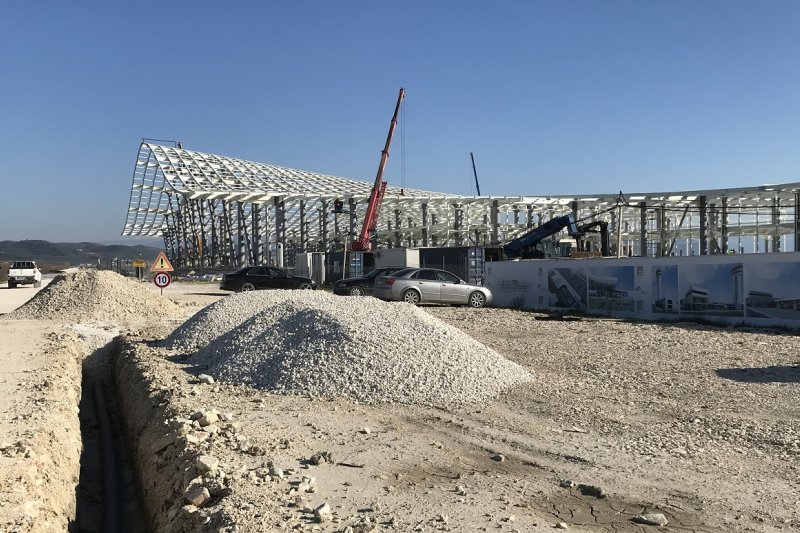
Risk of Delays for Vlora Airport Creates Confusion
Postponing deadlines for various projects, including those related to ports, airports, or railways in the country, has become increasingly common. For Vlora Airport, the first deadline for entering into operation was the end of 2024, followed by the summer of 2025, and subsequently, the deadline was postponed to the summer of 2026.
These deadlines issued by government officials under electoral fever, but not only, have always taken the form of empty promises, without actually weighing the damage caused to those who believe in them. Tourism is perhaps the sector directly affected by the unfulfilled promises of an airport in the South, Monitor reported.
This is the second year that tourist operators have signed guarantee contracts and are waiting for charters to land in Vlora Airport.
The situation is so unclear at present that even tourist operators do not have a common idea about what will happen. Rrahman Kasa, from the Albanian Tourist Union, told Monitor just a few weeks ago that it is not yet clear whether flights will start.
But another tourist operator underlines that the start of flights is certain this summer. Elvis Kotherja, founder of “Elite Travel Group & Elite Hospitality,” said earlier in a February interview for “Monitor” that Nordics would come to the South from Vlora Airport.
“Looking at the commitment of the central authorities, as well as the interest of investors, I do not see any sign that this will not happen, because the infrastructure and commitment are maximum. The administration communicates and is in a secure connection. This makes me rule out the possibility of not opening. At least for charters, it will start,” underlined Kotherja.
The deepening of the conflict over Vlora Airport has not gone without also raising Arbitration as a possibility. During the press conference that Mabco held with the media in February, it was underlined that if a solution were not found, Mabco, as a company established in Switzerland, would seek its rights in international courts.
It is worth noting that in public international law, the actions of any state body, including the courts, are considered actions of the state itself.
In addition, the Concession Contract also treats the actions of the courts as actions of the state. Consequently, even the court decisions with the effect of expropriating Mabco are considered state measures in relation to a foreign investment, which paves the way for international arbitration procedures. Such a process would not only entail considerable costs for the legal defense of the state. If a violation of the treaty were to be found, Albania could also face significant damages, interests, and procedural expenses.
“For this reason, we see this issue as a real risk that, in the absence of a constructive dialogue and reaching an agreement to resolve our claims, could produce financial consequences for the state and, ultimately, for Albanian taxpayers,” company representatives would underline at the time.
This would not be the first time that Albania would face Arbitration and pay high bills, which reach considerable values.