Thousands in Spain Return Home but New Heatwave Raises Wildfire Fears
Spanish authorities have allowed thousands of people evacuated because of wildfires to return to their homes after restrictions were lifted in the areas of Toledo, Madrid, Ávila, and Castellón.
In the Madrid region alone, 24,000 people have been told they can return and lockdowns on another 20,000 have been lifted.
Spain and France are both braced for the start of the fourth heatwave so far this summer and some fires have continued to burn, including one at Burgohondo 150km (93 miles) west of Madrid.
In south-west France, the largest fires in the Gironde region are described as "still stabilised" despite several flare-ups, however officials warn of dry winds and temperatures of up to 41C (106F).
The mayor of Le Barp, south-west of Bordeaux, Blandine Sarrazin, warned that the situation was "getting harder", after two fires had broken out the day before, and said everyone had to be "hyper-vigilant".
Sixteen departments or districts are under orange heatwave alert, including in the Landes area further south.
The fire service has had to deploy special measures in Gironde to protect a number of sites linked to France's defence and aerospace industries. The so-called "Seveso" sites include plants that manufacture hazardous materials for missiles and rockets.
Spanish Prime Minister Pedro Sánchez has warned the next 12 hours will be "decisive" in putting out the wildfire near the capital. "Things are progressing favourably, with maximum caution," he told reporters, because of higher temperatures, lower humidity and the risk of gusts of wind.
One fire remains out of control, at Vall d'Uixó north-west of Valencia.
Meanwhile, the fire at Burgohondo in Ávila province has already ravaged more than 43,000 hectares (108,000 acres) - and is now considered the largest recorded wildfire in Spanish history.
It has forced 40,000 people from their homes, and one of the team directing firefighting operations, Francisco Bolaños, said that while the fire "has not moved a centimetre during the night", there were concerns it could re-ignite because of the higher temperatures, and the focus was on stabilising a perimeter of 180km (112 miles).
Among those returning to their homes were about 1,000 residents of the towns of Navas del Rey and Chapinería to the west of Madrid who had been staying in Leganés, a town on the south-west fringe of the capital.
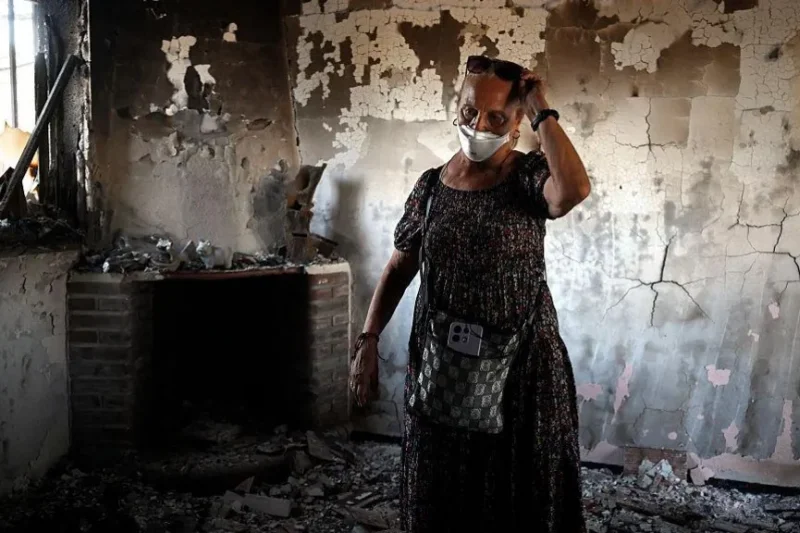
The mayor of Chapinería, Lucía Moya, told Telemadrid that the consequences for the town were very severe and that "many residents have lost their homes and jobs. Getting back on track is going to be an arduous task".
Many of the 2,000 people forced to flee the fires in the nearby Tiétar Valley were looked after by volunteers in the town of Talavera de la Reina, some distance south of the fire.
However, some 300 of the evacuees remained on Wednesday morning and Mayor José Julián Gregorio told Europa Press that they would receive "the same level of care as on the first day".
Although no fatalities have been reported in the fires surrounding Madrid and in Castellón on the east coast, authorities in the southern city of Seville say a woman, who was badly burned in the Los Gallardos fire in Almería earlier this month, has died of her injuries in hospital.
Fourteen people died in the Almería fires, including UK and Belgian nationals as well as US, French and Spanish citizens.
Fires are also burning in neighbouring Portugal, in the north-eastern district of Vila Real.
Civil protection officials have told public broadcaster RTP there is an active front of a kilometre and they are keeping a close watch on a local water treatment plant and a gas depot near the town of Valpaços.
Wildfires have also broken out in Greece, on the island of Paros in the Aegean Sea and the southern town of Trifylia on the Greek mainland.
Climate change is driving up temperatures around the world, and Europe is the fastest warming continent, heating up twice as fast as the global average, according to the Copernicus Climate Change Service.
This is causing increased summer heatwaves, greater pressure on Europe's water supply, and more intense wildfires.
(Source: BBC)