
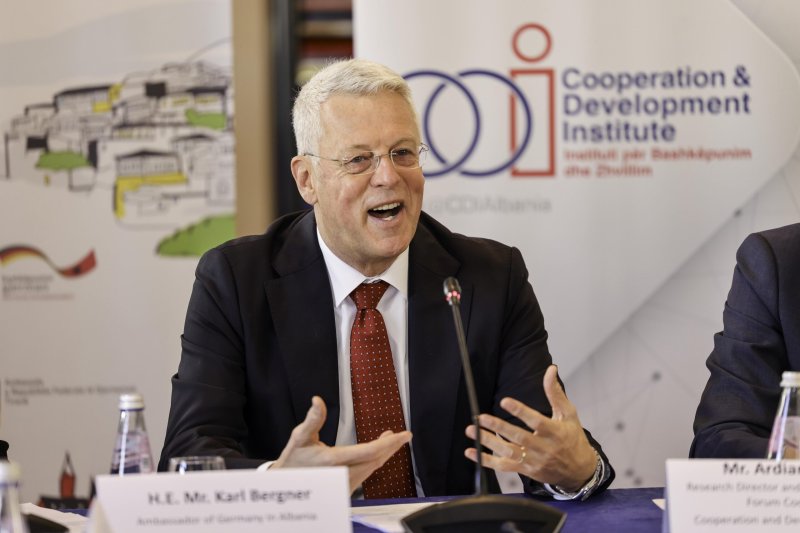
'Vocational Education, Economy’s Backbone'
The German Ambassador to Albania, Karl Bergner, praised on Wednesday the importance of vocational education and training as a central pillar of economic development and employment growth in the country, during the 3rd National Conference on Vocational Education and Training, where the results of the reforms and the “Skills 2030” vision were discussed.
The event emphasized the role of vocational education in preparing the workforce according to market needs.
Ambassador Bergner stated that it is very important for policymakers, administration, employers, training providers, and development partners to share views and cooperate on the future of skills development in Albania.
He stressed that academic education is often seen as the only path, but this, according to him, is a wrong approach, as vocational education is the backbone of modern economies and the basis for innovation and sustainable development.
He appreciated the progress made by the Ministry of Economy and Innovation in drafting the skills strategy 2023-2030, as well as the improvement of the vocational training system in line with the needs of the labor market and the private sector.
The German Ambassador also underlined Germany's continued support in this sector through development cooperation instruments, mentioning the technical cooperation of GIZ and financial support through KfW in infrastructure investments.
He highlighted the importance of international cooperation with partners such as Switzerland, the UN, and the European Union, emphasizing that this coordination has helped strengthen institutional capacities and develop the vocational education system in Albania.
Bergner announced that in the April bilateral negotiations between Germany and Albania, a package of Euro 14 million was committed for the vocational education and training sector for the coming years. The ambassador emphasized that in a global context characterized by geopolitical uncertainty, technological changes, and economic transformations, investing in skills and human capital is more important than ever.
According to him, the vocational education system must remain flexible, competency-based, and able to adapt to labor market dynamics, especially in areas such as digitalization and the green transition. He also appreciated the role of teachers and trainers in this process, describing them as the main source of knowledge and a key factor for the quality of vocational education, expressing gratitude for their commitment.