
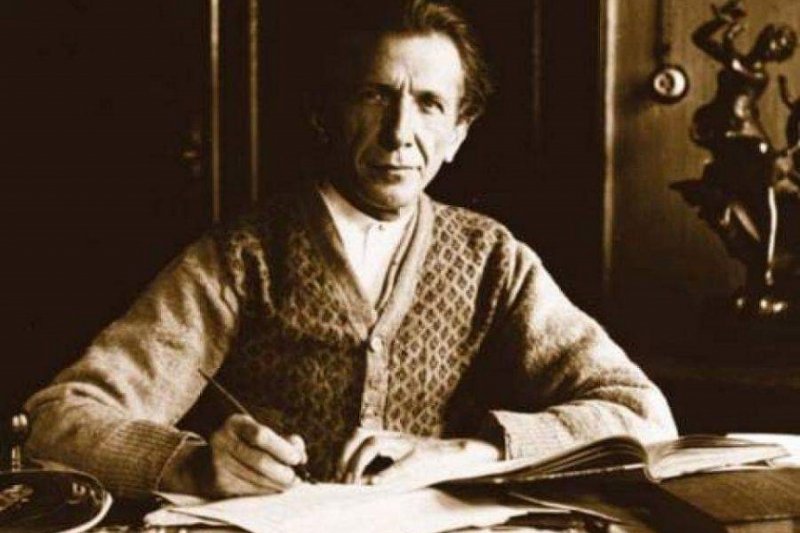
Remembering Milan Sufflay

It has happened rarely that international historical figures have had the courage, dedication and bravery to devote passionately and selflessly their life and deed to Albania and Albanians being aware that the ‘death shadow’ followed them in every step in their countries and abroad. One such exception has been the Croatian great impressive personality of albanology, Milan Shufflay who has turned into a beacon of thorough knowledge of albanology and a reference point for any further studies in this field.
In this frame this passionate ‘lover’ of Albania and Albanians is particularly remembered by the Albanian world with veneration but also pain on the 90th anniversary of his tragic death being brutally assassinated on February 19, 1931. And it is not a coincidence that his assassin and the masterminds of this monstrous crime, the radical anti-Albanian circles in the first Yugoslav state – the Kingdom of Serbs, Croats and Slovenes, founded in 1918, chose the time of his return from Albania where he travelled to discuss with the Albanian government of that time to write the “Acta Albaniae†to perpetrate that treacherous murder cutting short the life and work of an exceptional bright intellectual giant.
But it is worth to refresh the memory and say a few words who Shuffray was on this anniversary. An aristocrat by birth, Shufflay was born in Lepoglava, Croatia, on 9 November 1879, and his family was able to provide him proper education fostering his many talents. He studied history and classical philology at the University of Zagreb and was a polyglot, a linguistic genius beyond doubt knowing a great number of foreign languages, including Albanian. He got a Ph. D. in history at the University of Zagreb as well, with additional specialization in Vienna and Budapest in the history of the Balkans. His scientific work was focused on the medieval history of Croatia and the history of the Albanian people.
Albanology became one of his main domains of research career during which he wrote many books on Albania. Just to mention some of them Shufflay published “Biology of the Albanian Genetic Tree†and â€The conditions in churches in the pre- Ottoman Albania“ in 1916, two books on Albanian history, the first, “History of the Northern Albanians“ followed by “Towns and Fortresses of Albania, Primarily during the Middle Ages“ published in 1924.
But the two volumes of the so called “Codex albanicus†compiled together with Ludwig von Thalloczy and Konstantin Jirecek, are the jewels of his work as it is an archival collection entitled “Acts and Diplomatic Affairs illustrating the Middle Ages in Albania“. The first volume was published in Vienna in 1913, and the second one in 1918. Both volumes cover the period from 344 to 1406.
But the great historical researcher could not stop at that 'station' to continue with the 3rd volume of the “Codex albanicus†after the Albanian government and the Academy of Sciences in Vienna contracted him. And as the evidence of the time reveals it is at that time when he started receiving threats from the Greater Serbian circles because of his commitment to the research of Albanian history. Ignoring the threats, in 1931 Shufflay travelled to Albania to get fully engaged on writing the “Acta Albaniaeâ€.
Soon after returning from Tirana, on 18 February 1931 he was savagely attacked by Serbian radicals who ambushed him in Zagreb, at his very doorstep, breaking his skull with a hammer. The attackers then broke into Shufflay’s apartment and stole the manuscript of the 3rd volume of the “Codex albanicusâ€. Shufflay died the very next day, on 19 February 1931. The authorities even refused to investigate the murder.
The international intellectual community was in shock at the news of Milan Shufflay's murder. Outstanding figures like Albert Einstein and Heinrich Mann appealed to the International League for Human Rights and to the international scientific and cultural community to protest against the murder of Milan Shufflay. On 6 May 1931, their appeal made it even to the front page of the New York Times that was explicitly accusing the Yugoslav King Alexander I of complicity in the crime.
For his huge contribution to the affirmation of the Albanian people in the historical literary spectrum, Shufflay was granted by the Albanian government the prestigious award "Naim Frasheri d'or", during the scientific conference "Shuflaj dhe Shqiptarët" on his work and contribution to Albanian studies that was held in Tirana in 2002. Both in Tirana and in Durres streets are named after Milan Shufflay to honour his memory.
There are many bonds of true friendship between the Croatian and the Albanian people but Milan Shufflay is one of the most lasting and most inspiring figures highly commemorated on this 90th anniversary.
President Meta commemorates Shufflay's work and deed
On the occasion of the 90th anniversary of the murder of Milan Sufflay, outstanding Croatian patriot, politician, historian, great friend of the Albanian nation by Serb radicals President Ilir Meta called him the Martyr of Albanology.
"On the 90th anniversary of his brutal murder, we honor today with gratitude the unforgettable memory and extraordinary work of the great friend of our nation, the Martyr of Albanology, Milan Sufflay, who sacrificed his life to throw light on the truth of the history and antiquity of the Albanians," said President Meta in a note posted on FB on Friday.
"A Croatian heart, beating for Albania, was immortalized as an important bridge and a symbol of traditional friendship between our two peoples!" said Albanian head of state.
Croatian Ambassador Kramaric
But what the Ambassador of Croatia to Tirana, Zlatko Kramaric said on ‘one of the world's best albanologists’ Milan Sufflay exclusively for Albanian Daily News on Friday follows below:
The work of Milan Sufflay (1879-1931), an important Croatian historian and one of the world's best albanologists, also includes K. Jiracek and L. Thalloczy, who testify in the best possible way to the exceptional political and cultural ties between the Albanian and Croatian peoples. Because of his obsessive commitment to studying Albania's medieval past on February 19, 1931, M. Sufflay was brutally murdered in Zagreb, in front of his apartment. The murder was committed by police agents on the orders of Belgrade. It was an extremely brutal murder to which the greatest European intellectuals of the time (A. Einstein, H. Mann ...) reacted very sharply, calling on the world cultural public to protest against this grave crime through the International League for Human Rights.
Milan Sufflay was 'guilty' because his historical research on the past of these Balkan areas showed the unscientific nature of many previous knowledge / theses / attitudes about these areas, especially those related to the medieval history of Albania. It is very significant that he was killed just after returning from Albania. Therefore, Croatia must be grateful to Albania for still preserving the memory of the great historian, albanologist, so in 2002 M. Sufflay was posthumously awarded the highest Albanian medal Naim Frasheri d'or.
These pleasant facts, in a way, oblige all of us to continue our historical research, because all our medieval histories are still a great terra incognita, and an insight into that history can give us very interesting answers to many of our current situations. And it is precisely the work of M. Sufflay that is the best proof of this statement.
What makes me proud as the Croatian ambassador is the fact that 100 years ago there was a great interest in 'Albanian topics' in Croatia and I would be happy if Croatian albanology continues to be one of the best albanologies in the world, and names like M. Sufflay, S. Stipcevic and others, show this continuity and commitment to studying the history of the people with whom my people share much more than we are aware of. Therefore, it is extremely important to remember every year all those exceptional individuals who have dedicated their lives to studying political, cultural, religious ties between our two friendly peoples.