Albania, Difficult Place to Do Business
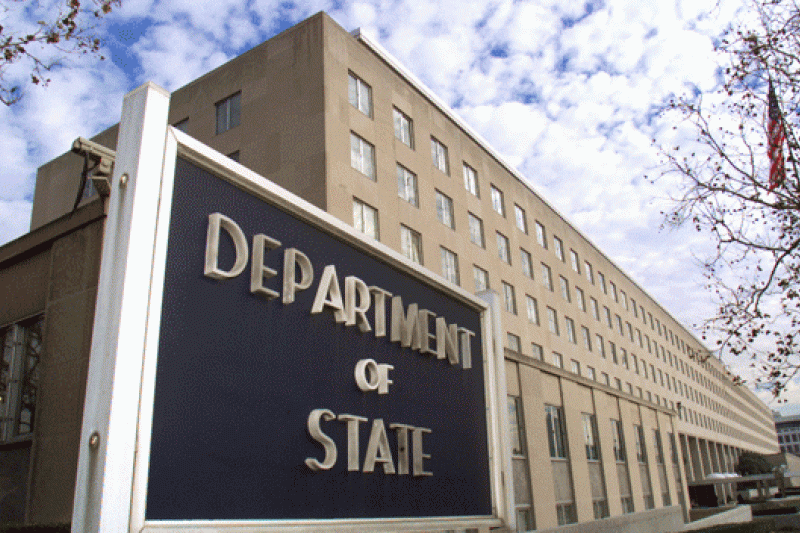
The U.S. Department of State has released its annual 2025 Investment Climate Statements for Albania, highlighting both the potential and the serious challenges the country faces in attracting foreign investment.
According to the report, Albania offers great opportunities in areas such as energy, tourism, health, agriculture, technology, and mining. However, high informality, corruption, and legal challenges are hindering economic development and dampening investor confidence.
Albania has broad economic potential, a sound legal framework, and has progressed in limiting petty corruption by digitizing public services for both citizens and businesses. Albania’s score on the Transparency International Corruption Perceptions Index improved from 37 to 42 out of 100 in 2024. However, foreign investors continue to perceive Albania as a difficult place to do business. They cite continuing challenges for investment and business in Albania due to: corruption in the public sector, the judiciary, and public procurements; unfair and distorted competition, a large informal economy, money laundering; frequent changes to fiscal legislation; property rights; and weak enforcement of contracts,” the reports noted.
According to the U.S. Department of State, the emigration of young, skilled labor has created labor shortages that affect investment prospects. “The business community reports that the large influx of illicit proceeds from drug trafficking, smuggling, fiscal evasion, and corruption distorts competition in the market. Investors report that they can be targets of extortion by public administration, media, and criminal groups.”
The report noted that reports of corruption in government procurement are common, with investors frequently reporting cases of government corruption delaying and preventing investments in Albania. “The continued use of public-private partnership (PPP) contracts has reduced opportunities for competition, including by foreign investors, in infrastructure and other sectors. Weak analysis and a lack of technical expertise in drafting and monitoring PPP contracts are ongoing concerns. Several U.S. investors have faced contentious commercial disputes with both public and private entities, including some that went to international arbitration,” the statement noted.
“Property rights continue to be a challenge in Albania because a clear title is difficult to obtain. There have been instances of individuals allegedly manipulating the court system to obtain illegal land titles,” the U.S. Department of State noted, adding that overlapping property titles are widespread.
The State Department notes that foreign direct investment has increased significantly over the past decade, with the Netherlands, Switzerland, Canada, Italy, Turkey, and Austria topping the list. U.S. investment is still low but growing.
“In the last decade, Albania has attracted greater levels of foreign direct investment (FDI). Albania lacks an investment screening mechanism for inbound FDI,” the Department of State noted, adding that the stock FDI reached almost Dollar 16.7 billion in 2024, dominated by: real estate (23%), extractive industries (13.5%), banking and insurance (18%), and the processing industry (11%).
The report also highlights unresolved ownership issues that have contributed to protracted legal disputes, with many U.S. citizens of Albanian origin embroiled in protracted litigation.
Despite the existence of a legal framework to combat corruption, implementation remains weak. The State Department emphasizes that further progress in the fight against organized crime and convictions for high-level corruption are key to improving the business climate and increasing Albania’s competitiveness in the global market.