1024 Arrests in Global Operation against Human Trafficking
Europol supported a global operation against human trafficking conducted by 59 countries, resulting in the detection of 2 070 potential victims and the arrest of 1 024 suspects, 334 of which are suspected of human trafficking. As part of ongoing investigations, an additional 201 human trafficking suspects have also been detected. The crackdown, code-named ‘Operation GLOBAL CHAIN’, focused on trafficking for the purpose of sexual exploitation, forced criminality, and forced begging, with a special focus on underage victims.
This year’s edition of the annual effort took place from 8 to 12 June 2026 with coordination and support from Europol, Frontex, and INTERPOL. It aimed to detect and disrupt criminal activities associated with human trafficking to identify involved individuals, to trigger investigations against organised crime groups, and to safeguard potential victims. The operation was conducted under the EMPACT framework, with Austria serving as action leader and Romania as co-leader.
Total results of the operation
- 1 024 arrests (334 for human trafficking and 690 for other crimes);
- 2 070 victims and potential victims identified (1908 adults and 162 minors);
- 201 additional suspects identified;
- 465 new investigations opened;
- 80 cases of document fraud detected.
Investigative results indicate that the vast majority of victims are female and adult, with 64.2% trafficked for sexual exploitation (20.9% forced criminality, 11.3% forced labour, 1.5% forced begging, 2.1% other forms). The percentage of underage victims trafficked for sexual exploitation is even higher with 86.4% (6.2% forced labour, 3% forced begging, around 0.6% forced criminal activity such as pickpocketing, 3.8% other forms). In many of these cases, the safeguarding of victims can be challenging, as they are often exploited by family members.
Potential victims mostly from Latin America
The operation engaged over 40 000 officers from 59 different countries and involved law enforcement, border guards, labour inspectorates, and tax- and customs authorities. Potential victims were reported from 45 different countries, with a majority from Colombia, Argentina, Venezuela, Nepal, and Moldova. Many of the victims had been trafficked across borders, and even continents, demonstrating the global nature of human trafficking schemes.
In total, the deployed officers checked:
- 565 470 persons;
- 360 317 ID documents;
- 140 737 vehicles;
- 20 342 locations;
- 6 133 flights and vessels.
Coordination of officers from Africa, Americas, Asia, and Europe
To further improve cross-border and cross-continent collaboration, the operation expanded globally through the establishment of two coordination centres. One coordination centre was established in Skopje, North Macedonia, covering participating countries in Europe, Asia, and Africa, while a second one was established by Ameripol in Rio de Janeiro, Brazil, to coordinate activities in the Americas. Europol deployed experts in the fight against human trafficking to both coordination centres, bridging operational activities between continents and aligning simultaneous actions against organised crime networks engaged in these activities.
Each participating country carried out targeted operations in their jurisdictions and efficiently shared intelligence via the coordination centres set up in Skopje and Rio de Janeiro. This integrated, multi-country and multi-agency approach was essential for the successful disruption of criminal networks and identification of victims.
Operational highlights from across the globe
Belgium
A large-scale police operation in Charleroi and Verviers dismantled a trafficking ring recruiting underage girls via social media. The suspects allegedly held the victims captive, forcing them into sexual services across Belgium and France. Charges include forced prostitution and inciting minors into sexual acts. The operation resulted in 17 arrests, the detection of 22 minor victims (21 Belgian, 1 Polish), and uncovered links to ongoing investigations.
Costa Rica
Authorities in Costa Rica detected 20 potential human trafficking victims (12 Nicaraguan, 8 Costa Rican) exploited for forced begging.
Targeting areas of extreme vulnerability, intervening officers collected information to assess potential human trafficking cases for further investigation.
France
French authorities uncovered an organised prostitution network running three massage parlours in Lille and Paris. A coordinated operation involving over 30 officers led to the arrest of two Chinese suspects, the safeguarding of five victims, and the seizure of over EUR 73 000 in cash, a vehicle, luxury items, and frozen bank accounts.
Iceland
Icelandic authorities deployed surveillance teams at two suspected prostitution sites believed to be run by a Chinese organised crime network.
Over 50 clients were recorded on camera, five of which were arrested, and authorities seized EUR 14 000 in cash, 13 mobile phones, and 11 ID cards. Further investigative measures such as witness interviews are being conducted to gather more evidence against the network. 16 possible victims of sexual exploitation were identified and offered appropriate assistance, and two were arrested for illegal stay in Iceland.
Ireland
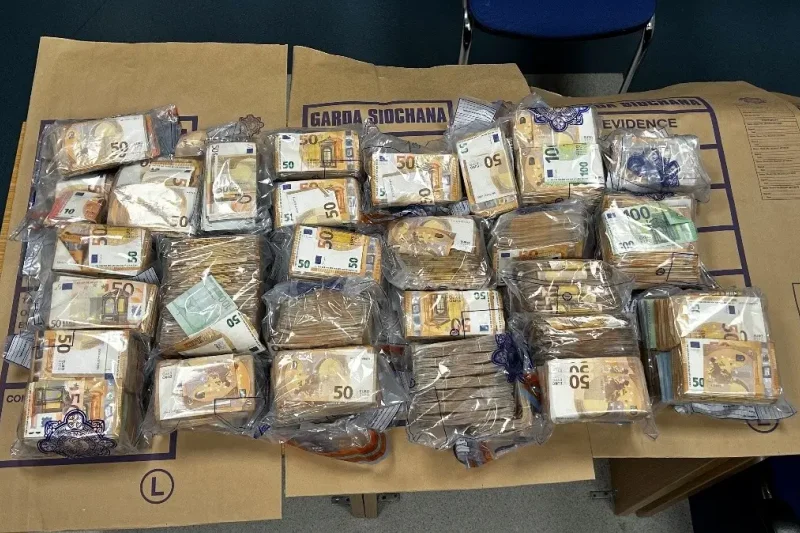
During an investigation conducted under Operation GLOBAL CHAIN, law enforcement seized over EUR 840 000 in cash during a house search in Limerick, Ireland. One individual suspected of human trafficking for sexual exploitation has been arrested.
Moldova
In Moldova, authorities dismantled a sexual exploitation ring led by a former gendarme and his fiancée, who recruited three underage victims (aged 16-17) from economically vulnerable backgrounds.
The victims were coerced into prostitution through manipulation, financial control, and threats, advertised online, and subjected to daily exploitation with minimal earnings. The accused were arrested and are awaiting trial, while victims received psychological support.
Nigeria
Nigerian authorities carried out nine different operations, leading to the arrest of five individuals. Investigators uncovered elements of sexual exploitation and debt bondage and managed to identify at least 33 potential victims of human trafficking.
North Macedonia
Authorities in North Macedonia launched an investigation for trafficking of human beings for forced begging. A vulnerable female victim with a disability was allegedly exploited by a close family member, who compelled her to beg while monitoring her activities and confiscating earnings. Supported by witness statements, video evidence, and operational findings, further investigative measures are ongoing to gather additional evidence.
Portugal
A Portuguese investigation led to the arrest of two Brazilians and one Portuguese national for illegally recruiting Brazilian women to work in massage parlours and forcing them into prostitution at a nightclub. Eight victims were safeguarded, and the nightclub, EUR 10 000 in cash, and three vehicles were seized during the operation involving 64 officers.
Ukraine
Ukrainian authorities charged two individuals with labour exploitation offences involving 13 disabled residents of a rehabilitation centre in the Vinnytsia region. The suspects allegedly forced vulnerable residents into labour.
In Kyiv, authorities dismantled a criminal group of four suspects involved in labour exploitation. The alleged criminals recruited, transported, and exploited victims through deception, coercion, and abuse of their vulnerable status. 12 victims were rescued and assisted.
United States
United States authorities (FBI and HSI) arrested 16 individuals (14 from Guatemala, 1 from the US, 1 from the Philippines) on charges of trafficking in human beings for sexual exploitation. 22 victims of trafficking (8 US nationals, 4 Filipinos, 5 Chinese, 5 Guatemalans) were identified and safeguarded, including 12 minors.
Thailand
Thai authorities safeguarded an underage victim and arrested two suspects for trafficking the child for sexual exploitation. In the context of GLOBAL CHAIN, authorities across Thailand also arrested 99 individuals suspected of other crimes, including illegal entry and border crossing, cyber fraud, drug offences, and document fraud.