Milot-Balldren Project Includes 35-year Maintenance
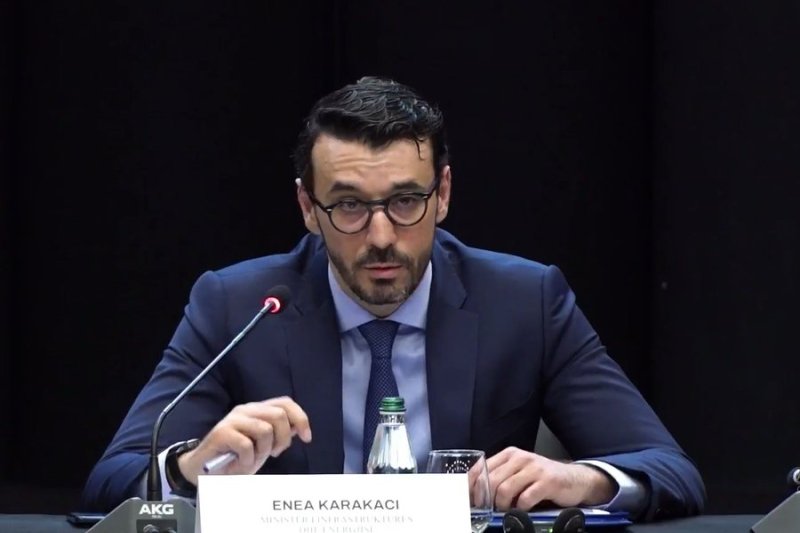
The Minister of Infrastructure and Energy, Enea Karakaçi, reacted on Sunday to what he described as misinformation regarding the cost of the Milot-Balldren highway project, emphasizing that the evaluation of such a work cannot be made solely on the basis of its length.
In a statement, Karakaçi said that comparisons based solely on the cost per kilometer are incorrect, as each infrastructure project varies depending on the characteristics of the terrain, geological conditions, and engineering works it includes.
The minister explained that the total value of EUR 364.7M refers to the 35-year concession contract, which includes design, construction, operation, routine and periodic maintenance, electronic monitoring and charging system, as well as the resurfacing of the highway during the contract period.
According to him, the cost of building the highway itself is EUR 182M; meanwhile the project includes a two-tube tunnel of 850 meters, a 620-meter bridge over the Mat River, a 223-meter bridge over the Drin River, five interchanges, about 9.5 kilometers of secondary roads, as well as electronic monitoring and tolling systems.
He emphasized that the segment crosses an alluvial area near the Adriatic coast, which requires additional work for terrain stabilization, drainage, and other engineering measures.
The minister described the project as of strategic importance, part of the European transport network, connecting Albania with Montenegro and further with the TEN-T network, adding that the government remains committed to its implementation as soon as possible.
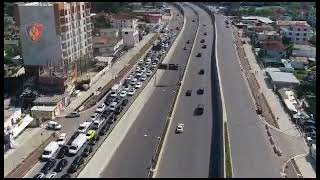
The Milot–Balldren highway project is a strategic 17-kilometer Category A motorway in northern Albania designed to bypass the highly congested city of Lezha. It is a critical component of the Adriatic–Ionian Corridor (the "Blue Corridor"), which connects northern Albania to neighboring markets and the broader European transport network.
Following several years of delayed procurement cycles and contract cancellations, the construction contract was formally awarded to the Salillari construction company by the Ministry of Infrastructure and Energy.